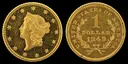
How Much Is a $2.50 Gold Quarter Eagle Worth? (Liberty and Indian Head Values)
A $2.50 gold quarter eagle holds 0.1209 troy oz of gold, and common Liberty and Indian Head dates sell for a few hundred dollars: a 1928 in NGC MS62 brought $456 at Heritage in 2024. The Indian Head key, the 1911-D, sold for $204,000 in PCGS MS66 in January 2022.
Have one in hand? Scan it with CoinLens to identify it and see an estimate in seconds.
| Coin | Gold value | Example sales | Notes |
|---|---|---|---|
| 1907 Liberty Head | $438.65 gold melt | PCGS AU58 $396 (Jan 2023); NGC MS62 $492 (Apr 2024); PCGS MS67 $7,800 (Stack’s Bowers, Aug 2021) | Last Liberty Head year |
| 1928 Indian Head | $438.65 gold melt | NGC MS61–MS62 $456 (2022–2024); PCGS MS65 $2,040 (Heritage, Jan 2022) | Common Indian date |
| 1929 Indian Head | $438.65 gold melt | PCGS MS63 $528 (May 2024); NGC MS65 $7,151 (Heritage, Jul 2023) | Last quarter eagle |
| 1925-D Indian Head | $438.65 gold melt | NGC AU55 $420 (Apr 2024); PCGS MS66 $12,000 (Heritage, Jul 2023) | Gem premium is large |
| 1911-D Indian Head (strong D) | — | PCGS XF45 $3,240 and AU50 $4,440 (Heritage, Jan 2023); PCGS MS66 $204,000 (Heritage, Jan 2022) | Key date of the Indian series |
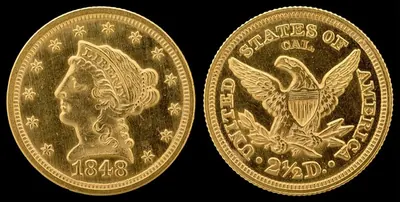
| 1848 CAL. | — | $402,500 (auction, 2006, per Wikipedia) | 1,389 struck from California gold |
Which one is yours? Check it with CoinLens →
Sales from NGC Auction Central (Heritage and Stack's Bowers results) unless noted. Records are not typical values. Gold melt at $3627.00/oz, November 26, 2026.
DEMO
Check your 1796–1929 (Liberty Head 1840–1907; Indian Head 1908–1929) Quarter Eagle ($2.50 gold)
Add a photo of each side
Add a photo of at least one side first.
Demo — photos stay on your device. Nothing is uploaded.
DEMO
Your photos are ready. The identification happens in the CoinLens app.
On the web this is a demo — it can't recognize coins. In the app, the same two photos give you the coin's name, details and a value estimate.
Scan these in the free appEXAMPLE — what CoinLens shows
Value estimate:
Sample from our guide's data, not a result for your photo.
That was a sample. Scan your coin →·
Coin facts
- Coin
- Quarter Eagle ($2.50 gold)
- Years
- 1796–1929 (Liberty Head 1840–1907; Indian Head 1908–1929)
- Mints
- Philadelphia (no mint mark), Charlotte (C), Dahlonega (D), New Orleans (O), San Francisco (S), Denver (D, 1911–1925)
- Composition
- 90% gold, 10% copper
- Weight
- 4.18 g
- Diameter
- 18 mm
- Gold (AGW)
- 0.1209 troy oz
- Gold melt
- $438.65
- Designer
- Christian Gobrecht (Liberty Head); Bela Lyon Pratt (Indian Head)
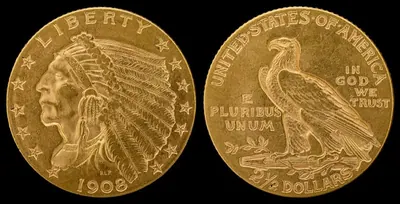
Quarter eagle value: quick answer
The $2.50 quarter eagle was struck from 1796 to 1929. Most coins found today are Liberty Head (1840–1907) or Indian Head (1908–1929) issues. Each holds 0.1209 troy ounces of gold (live gold value below), and common dates carry a modest collector premium over that.
- Common dates: about $400–$530 in AU58 to MS63 at Heritage in 2022–2024 (1907, 1925-D, 1928, 1929).
- Gems: much more, for example a 1907 in PCGS MS67 for $7,800 and a 1925-D in PCGS MS66 for $12,000.
- 1911-D Indian: the key of the Indian series, from $3,240 in XF45 to $204,000 for a PCGS MS66 (January 2022).
- 1848 CAL.: struck from California Gold Rush gold; one sold for $402,500 at auction in 2006.
How to identify your quarter eagle
- Liberty Head (1840–1907): Liberty wearing a coronet inscribed LIBERTY, surrounded by stars; heraldic eagle reverse.
- Indian Head (1908–1929): a Native American chief in headdress with the design sunk into the surface (incuse); standing eagle on the reverse.
- Mint mark: Liberty Head coins carry it below the eagle; Indian Head coins to the left of the fasces on the reverse. Branch mints include Charlotte (C), Dahlonega (D, before 1860), New Orleans (O), San Francisco (S) and Denver (D, 1911–1925).
- Genuine check: 4.18 g and 18 mm. Quarter eagles are counterfeited and often removed from jewelry; certify valuable dates.
Before 1840: the scarce early quarter eagles
The quarter eagle was created by the Coinage Act of 1792 as one quarter of the $10 eagle, but the first ones weren’t struck until 1796. Depositors wanted larger gold coins, so few quarter eagles were made, and many were exported and melted because their gold was worth more than face value. Around 25,000 Capped Head quarter eagles were struck from 1829 to 1834, but only about 400 to 500 are thought to survive (Wikipedia).
The Coinage Act of 1834 cut the coin’s weight and gold content to stop the melting. The Mint marked the change by dropping E PLURIBUS UNUM from the reverse, which introduced the Classic Head design. From 1837 the gold standard was .900 fine. That’s why every quarter eagle from 1837 on holds the same 0.121 troy oz of gold, and why pre-1834 coins are rarities rather than bullion.
Branch mints and the 1848 CAL.
Quarter eagles were struck at Philadelphia and at five branch mints:
- Charlotte (C): 1838–1860
- Dahlonega (D): 1839–1859
- New Orleans (O): 1839–1857
- San Francisco (S): 1854–1879
- Denver (D): 1911–1925
No quarter eagles were made at all in 1809–1820 and 1916–1924 (Wikipedia). A C or D mint mark on a pre-1861 coin means one of the Southern gold mints, and those coins are worth having authenticated.
The 1848 CAL. is the most famous Liberty Head quarter eagle. California’s military governor, Col. R. B. Mason, sent 230 ounces of Gold Rush gold east, and the Mint made it into quarter eagles marked CAL. above the eagle. Only 1,389 were struck (Wikipedia).
The Indian Head quarter eagle (1908–1929)
President Theodore Roosevelt wanted new, artistic coin designs. His friend Dr. William Sturgis Bigelow brought him the Boston sculptor Bela Lyon Pratt, whose design sank the portrait below the surface of the coin. It is the only incuse design ever used on circulating US coins, shared with the $5 half eagle. The new coins reached circulation in November 1908, and critics complained that the recesses would collect dirt and the coins wouldn’t stack (Wikipedia).
The quarter eagle was popular as a Christmas present: banks sold them in December and they returned to the vaults by January. Production stopped after 1915. It resumed in 1925 at Denver only, then at Philadelphia from 1926 to 1929, again mostly for gifts. There are only 15 date and mint combinations, and the 1911-D is the key. The series ended when gold coinage stopped in 1933 (Wikipedia).
Commemorative quarter eagles
Two early commemoratives are quarter eagles: the 1915-S Panama-Pacific (Liberty riding a hippocampus; only 6,749 sold) and the 1926 Sesquicentennial (Independence Hall; 46,019 sold) (Wikipedia). Both carry the same 0.121 oz of gold, but they’re collected as commemoratives, and the 1915-S is the scarcer.
In February 2026 the House of Representatives passed a bill requiring the Mint to strike $2.50 coins again for the nation’s 250th anniversary (Wikipedia).
Gold melt value
Each quarter eagle holds 0.12094 troy ounces of pure gold. The calculator below multiplies that by today’s gold spot price.
Gold melt value calculator
Quarter Eagle ($2.50 gold): 0.1209 troy oz of gold each
Melt value ($438.65 each)
Gold spot $3627.00/oz as of November 26, 2026 (gold-api.com)
Melt value today for several gold and silver coins → Gold & silver melt calculator
Melt value is the floor. Condition and mint details decide the rest — check yours in the app.
How to check your coin with CoinLens
Photograph both sides in CoinLens. The app identifies the type, date and mint from its database of almost 500,000 coins and gives an instant value estimate you can save to your collection. CoinLens gives estimates; for a possible 1911-D, branch-mint coin or CAL. piece, use PCGS or NGC authentication.
Where to sell
Common dates sell to coin and bullion dealers; compare offers. Certified key dates sell best at Heritage, Stack’s Bowers or GreatCollections.
Frequently asked questions
How much is a $2.50 gold coin worth?
Common-date Liberty Head and Indian Head quarter eagles sold for about $400–$530 in AU to MS63 at recent Heritage auctions, about 0.12 oz of gold plus a collector premium. Gems and key dates such as the 1911-D sell for thousands to six figures.
What is the 1848 CAL. quarter eagle?
In 1848 about 230 ounces of California gold were sent to Washington, and 1,389 quarter eagles were struck from it with CAL. punched above the eagle. They mark the start of the Gold Rush and are highly prized.
Why does the Indian Head quarter eagle look sunken?
Bela Lyon Pratt’s design is incuse: the portrait and lettering are pressed into the coin instead of raised above it, unlike any other US circulating coins of the time except the matching $5 half eagle.
Where is the mint mark on an Indian Head quarter eagle?
On the reverse, to the left of the fasces (bundle of rods) the eagle stands on. On the 1911-D, check that the D is strong and clear.
When was the last quarter eagle made?
- The denomination was formally ended in 1933 when the US stopped issuing gold coins.
Sources
- Quarter eagle (history, mints, 1848 CAL., specifications)
- Indian Head gold pieces (Pratt-Bigelow incuse design)
- NGC Auction Central: 1907 $2.50
- NGC Auction Central: 1928 $2.50
- NGC Auction Central: 1929 $2.50
- NGC Auction Central: 1925-D $2.50
- NGC Auction Central: 1911-D Strong D $2.50
Values are estimates, not offers. Condition decides the price; for a valuable coin, get a professional grade.