How Much Is a Sacagawea Dollar Worth? (Golden Dollar Values by Year & Rare Ones)
Sacagawea dollars are gold-colored manganese brass, not gold, and most are worth $1. The valuable ones date from 2000: the Cheerios dollar (5,500 made) has sold for $34,500, and the Washington quarter mule error set a record of $194,062.50 at GreatCollections in January 2024.
Have one in hand? Scan it with CoinLens to identify it and see an estimate in seconds.
| Coin | Typical | Example sale | Notes |
|---|---|---|---|
| 2000–2008, regular (P, D) | $1 | — | Eagle reverse; very common |
| 2000-P Cheerios | Premium | PCGS MS68 $34,500 (Jul 2008) | Detailed tail feathers; see the 2000 guide |
| 2000-P Wounded Eagle | Small premium | About $40–$98 raw on eBay (Jul–Nov 2026); MS68 $7,200 (Heritage, Jul 2023) | Die gouge across the eagle’s breast |
| Washington quarter / Sacagawea mule | — | $194,062.50 (GreatCollections, Jan 2024) | Undated; quarter obverse |
| 2009– Native American reverses | $1 | — | New reverse design each year |
Which one is yours? Check it with CoinLens →
Figures from the cited auction reports, not a price guide.
DEMO
Check your 2000–2008 (eagle reverse); 2009– Native American designs Sacagawea Dollar
Add a photo of each side
Add a photo of at least one side first.
Demo — photos stay on your device. Nothing is uploaded.
DEMO
Your photos are ready. The identification happens in the CoinLens app.
On the web this is a demo — it can't recognize coins. In the app, the same two photos give you the coin's name, details and a value estimate.
Scan these in the free appEXAMPLE — what CoinLens shows
Value estimate:
Sample from our guide's data, not a result for your photo.
That was a sample. Scan your coin →·
Coin facts
- Coin
- Sacagawea Dollar
- Years
- 2000–2008 (eagle reverse); 2009– Native American designs
- Mints
- Philadelphia (P), Denver (D), San Francisco (S, proof)
- Composition
- Manganese brass clad (77% copper, 12% zinc, 7% manganese, 4% nickel outer layers) on a copper core
- Weight
- 8.1 g
- Diameter
- 26.5 mm
- Designer
- Glenna Goodacre (obverse), Thomas D. Rogers (eagle reverse)
Mintage
- 2000-P
- 767,140,000
- 2000-P Cheerios
- 5,500
| Year | Philadelphia (P) | Denver (D) | Proof (S) |
|---|---|---|---|
| 2000 | 767,150,500 | 518,916,000 | 4,047,904 |
| 2001 | 62,468,000 | 70,939,500 | 3,183,740 |
| 2002 | 3,865,610 | 3,732,000 | 3,211,995 |
| 2003 | 3,080,000 | 3,080,000 | 3,298,439 |
| 2004 | 2,660,000 | 2,660,000 | 2,965,422 |
| 2005 | 2,520,000 | 2,520,000 | 3,344,679 |
| 2006 | 4,900,000 | 2,800,000 | 3,054,436 |
| 2007 | 3,640,000 | 3,920,000 | 2,259,847 |
| 2008 | 1,820,000 | 1,820,000 | 1,998,108 |
| 2009 | 37,380,000 | 33,880,000 | 2,179,867 |
| 2010 | 32,060,000 | 48,720,000 | 1,689,216 |
| 2011 | 29,400,000 | 48,160,000 | 1,673,010 |
| 2012 | 2,800,000 | 3,080,000 | 1,189,445 |
| 2013 | 1,820,000 | 1,820,000 | 802,460 |
| 2018 | 1,400,000 | 1,400,000 | 517,081 |
| 2022 | 980,000 | 980,000 | 399,950 |
Which one is yours? Check it with CoinLens →
From Wikipedia's Sacagawea dollar mintage table (selected years shown; 2014–2021 are in the same low range as 2012–2013). From 2002 to 2008, and again from 2012, the coins were struck for collectors rather than for general circulation.
| Coin | Set | Mintage |
|---|---|---|
| 2000-P ‘Goodacre presentation’ finish | Paid to designer Glenna Goodacre as her $5,000 fee | 5,000 coins (her $5,000 fee) |
| 2000-D burnished | Millennium Coinage & Currency Set | 75,000 |
| 2014-D Enhanced Uncirculated | Coin and Currency Set | 50,000 |
| 2015-W Enhanced Uncirculated | Coin and Currency Set | 90,000 |
| 2016-S Enhanced Uncirculated | Coin and Currency Set | 75,000 |
| 2017-S Enhanced Uncirculated | Enhanced Uncirculated Mint Set | 225,000 |
| 2019-P Enhanced Uncirculated | Coin and Currency Set | 50,000 |
Which one is yours? Check it with CoinLens →
From Wikipedia's Sacagawea dollar article. These finishes were not released into circulation, so a loose example came from a broken set; values depend on certification and finish.
| Year | Theme |
|---|---|
| 2009 | Three Sisters (agriculture) |
| 2010 | Great Law of Peace |
| 2011 | Wampanoag Treaty |
| 2012 | Trade Routes of the 17th Century |
| 2013 | Treaty with the Delawares |
| 2014 | Native Hospitality |
| 2015 | Mohawk Ironworkers |
| 2016 | Code Talkers |
| 2017 | Sequoyah |
| 2018 | Jim Thorpe |
| 2019 | American Indians in Space |
| 2020 | Elizabeth Peratrovich and Alaska’s Anti-Discrimination Law |
| 2021 | American Indians in the U.S. Military |
| 2022 | Ely S. Parker |
| 2023 | Maria Tallchief and American Indians in Ballet |
| 2024 | Indian Citizenship Act of 1924 |
| 2025 | Mary Kawena Pukui |
| 2026 | Oneida Indian Nation at Valley Forge |
From Wikipedia's Sacagawea dollar article. Regular examples of every year are worth face value or a small premium uncirculated.
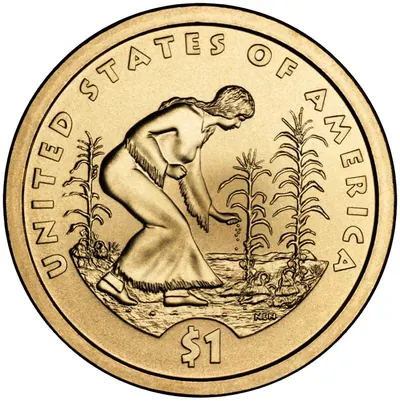
Sacagawea dollar value: quick answer
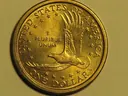
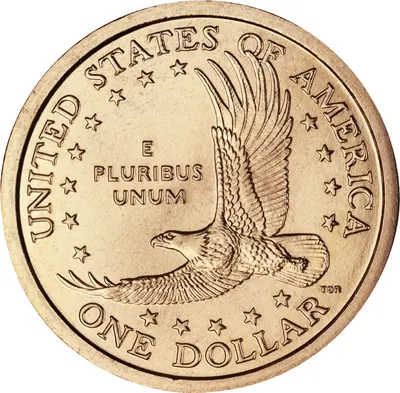
The Sacagawea “golden dollar” was introduced in 2000. From 2000 to 2008 it carried a soaring eagle on the reverse; since 2009 the same obverse has been paired with yearly Native American reverse designs. Hundreds of millions circulated, so a regular coin is worth $1. It is not gold.
The valuable ones are almost all from 2000:
- Cheerios dollar: 5,500 early 2000-P coins with a prototype reverse, packed in Cheerios boxes. A PCGS MS68 sold for $34,500 in 2008.
- Wounded Eagle: a 2000-P die variety; raw examples sold for about $40–$98 on eBay in 2026, and an MS68 brought $7,200 at Heritage in July 2023.
- Quarter mule: a dollar struck with a Washington quarter obverse, record $194,062.50 (2024).
The 2000 guide explains how to spot each one.
How to identify your Sacagawea dollar
- Obverse: Sacagawea carrying her infant son, Jean Baptiste. Date and mint mark (P, D or S) at the lower right.
- Reverse: a soaring eagle (2000–2008) or a Native American theme with the year’s design (2009 onward). From 2009 the date moved to the edge.
- Color: golden brass that tones brown. A silver-colored “Sacagawea” is either plated or a wrong-planchet error worth checking.
Errors
- Mule: quarter obverse with dollar reverse, no date on the faces.
- Struck on a quarter planchet: silver-colored, wrong weight.
- Missing clad layer: copper patches where the brass layer is missing.
- Off-center strikes with the date visible.
Why most Sacagawea dollars are worth face value
The golden dollar was created by the United States $1 Coin Act of 1997 to replace the Susan B. Anthony dollar, which vending machine and transit operators liked but the public confused with quarters. The law required a coin “golden in color” with a distinctive edge. Glenna Goodacre’s portrait of Sacagawea carrying her son was chosen for the obverse and Thomas D. Rogers’ soaring eagle for the reverse (Wikipedia).
The first coins were released on January 27, 2000. The Mint spent about $41 million promoting them, shipped $100 million of the coins to Wal-Mart and Sam’s Club stores, and put them in Cheerios boxes: one box in 2,000 held a dollar. Over 1.29 billion 2000-dated coins were struck. That’s why a 2000-P or 2000-D in your change is almost always worth $1 (Wikipedia).
The public still didn’t use them. Mintage fell by about 90% in 2001. From 2002 through 2008 the coins were made only for collectors, and after the 2011 issue the Treasury announced all future dollar coins would be for collectors only. Many of the coins do circulate in Ecuador and El Salvador, which use the US dollar (Wikipedia).
Low-mintage years and special finishes
The scarcest Sacagawea dollars are not old ones but low-mintage collector years, such as 2008 (1.82 million per mint), 2013 (1.82 million) and 2022 (980,000). Because collectors bought them in rolls and sets, uncirculated examples are easy to find; check sold listings for your exact year and mint.
More interesting are the special finishes sold only in Mint sets, listed in the table above. The best known is the Goodacre presentation finish: Goodacre asked for her $5,000 design fee to be paid in dollar coins, and the Mint struck those 2000-P coins on specially burnished blanks. The 2000-D burnished coins in the Millennium set used a similar finish (Wikipedia). If you have a loose 2000 dollar with an unusual satin finish, have it checked.
The 22-karat gold Sacagawea dollars
In 1999 the Mint struck Sacagawea dollars in 22-karat gold, planning to sell them to collectors. Members of Congress questioned the Mint’s authority to strike the design in a different metal, and the plan was halted on March 20 of that year. Of 39 gold pieces struck with a $1 denomination, twelve were judged good enough to keep; they flew on the Space Shuttle Columbia on mission STS-93 in July 1999 and were then put in storage. None was ever sold, so a “gold Sacagawea dollar” offered for sale is a plated coin (Wikipedia).
More about the quarter mule
The first Washington quarter / Sacagawea dollar mule was found in May 2000 in a roll bought from a bank in Mountain Home, Arkansas. Eleven had been authenticated by 2011. A federal investigation found the coins were struck by accident, but two former Mint employees were convicted for selling some of them. A bin of several thousand was found at the Philadelphia Mint and melted (Wikipedia).
Melt value
Sacagawea dollars contain no precious metal; their metal value is under $1.
How to check your coin with CoinLens
Photograph both sides in CoinLens. The app identifies the year, mint and design from its database and gives an instant value estimate you can save to your collection. CoinLens gives estimates and does not certify varieties; confirm a suspected Cheerios, Wounded Eagle or mule with PCGS or NGC.
Where to sell
Regular golden dollars can be spent. Certified varieties and errors sell best at Heritage, Stack’s Bowers, GreatCollections or on eBay.
Frequently asked questions
How much is a Sacagawea dollar worth?
Almost all are worth $1. The 2000-P Cheerios dollar, the 2000-P Wounded Eagle variety and the Washington quarter mule error are the exceptions, along with top-grade and error coins.
Is a Sacagawea dollar real gold?
No. Its golden color comes from a manganese brass outer layer over a copper core. It contains no gold or silver.
Are Sacagawea dollars still made?
Yes. The Sacagawea portrait continues on the Native American $1 coin series, which has carried a new reverse design every year since 2009. Since 2012 they have been struck mainly for collectors.
What is the most valuable Sacagawea dollar?
The mule error struck with a Washington state quarter obverse and a Sacagawea reverse. One sold for $194,062.50 at GreatCollections in January 2024.
Should I clean a tarnished Sacagawea dollar?
No. The brass surface tones brown naturally, and cleaning leaves marks that reduce value to collectors.
Why are 2002–2008 Sacagawea dollars hard to find in change?
The coin was unpopular, and mintage dropped by about 90% after 2000. From 2002 through 2008 Sacagawea dollars were struck only for sale to collectors, in runs of roughly 2–5 million per mint, so they rarely appear in circulation. They are still common enough that ordinary examples sell for little over face value.
Where is the date on newer Sacagawea dollars?
On the edge. From 2009 the Native American $1 Coin Act moved the date, the mint mark and E PLURIBUS UNUM to the lettered edge, so the front of the coin shows no date.
Sources
- NGC Auction Central: Sacagawea dollars (Heritage results for Cheerios and Wounded Eagle)
- Sacagawea dollar (composition, designers, Native American series)
- PCGS CoinFacts: 2000-P SAC$1 (mintage)
- CoinWeek: The incredible 2000 Sacagawea dollars (Cheerios mintage 5,500)
- PriceCharting: 2000-P Wounded Eagle (FS-901) eBay sold listings
- CoinWeek: Sacagawea dollar / Washington quarter mule sets record at GreatCollections
Values are estimates, not offers. Condition decides the price; for a valuable coin, get a professional grade.