How Much Is a Shield Nickel Worth? (1866–1883 Values & Key Dates)
Common-date Shield nickels (1866–1883) sell for about $5–$45 worn and $60–$100 in certified VF. The 1866–1867 With Rays coins bring $134–$207 in VF. Key dates cost far more: an 1879 (25,900 made for circulation) sold for $1,195 on eBay on 8 March 2026.
Have one in hand? Scan it with CoinLens to identify it and see an estimate in seconds.
| Coin | Mintage | Worn, raw | Certified sales |
|---|---|---|---|
| Common date (e.g. 1868) | 28,817,000 | $4.95–$43 (Nov 2026) | PCGS/NGC VF25–VF35 $60–$99.99 (2026) |
| 1866 With Rays | 14,742,500 | $6.50–$16.95 (Nov 2026) | PCGS/NGC VF20–VF35 $134–$180 (2026) |
| 1867 With Rays | 2,019,000 | $7.51–$75 (Nov 2026) | PCGS/NGC VF25–VF35 $149.50–$207 (2025–2026) |
| 1881 | 68,800 circulation + 3,575 proofs | $100–$341 (2026) | PCGS/NGC G6–VF30 $430–$680 (2025–2026) |
| 1880 | 16,000 circulation strikes | — | PCGS VG10–F12 $4,599–$5,850 (2024–2026) |
| 1877 (proof only) | 900 | — | PCGS/NGC PR64–PF66 Cameo $3,250–$4,565 (2023–2024) |
| 1878 (proof only) | 2,350 | — | PCGS/NGC PR62–PR64 $1,400–$1,650 (2023–2026) |
| 1883/2 overdate (FS-302) | Part of 1,456,919 | — | PCGS AU55–AU58 $1,575–$1,684 (2025–2026) |
Which one is yours? Check it with CoinLens →
Completed eBay sales recorded by PriceCharting. Individual sales, not a price guide. Mintages from Wikipedia.
DEMO
Check your 1866–1883 Shield nickel
Add a photo of each side
Add a photo of at least one side first.
Demo — photos stay on your device. Nothing is uploaded.
DEMO
Your photos are ready. The identification happens in the CoinLens app.
On the web this is a demo — it can't recognize coins. In the app, the same two photos give you the coin's name, details and a value estimate.
Scan these in the free appEXAMPLE — what CoinLens shows
Value estimate:
Sample from our guide's data, not a result for your photo.
That was a sample. Scan your coin →·
Coin facts
- Coin
- Shield nickel
- Years
- 1866–1883
- Mints
- Philadelphia (no mint mark)
- Composition
- 75% copper, 25% nickel
- Weight
- 5.0 g
- Diameter
- 20.5 mm
- Designer
- James B. Longacre
Mintage
- 1866 With Rays
- 14,742,500
- 1867 With Rays
- 2,019,000
- 1880 (circulation)
- 16,000
- 1881 (circulation)
- 68,800
- 1877 (proof only)
- 900
- 1878 (proof only)
- 2,350
| Date | Circulation mintage | Raw sold range | Note |
|---|---|---|---|
| 1870 | 4,806,000 | $2.66–$73 (Oct–Nov 2026) | Better date in VF and up |
| 1871 | 561,000 | $8.95–$225 (Aug–Nov 2026) | Low mintage; cull coins sell cheaply |
| 1873 Closed 3 | About 436,050 | $15.84–$299.95 (Jul–Nov 2026) | Scarcer of the two 1873 styles |
| 1879 | 25,900 | $100–$1,200 (May 2025–Aug 2026) | Key date; check it isn’t a proof |
| 1882 | 11,472,900 | $3.78–$92.11 (Nov 2026) | Common |
| 1883 | 1,451,500 | $12.50–$203 (Nov 2026) | Last year; watch for the 1883/2 |
Which one is yours? Check it with CoinLens →
Completed eBay sales recorded by PriceCharting, raw coins in mixed grades as listed by sellers. Individual sales, not a price guide. Circulation mintages from Wikipedia.
| Year | Circulation | Proof (estimate before 1878) |
|---|---|---|
| 1866 With Rays | 14,742,500 | 600+ |
| 1867 With Rays | 2,019,000 | 25+ |
| 1867 No Rays | 28,890,500 | 600+ |
| 1868 | 28,817,000 | 600+ |
| 1869 | 16,395,000 | 600+ |
| 1870 | 4,806,000 | 1,000+ |
| 1871 | 561,000 | 960+ |
| 1872 | 6,036,000 | 950+ |
| 1873 Closed 3 / Open 3 | 436,050 / 4,113,950 (est.) | 1,100+ (Closed 3) |
| 1874 | 3,538,000 | 700+ |
| 1875 | 2,097,000 | 700+ |
| 1876 | 2,530,000 | 1,150+ |
| 1877 | None | 510+ |
| 1878 | None | 2,350 |
| 1879 | 25,900 | 3,200 |
| 1880 | 16,000 | 3,955 |
| 1881 | 68,800 | 3,575 |
| 1882 | 11,472,900 | 3,100 |
| 1883 | 1,451,500 | 5,419 |
Which one is yours? Check it with CoinLens →
From Wikipedia's Shield nickel article. Proof mintages before 1878 are modern estimates and vary between references. All were struck at Philadelphia without a mint mark.
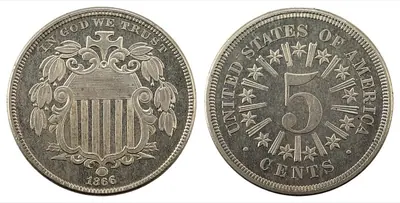
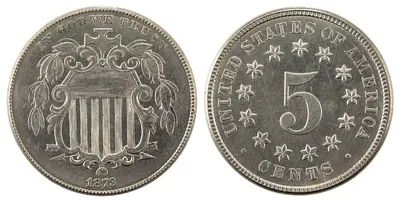
Common dates are worth a few dollars to about $100; key dates are worth hundreds to thousands. The Shield nickel, designed by James B. Longacre, was struck from 1866 to 1883 and was the first US five-cent coin made of copper-nickel (Wikipedia). Recent eBay sales:
- Common dates (like 1868), worn: $4.95–$43; certified VF $60–$99.99.
- 1866 and 1867 With Rays: $134–$207 in certified VF.
- 1881 (68,800 circulation strikes): $430–$680 certified.
- 1880 (16,000 circulation strikes): $4,599–$5,850 in PCGS VG10–F12.
- 1877 and 1878 (proof only): $1,400–$4,565 certified.
With Rays vs No Rays
Turn the coin over. On 1866 and early 1867 coins, rays run between the 13 stars around the large 5. The rays were removed in 1867 because the design struck poorly, so most 1867 coins are No Rays (Wikipedia). With Rays coins sell for more.
Shield nickel key dates and varieties
- 1880: the rarest non-proof Shield nickel (Wikipedia).
- 1881: 68,800 circulation strikes plus 3,575 proofs.
- 1877 and 1878: no circulation strikes; proofs only (900 and 2,350).
- 1879: 25,900 circulation strikes plus 3,200 proofs (Wikipedia).
- 1883/2 overdate: traces of a 2 under the final 3.
- 1873 Open 3 and Closed 3: two date styles; check the gap in the 3.
Why the Shield nickel exists
Before 1866, America’s five-cent coin was the small silver half dime. During the Civil War almost all coins vanished from circulation, and people made do with merchant tokens, encased postage stamps and paper fractional currency in amounts as low as three cents. To bring coins back, Congress turned to low-value base-metal coins (Wikipedia).
Industrialist Joseph Wharton controlled most US nickel mining and pushed for nickel in coinage. The five-cent copper-nickel coin was authorized on May 16, 1866, and Congress made it heavier than the Mint wanted, which meant more nickel for Wharton to sell. The new coin was legal tender up to one dollar, and fractional currency notes under ten cents were withdrawn (Wikipedia).
Chief engraver James B. Longacre adapted his two-cent piece design: a shield based on the Great Seal, with the 13 vertical stripes standing for the states and the upper bar for Congress. Not everyone liked it. Wharton said the shield suggested “a tombstone surmounted by a cross”, and the American Journal of Numismatics called it “the ugliest of all known coins” (Wikipedia).
Why some years are so rare
The copper-nickel alloy was hard, the dies wore out quickly and coins often struck weakly. That’s why the rays came off the reverse in 1867. By late 1869 there were enough nickels for commerce. After hoarded silver came back into circulation in 1876, the Mint halted Shield nickel production in late 1876, striking only proofs for collectors in 1877 and 1878. Small runs followed (25,900 in 1879, 16,000 in 1880, 68,800 in 1881) until full production restarted on December 12, 1881 (Wikipedia).
That creates a trap: for 1879–1881 the Mint struck thousands of proofs, with mirror-like fields and sharp rims, alongside tiny circulation runs. Certified grading separates the two, and the price difference is large.
Varieties collectors look for
- 1868 doubled dies and repunched dates. Shield nickel dies wore out so fast that new ones were made in a hurry. Specialists have found more than 180 doubled-die varieties, and Q. David Bowers calls the 1868 “a playground” for repunched dates and errors (Wikipedia).
- 1873 Closed 3 vs Open 3. The first 1873 date punch made the 3 look like an 8; the chief coiner complained, and an open 3 replaced it. The Closed 3 is the scarcer style.
- 1883/2 overdate. Leftover 1882 dies were repunched with 1883. Five such dies are known; Bowers estimates 118,975 were struck, and specialist Howard Spindel estimates only 0.2%–0.3% survive (Wikipedia).
- Proof restrikes. Mint officials reused old dies to strike proofs for favoured collectors, sometimes years later, producing odd die pairings that specialists study (Wikipedia).
How to check your coin with CoinLens
Photograph both sides with Coin Identifier – CoinLens to identify the date and type, see its mintage and composition and get an instant value estimate. For an 1880, 1881, 1877 or 1878, get the coin certified; proofs and altered dates are easily confused.
Where to sell Shield nickels
- Common dates and With Rays coins: eBay or a local coin shop.
- Certified key dates and proofs: eBay, Heritage, Stack’s Bowers or GreatCollections.
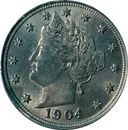
The Shield nickel was replaced in 1883 by the Liberty Head nickel; see our Liberty Head V nickel value guide.
Frequently asked questions
How much is a Shield nickel worth?
Common dates sell for about $5–$45 worn and $60–$100 in certified VF. The 1866 and 1867 With Rays coins bring $134–$207 in VF, the 1881 $430–$680, and the 1880 thousands of dollars.
What is the rarest Shield nickel?
The 1880. Only 16,000 were struck for circulation, making it the rarest non-proof Shield nickel (Wikipedia); certified VG10 and F12 coins sold for $4,599–$5,850. The 1877 and 1878 were struck only as proofs.
What is the difference between With Rays and No Rays?
In 1866 and early 1867 the reverse had rays between the stars around the 5. The rays were removed in 1867 because the design struck poorly (Wikipedia). With Rays coins are worth more.
Why is it called a nickel?
The Shield nickel was the first US five-cent coin made of copper-nickel, and the first five-cent coin called a nickel; earlier five-cent coins were silver half dimes (Wikipedia).
What is the 1883/2 Shield nickel?
An overdate where traces of a 2 show under the 3. Certified AU55–AU58 examples (FS-302) sold for $1,575–$1,684 on eBay in 2025–2026.
Why are 1879, 1880 and 1881 Shield nickels so rare?
In late 1876 the Mint stopped striking Shield nickels for circulation because the Treasury held a large stock of them. Only small numbers were made over the next few years, 25,900 in 1879, 16,000 in 1880 and 68,800 in 1881, until full-scale production resumed on December 12, 1881. Proofs of those years were made in the thousands, so some proofs are more common than the circulation strikes (Wikipedia).
How do I tell an 1873 Closed 3 from an Open 3?
Look at the 3 in the date. On the Closed 3, struck first, the arms of the 3 curl in close together so it can look like an 8; the chief coiner complained, and new punches with a more open 3 were made. About 436,050 Closed 3 and 4,113,950 Open 3 coins are estimated (Wikipedia).
Sources
- Wikipedia: Shield nickel (history, specifications, rays removed, 1877–1878 proofs, 1880 rarity)
- Wikipedia: United States nickel mintage figures (Shield nickel table)
- PriceCharting: 1868 Shield nickel, completed eBay sales
- PriceCharting: 1866 With Rays Shield nickel, completed eBay sales
- PriceCharting: 1867 With Rays Shield nickel, completed eBay sales
- PriceCharting: 1881 Shield nickel, completed eBay sales
- PriceCharting: 1880 Shield nickel, completed eBay sales
- PriceCharting: 1877 Shield nickel proof, completed eBay sales
- PriceCharting: 1878 Shield nickel proof, completed eBay sales
- PriceCharting: 1883/2 Shield nickel overdate, completed eBay sales
- PriceCharting: 1870 Shield nickel, completed eBay sales
- PriceCharting: 1871 Shield nickel, completed eBay sales
- PriceCharting: 1873 Closed 3 Shield nickel, completed eBay sales
- PriceCharting: 1879 Shield nickel, completed eBay sales
- PriceCharting: 1882 Shield nickel, completed eBay sales
- PriceCharting: 1883 Shield nickel, completed eBay sales
Values are estimates, not offers. Condition decides the price; for a valuable coin, get a professional grade.