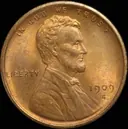
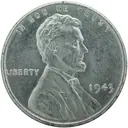
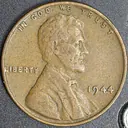
How Much Is a Wheat Penny Worth? (1909–1958 Key Dates & Values)
A common circulated wheat penny from 1942–1958 is worth about 3¢ to 10¢. Key dates pay far more: a 1931-S brings $100+ in XF, a certified 1909-S VDB about $1,255–$1,445 in VF, and a 1958 doubled die sold for $1,136,250 (January 2023). Check the date, mint mark and doubling.
Have one in hand? Scan it with CoinLens to identify it and see an estimate in seconds.
| Coin | Mintage / known | Circulated | Top sale seen |
|---|---|---|---|
| 1909-S VDB | 484,000 | $1,255–$1,445 (PCGS VF, eBay 2025–2026) | $345,375, PCGS MS67 Red CAC (GreatCollections, Jan 2023) |
| 1914-D | 1,193,000 | — | $158,625, MS66+ Red (May 2018) |
| 1922 No D (strong reverse) | Part of 7,160,000 1922-D | — | $92,000, NGC MS64 Red-Brown (Stack’s, Jan 2008); $82,250, NGC MS65 Brown CAC (Heritage, Apr 2013) |
| 1931-S | 866,000 | $100+ (choice XF) | $38,400, PCGS MS67 Red (Heritage, Jan 2025) |
| 1943 bronze (copper) error | About 27 confirmed | $204,000+ | $1,700,000, 1943-D (2010) |
| 1944 steel error | About 36–39 known | $37,375+ | $490,500, 1944-S (GreatCollections, Jan 2025) |
| 1955 doubled die obverse | About 24,000 released | $2,000–$3,000 (XF–AU) | $320,625, PCGS MS65+ Red CAC (GreatCollections, Feb 2025) |
| 1958 doubled die obverse | 3 known | — | $1,136,250, PCGS MS65 Red CAC (GreatCollections, Jan 2023) |
| Common dates 1942–1958 | Hundreds of millions each | 3¢–10¢ | Under $1 in MS63 Red-Brown |
Which one is yours? Check it with CoinLens →
Circulated figures are CoinWeek market summaries or eBay sales recorded by PriceCharting; top sales are prices realized cited below. "—" means no verified sale found as of Nov 2026.
DEMO
Check your 1909–1958 Lincoln Wheat Cent
Add a photo of each side
Add a photo of at least one side first.
Demo — photos stay on your device. Nothing is uploaded.
DEMO
Your photos are ready. The identification happens in the CoinLens app.
On the web this is a demo — it can't recognize coins. In the app, the same two photos give you the coin's name, details and a value estimate.
Scan these in the free appEXAMPLE — what CoinLens shows
Value estimate:
Sample from our guide's data, not a result for your photo.
That was a sample. Scan your coin →·
Coin facts
- Coin
- Lincoln Wheat Cent
- Years
- 1909–1958
- Mints
- Philadelphia (no mint mark), Denver (D, from 1911), San Francisco (S)
- Composition
- Bronze, 95% copper (1909–1942, 1947–1958); zinc-coated steel (1943); 95% copper, 5% zinc (1944–1946)
- Weight
- 3.11 g
- Diameter
- 19.05 mm
- Designer
- Victor David Brenner
Mintage
- 1909-S VDB (lowest)
- 484,000
- 1931-S
- 866,000
- 1914-D
- 1,193,000
- 1909-S
- 1,825,000
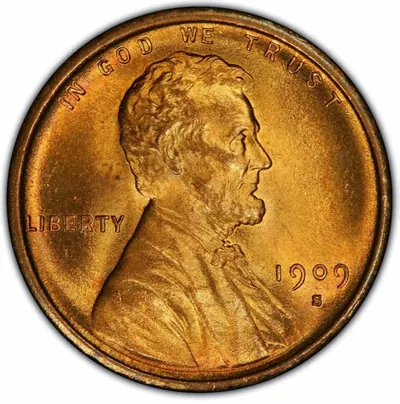
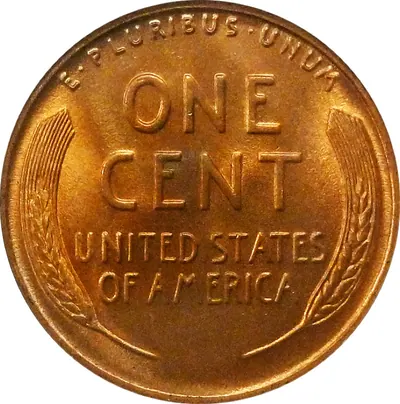
Most wheat pennies are worth a few cents. CoinWeek puts typical circulated 1942–1958 wheat cents at 3¢ to 10¢, and most of those dates sell for under $1 even in MS63 Red-Brown, because hundreds of millions were struck and many rolls were saved.
The value is in the key dates and errors in the table above. One of those can be worth hundreds to over a million dollars.
How to check a wheat penny in 3 steps
- Read the date. Wheat cents run from 1909 to 1958. Dates before 1934 are worth checking more closely.
- Find the mint mark under the date: D (Denver), S (San Francisco) or none (Philadelphia). Low-mintage D and S coins make up most key dates.
- Look for errors with a 10x loupe: doubled letters (1955, 1958, 1917, 1936 and others), a missing mint mark (1922), or the wrong metal (1943 copper, 1944 steel).
Wheat penny key dates list
- 1909-S VDB. The lowest mintage, 484,000. Needs both the S under the date and V.D.B. on the reverse rim. Often faked.
- 1909-S (no VDB). 1,825,000 struck; a better date than most.
- 1914-D. 1,193,000 struck, and very scarce in full Red; CoinWeek reports a $158,625 sale for an MS66+ Red in 2018 and $66,000 for a PCGS MS66 at Heritage in January 2025.
- 1922 No D. Only Denver struck cents in 1922. The valuable “strong reverse” coins (Die Pair II) lost the D when a clashed die was polished; Mint State examples have sold for $37,375–$92,000 at auction (CoinWeek).
- 1931-S. 866,000 struck, but many rolls were saved. Expect $100+ in XF and $300+ in choice uncirculated (CoinWeek).
- 1943 steel. Common, but the bronze version is the famous rarity.
- 1955 doubled die. Strong doubling on the date and lettering; $2,000–$3,000 even in XF–AU.
Wheat penny colors and grades
Copper cents are graded by wear and color: Red (RD), Red-Brown (RB) or Brown (BN). A full-Red uncirculated key date is worth many times a brown one. Never clean wheat pennies; cleaning removes their value.
How to check your coin with CoinLens
Photograph both sides with Coin Identifier – CoinLens. The app identifies the coin within seconds, shows an instant value estimate, composition and minting years, and lets you save your wheat cents to a collection with a running total. For key dates and errors, follow up with professional grading, since fakes are common.
Where to sell wheat pennies
- Common dates: sell by the roll or in bulk lots to a coin shop or on eBay.
- Key dates and errors: get them certified by PCGS or NGC first, then sell through Heritage, Stack’s Bowers or GreatCollections.
The most famous key date has its own guide: 1909-S VDB penny value.
Frequently asked questions
How much is a wheat penny worth?
Most circulated wheat pennies from 1942–1958 are worth about 3¢ to 10¢ each, and many uncirculated ones under $1. Key dates such as the 1909-S VDB, 1914-D, 1922 No D and 1931-S are worth $100 to thousands of dollars, and famous errors sell for six or seven figures.
What wheat pennies are worth the most?
The 1943 bronze cent (up to $1.7 million), the 1958 doubled die ($1,136,250), the 1944 steel cent (up to $490,500), the 1909-S VDB (up to $345,375) and the 1955 doubled die (up to $320,625).
What years are wheat pennies?
1909 to 1958. In 1959 the Lincoln Memorial reverse replaced the wheat ears. Mint marks (D or S) appear under the date; Philadelphia coins have none.
Are wheat pennies worth keeping?
Yes, for the chance of a key date or variety. Sort by date and mint mark first. Older dates (1909–1933) and S or D mint marks are where the valuable coins are most often found.
How do I tell a real 1922 No D penny?
Genuine 1922 No D cents come from Denver dies on which the D was polished off, and the valuable strong-reverse die has sharp wheat lines. Many fakes are 1922-D cents with the D scraped off; look for tool marks under the date and get the coin certified.
Sources
- CoinWeek: Understanding Lincoln Wheat Cents — Issues Worth $1 or Less
- CoinWeek: 11 Amazing Rare Lincoln Cents Worth a Lot of Money
- CoinWeek: The $158,625 Penny — Why the 1914-D Is Rarer Than the 1909-S VDB in Mint State
- CoinWeek: The 1922 No D Lincoln Cent Strong Reverse
- CoinWeek: 1922-D Lincoln Cent — A Collector's Guide (1922 No D auction results)
- CoinWeek: 1931-S Lincoln Cent — A Collector's Guide
- CoinWeek: 1909-S V.D.B. Lincoln Wheat Cent — History & Value
- PriceCharting: 1909-S VDB Lincoln cent, completed eBay sales by grade
- PR Newswire / GreatCollections: $1.136 Million Paid for 1958 Penny (Jan 2023)
- PCGS CoinFacts: 1944-S 1C Steel (Jan 2025 $490,500)
- PCGS CoinFacts: 1943-D 1C Bronze ($1.7M, 2010)
- CoinWeek: The 1955 Doubled Die Lincoln Cent — America's Most Famous Coin Mistake
- Wikipedia: Lincoln cent mintage figures (US Mint data)
Values are estimates, not offers. Condition decides the price; for a valuable coin, get a professional grade.