How Much Is a 2000 Quarter Worth? (State Quarters, Errors & the $194,062 Mule)
A circulated 2000 quarter is worth 25 cents, whichever of the five state designs it shows. Value comes from errors and silver proofs: an off-center 2000-P New Hampshire sold for $194.62, and the famous quarter/Sacagawea dollar mule, struck in 2000, set a $194,062.50 record at GreatCollections in January 2024.
Have one in hand? Scan it with CoinLens to identify it and see an estimate in seconds.
| Coin | Circulated | Sales found | Note |
|---|---|---|---|
| Any 2000-P or 2000-D state quarter | 25¢ | Uncirculated rolls and bags sell near face plus a small premium | Only top-grade gems carry real premiums |
| 2000-S silver proof (90% silver) | $7.84 melt | Sold in 2000 silver proof sets (965,421) | Worth at least silver melt |
| 2000-P New Hampshire, 25% off-center | — | NGC MS67 $194.62 (GreatCollections, Feb 2022) | Comparable MS67+ off-centers up to $225 |
| (2000)-P quarter obverse / Sacagawea dollar reverse mule | — | NGC MS66 $31,050 (Heritage, Aug 2000); NGC MS67 $192,000 (Stack’s Bowers, Mar 2018) | PCGS MS66 $194,062.50 (GreatCollections, Jan 2024), record |
Which one is yours? Check it with CoinLens →
Estimates from the sales cited below, not a price guide. The mule is struck on a golden dollar planchet, not a quarter planchet.
DEMO
Check your 50 State Quarter (2000 designs)
Add a photo of each side
Add a photo of at least one side first.
Demo — photos stay on your device. Nothing is uploaded.
DEMO
Your photos are ready. The identification happens in the CoinLens app.
On the web this is a demo — it can't recognize coins. In the app, the same two photos give you the coin's name, details and a value estimate.
Scan these in the free appEXAMPLE — what CoinLens shows
Value estimate:
Sample from our guide's data, not a result for your photo.
That was a sample. Scan your coin →·
Coin facts
- Coin
- 50 State Quarter (2000 designs)
- Years
- 2000
- Mints
- Philadelphia (P), Denver (D), San Francisco (S, proofs only)
- Composition
- Copper-nickel clad; silver proofs 90% silver
- Weight
- 5.67 g
- Diameter
- 24.3 mm
- Designer
- Thomas D. Rogers (MA, MD, SC), William Cousins (NH), Edgar Z. Steever (VA); obverse John Flanagan
Mintage
- Massachusetts P / D
- 628,600,000 / 535,184,000
- Maryland P / D
- 678,200,000 / 556,532,000
- New Hampshire P / D
- 673,040,000 / 495,976,000
- Virginia P / D
- 943,000,000 / 651,616,000
- 2000-S proof sets (clad / silver)
- 4,020,172 / 965,421
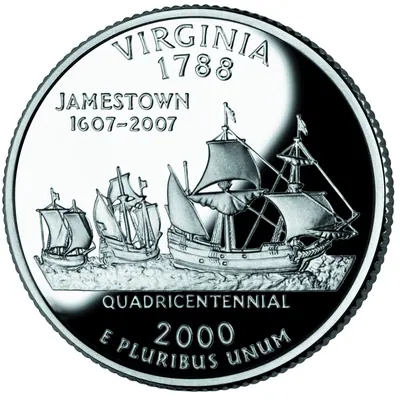
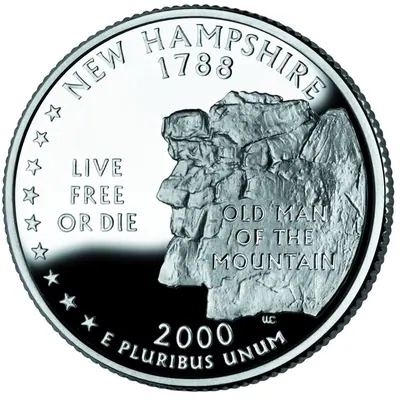
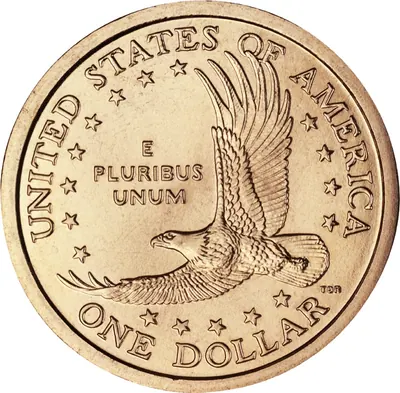
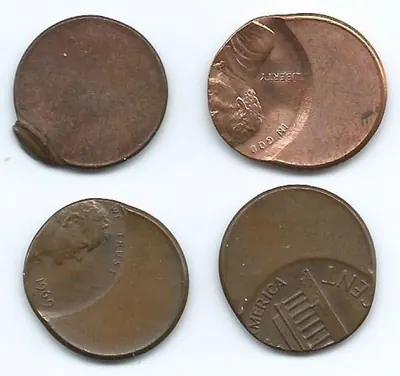
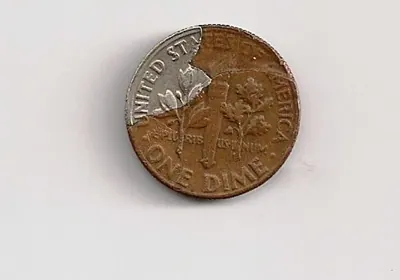
In 2000 the Mint issued five 50 State quarters, in this order: Massachusetts, Maryland, South Carolina, New Hampshire and Virginia. Philadelphia and Denver struck hundreds of millions of each, so a circulated 2000 quarter is worth 25 cents.
Here is what can make a 2000 quarter worth more:
- Mint errors. A 25% off-center 2000-P New Hampshire graded NGC MS67 sold for $194.62 at GreatCollections, and CoinWeek notes comparable MS67+ off-centers have brought up to $225.
- The 2000 quarter/dollar mule, a Sacagawea dollar struck with a state quarter obverse. The record is $194,062.50 (PCGS MS66, GreatCollections, January 2024).
- 2000-S silver proofs, which are 90% silver and worth at least their melt value.
The five 2000 state quarter designs
| State | Release | Reverse design | Designer | Mintage P / D |
|---|---|---|---|---|
| Massachusetts | January 3, 2000 | The Minute Man statue over the state outline, “The Bay State” | Thomas D. Rogers | 628,600,000 / 535,184,000 |
| Maryland | March 13, 2000 | Maryland State House dome with white oak clusters, “The Old Line State” | Thomas D. Rogers | 678,200,000 / 556,532,000 |
| South Carolina | May 22, 2000 | Carolina wren, yellow jessamine and palmetto tree | Thomas D. Rogers | — |
| New Hampshire | August 7, 2000 | Old Man of the Mountain with nine stars | William Cousins | 673,040,000 / 495,976,000 |
| Virginia | October 16, 2000 | The ships Susan Constant, Godspeed and Discovery | Edgar Z. Steever | 943,000,000 / 651,616,000 |
San Francisco struck proofs of all five: 4,020,172 clad proof sets and 965,421 silver proof sets.
How to check your 2000 quarter
- Mint mark: on the obverse, right of Washington’s ponytail. P or D coins are circulation strikes; S coins are proofs from Mint sets.
- Silver check for S coins: a silver proof has no copper stripe on the edge. Clad proofs show a copper stripe.
- Look for errors: a blank crescent (off-center strike), a curved bite from the edge (clipped planchet), raised lumps or lines from die breaks, or a coin that is the wrong size or color.
2000 quarter error list with pictures
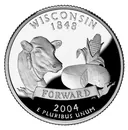
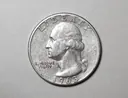
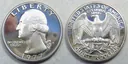
The photos at the top of this page show each error type. The coins pictured are other denominations where no free-licensed photo of a 2000 state quarter error exists, but the error looks the same on a quarter. Here is what to look for, in order of value:
| Error | What it looks like | Pictured above | Sales found for 2000 quarters |
|---|---|---|---|
| Quarter / Sacagawea dollar mule | A golden dollar with Washington on one side, no date | Sacagawea reverse used on the mule | $29,900 (2000) to the $194,062.50 record (PCGS MS66, GreatCollections, Jan 2024) |
| Off-center strike | Design shifted, a blank crescent on one side | Off-center and clipped cents | 2000-P New Hampshire, 25% off-center, NGC MS67: $194.62 (GreatCollections, Feb 2022) |
| Clipped planchet | A curved or straight bite missing from the rim | Off-center and clipped cents | Valued case by case |
| Missing or peeled clad layer | One face copper-colored, coin underweight | Peeled cladding on a clad coin | 2000-P Massachusetts, raw: $14.95 (eBay, Sep 2026) |
| Partial collar / broadstrike | A raised lip on part of the edge, or a wider coin with no reeding | Partial collar on a 5-cent coin | Valued case by case |
| Die cud | A raised blob of metal joined to the rim | Cud on a Jefferson nickel | Small cuds sell for a few dollars; big ones more |
1. The quarter/Sacagawea dollar mule
In 2000, a state quarter obverse die was paired with a Sacagawea dollar reverse die and struck on golden dollar planchets. The coin carries no date and two denominations. About 19 are known, and CoinWeek reports one collector owns at least 16. Public sales include $29,900 (PCGS MS66, the discovery coin, August 2000), $31,050 (NGC MS66, Heritage, August 2000), $56,350 (NGC MS67, Heritage, June 2001), $158,625 (Stack’s Bowers, August 2012), $192,000 (NGC MS67, Stack’s Bowers, March 2018) and the record $194,062.50 (PCGS MS66, GreatCollections, January 2024). It will not be in a roll of quarters: it is the size and color of a dollar coin. If you find a golden dollar with Washington on one side, have it authenticated right away.
2. Off-center strikes
The planchet sat partly outside the dies, so part of the design is missing and that part of the coin is blank. Value depends on how far off-center the strike is and whether the date and state name still show. The best-documented 2000 example is a New Hampshire quarter struck 25% off-center and graded NGC MS67, which brought $194.62 at GreatCollections; CoinWeek notes comparable MS67+ off-centers have reached $225.
3. Clipped planchets
The blank was punched from the edge of the metal strip or overlapping a hole, leaving a curved (or straight) bite. Look for the “Blakesley effect”: the rim opposite the clip is weak or missing. Without that sign, the “clip” may be damage done with a tool.
4. Missing clad layer
State quarters are made from a copper core with copper-nickel outer layers. If one layer split off before striking, that side looks copper and the design is often soft. A 2000-P Massachusetts listed with a missing clad layer sold raw for just $14.95 in September 2026, so price depends heavily on authentication. Weigh the coin: a genuine missing-layer quarter is lighter than the normal 5.67 g.
5. Partial collars and broadstrikes
The collar die forms the reeded edge. If it was not fully in place, the coin spreads out unevenly with a lip on part of the edge (partial collar), or wider all round with a plain edge (broadstrike).
6. Die cracks and cuds
As dies wear, cracks show as raised lines; a broken piece of die at the rim leaves a raised blob called a cud. Small cracks are common on all five 2000 designs and add little.
Not errors: prooflike coins and souvenirs
- Prooflike (PL) business strikes are not errors but early strikes from fresh dies with mirror fields. NGC labels them PL. A 2000-P Maryland NGC MS67PL sold for $190 in July 2023, and a 2000-P Massachusetts NGC MS67 PL for $40 in August 2023.
- Colorized and gold-plated quarters were made outside the Mint. A colorized 2000-P South Carolina sold for $4 in May 2026, about face value plus the capsule.
For errors across all 50 states, see our state quarter errors guide.
How to check your coin with CoinLens
Photograph both sides of your quarter with CoinLens. It identifies the state design, year and mint from a database of almost 500,000 coins and gives an instant value estimate. You can save coins to a collection that keeps a total value. CoinLens gives an estimate and does not certify errors, so send anything that looks like a major error to PCGS or NGC.
Where to sell a 2000 quarter
- Circulated coins: spend them or keep them for a state collection; they are worth face value.
- Silver proofs and proof sets: coin shops or eBay, priced near silver melt plus set premium.
- Certified errors: GreatCollections, Heritage, Stack’s Bowers or eBay with the holder shown. The mule belongs at a major auction house.
Frequently asked questions
How much is a 2000 quarter worth?
A circulated 2000 state quarter (Massachusetts, Maryland, South Carolina, New Hampshire or Virginia) is worth 25 cents. Errors such as off-center strikes, silver proofs and certified top-grade gems are worth more.
What 2000 quarters are worth money?
Genuine mint errors (off-center strikes, wrong planchets, die breaks), 2000-S silver proofs (worth at least melt), and rare gems in very high grades. The famous Sacagawea dollar/quarter mule, struck in 2000, is the most valuable of all.
Is a 2000 quarter silver?
Only the 2000-S silver proofs from the Mint’s silver proof sets, which are 90% silver. All 2000-P and 2000-D quarters are copper-nickel clad.
What is the 2000 quarter mule?
A coin struck with a state-quarter obverse and a Sacagawea dollar reverse on a golden dollar planchet. It has no date. About 19 are known, and one sold for $194,062.50 in January 2024.
Where is the mint mark on a 2000 quarter?
On the obverse, to the right of Washington’s ponytail, below the words IN GOD WE TRUST. P = Philadelphia, D = Denver, S = San Francisco (proofs).
Which 2000 state quarter had the highest mintage?
Virginia: 943,000,000 at Philadelphia and 651,616,000 at Denver, more than any other 2000 design.
Sources
- Wikipedia: 50 State quarters (2000 designs, designers, mintages, mule)
- CoinWeek: Dramatic New Hampshire state quarter error at GreatCollections ($194.62, NGC MS67, 25% off-center)
- CoinWeek: 2000 Sacagawea Dollar / Washington Quarter Mule, the $1.25 coin (die pairs, early auction records)
- CoinWeek: Stack's Bowers sets new record with sale of Sac dollar/Washington quarter mule ($192,000, Mar 2018)
- CoinWeek: Sacagawea dollar/Washington quarter mule sets record price at GreatCollections ($194,062.50, Jan 2024)
- PriceCharting: 2000-P Maryland state quarter, sold listings (NGC MS67PL $190, Jul 2023)
- PriceCharting: 2000-P Massachusetts state quarter, sold listings (missing clad layer $14.95, Sep 2026; NGC MS67 PL $40)
- PriceCharting: 2000-P South Carolina state quarter, sold listings (colorized $4, May 2026)
Values are estimates, not offers. Condition decides the price; for a valuable coin, get a professional grade.