Inherited a Coin Collection? What Grandpa's Old Coins Are Worth and What to Do
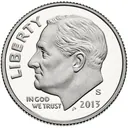
Most inherited collections are worth melt value for the silver plus a few better coins, but check before selling: three Ohio sisters inherited a 1975 no-S proof dime their brother had kept in a bank vault, and it sold for $506,250 (GreatCollections, October 2024). Sort, don't clean, then get several offers.
Have one in hand? Scan it with CoinLens to identify it and see an estimate in seconds.
| You find | How to spot it | Usually worth | What to do |
|---|---|---|---|
| US dimes, quarters, halves dated 1964 or earlier | Date; no copper stripe on the edge | Silver melt value (live below) | Set aside as silver; check key dates first |
| Kennedy halves 1965–1970 | Date | 40% silver melt | Set aside as silver |
| Jefferson ‘war nickels’ 1942–1945 | Large P, D or S above Monticello | 35% silver melt | Set aside as silver |
| Morgan and Peace dollars (1878–1935) | Large silver dollar, 38 mm | Melt or more; collector premium | Check dates and mint marks individually |
| Gold coins | Yellow, small, heavy for size | Gold value at least | Handle by the edges; get quotes from several dealers |
| Wheat pennies (1909–1958) | Wheat ears on the back | Mostly a few cents each | Check 1909-S VDB, 1914-D, 1922, 1931-S, 1943 copper |
| Proof and mint sets in Mint packaging, 1970s on | Flat plastic cases or cellophane | Often near face value | Keep in original packaging; check sold listings |
| Franklin Mint and other private ‘medals’ | No denomination; ‘sterling’ or ‘.925’ stamped | Usually silver melt | Weigh, price as silver |
| Foreign coins | Non-English legends | Mostly small amounts | Pull silver and gold; identify the rest |
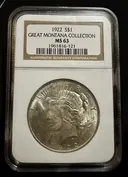
| Graded coins in plastic slabs (PCGS, NGC, ANACS) | Sealed holder with a grade and certification number | Look up the cert number | Don’t open the slab |
Which one is yours? Check it with CoinLens →
Silver dates from the Coinage Act of 1965 and the US Mint's specifications. 'Usually worth' is general guidance, not an appraisal; individual coins can be worth much more.
DEMO
Check your Inherited a Coin Collection? What Grandpa's Old Coins Are Worth and What to Do
Add a photo of each side
Add a photo of at least one side first.
Demo — photos stay on your device. Nothing is uploaded.
DEMO
Your photos are ready. The identification happens in the CoinLens app.
On the web this is a demo — it can't recognize coins. In the app, the same two photos give you the coin's name, details and a value estimate.
Scan these in the free appEXAMPLE — what CoinLens shows
Value estimate:
Sample from our guide's data, not a result for your photo.
That was a sample. Scan your coin →·
| Coin | Dates | Silver | Silver weight (troy oz) | Melt each |
|---|---|---|---|---|
| Dime | 1964 and earlier | 90% | 0.07234 | $3.14 melt |
| Quarter | 1964 and earlier | 90% | 0.18084 | $7.84 melt |
| Half dollar | 1964 and earlier | 90% | 0.36169 | $15.68 melt |
| Kennedy half dollar | 1965–1970 | 40% | 0.1479 | $6.41 melt |
| Jefferson war nickel | 1942–1945 | 35% | 0.05626 | $2.44 melt |
| Morgan or Peace dollar | 1878–1935 | 90% | 0.77344 | $33.53 melt |
| Eisenhower dollar, silver (S mint mark only) | 1971–1976 collector issues | 40% | 0.3162 | $13.71 melt |
Which one is yours? Check it with CoinLens →
Silver weights are the coins' legal specifications; worn coins hold slightly less. Melt value updates with the spot price. Dealers buy below melt.
| Coin or collection | Story | Sold for | Venue and date |
|---|---|---|---|
| 1975 no-S proof dime | Bought in 1978 for $18,200 by a man and his mother; kept in a bank vault 40+ years; inherited by his three sisters | $506,250 | GreatCollections, October 2024 |
| ‘Boston Collection’ (unopened boxes) | Assembled by the consignors’ grandfathers in the 1940s–60s; boxes sat in a garage for decades | $987,789 total | Heritage, September 2023 |
| Box of 25 unopened 1951 proof sets | Top lot of the Boston Collection | $60,000 | Heritage, September 2023 |
| 1909 $5 gold half eagle, NGC MS66 | Top single coin of the Boston Collection | $26,400 | Heritage, September 2023 |
| 1943 bronze cent | Found in high-school cafeteria change in 1947 and kept for life (Don Lutes Jr.) | $204,000 | Heritage, January 10, 2019 |
Which one is yours? Check it with CoinLens →
These are exceptional results reported by CBS News, CoinNews and Coin World, not typical values. They show why every collection deserves a check before it's sold by the pound.
| Item | Why people expect more | What the record shows |
|---|---|---|
| 1970s–2000s proof sets | Mint packaging, ‘proof’ sounds rare | Coin World (2012): dealers paid about $1.80 for a 1980-S set with $1.91 face; 2000-S sets $4–$4.50 wholesale |
| Franklin Mint sterling medal sets | Sold as limited editions at high prices | Coin World: most trade as bullion; a 1971 First Ladies set (41 oz silver) issued at $380 brought about $579 in 2014, essentially melt |
| 1976 bicentennial quarters (copper-nickel) | Special design, old date | The US Mint struck 1.67 billion; circulated ones are worth face |
| Worn common wheat pennies | Over 65 years old | Billions were struck; most sell for cents unless a key date or error |
Proof set prices are from a 2012 Coin World market report and are given as an example of how far below issue price common sets can fall, not as current quotes.
| Tier | Coins | Max value | Fee per coin |
|---|---|---|---|
| Modern | 1965–present | $3,000 | $20 |
| Economy | Non-gold US and world | $300 | $25 |
| Standard | All | $3,000 | $45 |
| Gold | Gold coins | $5,000 | $45 |
| Express | All | $10,000 | $80 |
Plus a $10 handling fee per submission and shipping both ways; direct submission requires NGC collector membership. PCGS has its own fee page and requires a Collectors Club membership. Check current fees before you submit.
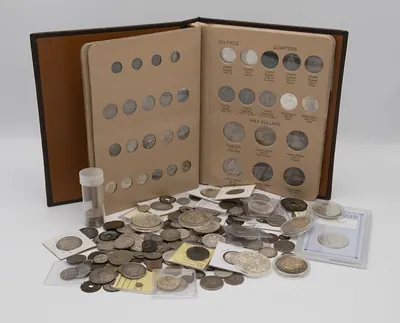
An inherited coin collection is usually worth the silver and gold it contains plus a handful of better coins. The rest is often worth face value or a little more. The risk is selling the whole lot to the first buyer before anyone has looked at the few coins that matter.
Do it in this order:
- Don’t clean anything.
- Sort silver, gold, slabs and everything else (the triage table above).
- Identify the better coins: dates, mint marks, condition.
- Decide what to grade, what to sell as bullion and what to keep.
- Get two or three offers before you sell, and never from a pop-up buyer.
Step 1: Leave the coins as they are
The instinct is to polish old coins so they “look nicer”. Don’t. NGC says unskilled cleaning is one of the most common reasons a coin gets a Details grade instead of a number, and harsh cleaning “is not correctable”. Collectors pay for original surfaces, including dark toning. A cleaned silver dollar can lose most of its collector premium and end up worth only melt. Our guide to whether you should clean coins explains why.
Also:
- Handle coins by the edges, ideally over a towel.
- Keep coins in their holders. Albums, 2×2 flips, Mint packaging and sealed slabs all help prove what a coin is. Unopened Mint boxes can be worth more sealed, as the Boston Collection showed.
- Keep any paperwork: receipts, invoices, the collector’s notes. A 1978 receipt for $18,200 is part of the story of the no-S dime that sold for $506,250.
Step 2: Sort the box in an hour
You don’t need to be a collector to do a first sort. You need good light, a magnifier and the table above.
Pull the silver first
The quickest test for US coins is the date plus the edge:
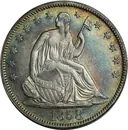
- Dimes, quarters and half dollars dated 1964 or earlier are 90% silver. Their edges are solid silver.
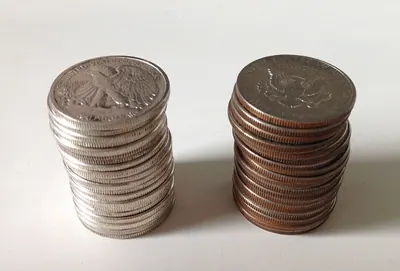
- Coins from 1965 onward are clad. You can see a copper stripe on the edge, as in the photo of the two stacks of half dollars.
- Kennedy halves dated 1965–1970 are the exception: they are 40% silver even though they look like clad coins.
- War nickels (late 1942–1945) have a large P, D or S above Monticello on the back and contain 35% silver.
- Morgan (1878–1921) and Peace (1921–1935) dollars are big 90% silver coins.
- Eisenhower dollars: only the S-mint collector versions are 40% silver; the ones from circulation are copper-nickel.
Count your 90% coins by face value. Ten dimes, four quarters or two halves make $1 face, which is about 0.715 troy oz of silver once worn. Our junk silver guide shows the arithmetic.
Then gold, slabs and sets
- Gold coins are small, heavy for their size, and usually marked with a dollar value ($2.50, $5, $10, $20) or a weight (1 oz, 1/10 oz). Even common ones are worth hundreds of dollars or more in gold.
- Graded coins sealed in PCGS, NGC or ANACS holders carry a certification number. Look it up on the grading service’s website before you do anything else. Never crack a slab open.
- Proof and mint sets in original packaging: leave them sealed and list them by year.
What’s left
That leaves wheat pennies, Buffalo and Jefferson nickels, foreign coins, tokens and medals. Bag them by type and go through them coin by coin later. Most will be common, but this is where key dates and errors hide.
Step 3: Find the coins that matter
Each series has a few key dates that are worth far more than the rest. A good first pass looks for:
- Wheat cents: 1909-S VDB, 1914-D, 1922 “plain”, 1931-S, and any 1943 cent that isn’t attracted to a magnet.
- Mercury dimes: 1916-D.
- Washington quarters: 1932-D and 1932-S.
- Morgan dollars: coins from Carson City (CC mint mark), 1893-S, 1895.
- Buffalo nickels: the 1937-D “three-legged” buffalo.
- Anything uncirculated: no wear on the high points, original mint lustre.
The table of family-collection sales above shows how wide the range is. The Boston Collection had sat in a garage for decades. Its top lot was a box of 25 unopened 1951 proof sets ($60,000), not a single famous rarity. The best single coin was an ordinary-date 1909 $5 gold piece that happened to be in MS66 condition and brought $26,400. Condition and original packaging made the money.
Things that disappoint
It’s equally useful to know what usually isn’t valuable, so you don’t overpay for grading or hold out for a price that won’t come:
- Modern proof sets. Dealers have at times paid less than face value for common 1970s–2000s sets: a 1980-S set brought about $1.80 against $1.91 face in a 2012 Coin World market report.
- Franklin Mint sterling medals. Coin World notes most trade as bullion. A 40-medal First Ladies set issued at $380 sold for about $579 in 2014, roughly its silver value.
- 1976 bicentennial quarters in copper-nickel. The Mint made 1.67 billion of them.
- Worn common wheat pennies. They’re old, but billions were made.
Step 4: When grading pays and when it doesn’t
Grading only makes sense when the coin is worth clearly more than the fee once certified. NGC charges $20–$45 per coin for most tiers plus $10 handling, membership and shipping. A rough rule: grade coins likely to be worth $100 or more in their grade, plus any suspected error or rarity where authentication itself adds value. Don’t grade common silver, worn wheat cents or modern sets.
If you have dozens of coins worth grading, a reputable dealer can submit them for you and may know which coins are worth it. See how to get coins graded for the full process.
Step 5: Sell without getting lowballed
Where to sell what
| What you’re selling | Best venue | Typical cost |
|---|---|---|
| Common silver and gold (bullion value) | Local coin shop or bullion dealer; compare quotes per $1 face or per ounce | The dealer’s spread below melt |
| $20–$500 collectible coins | eBay, coin shows, local shops | eBay: 13.25% on coins (bullion 13.6%) up to $7,500 per item, plus $0.30–$0.40 per order |
| Rare or graded coins, whole valuable collections | Auction houses (Heritage, Stack’s Bowers, GreatCollections) | Seller’s commission, negotiable on large consignments |
| Unknown mixed lots | Get an appraisal first, then decide | Appraisal fee, if any |
Our where to sell coins guide compares the options in detail.
How to avoid lowball buyers
- Avoid pop-up buyers. The US Commodity Futures Trading Commission warns: “don’t do business with traveling or pop-up precious metal dealers,” including those working from a hotel room or car or insisting on coming to your home. It also notes retail coin dealers are generally not regulated by state or federal authorities.
- Get at least three offers, in writing, for the same list of coins.
- Price the silver yourself first. Know the melt value (the table above updates with spot) so you can spot an offer far below it.
- Separate the lots. Ask for prices on the key coins individually, not just one number for the whole box.
- Check credentials. Members of the Professional Numismatists Guild agree to a code of ethics, and the PNG website has a dealer directory.
- Don’t let the appraiser also be the buyer if you can avoid it. A paid, independent appraisal removes the conflict.
Taxes on an inherited collection (US)
Two IRS rules matter. First, inherited property generally takes a basis equal to its fair market value on the date of death (IRS Publication 551), so gains before the inheritance usually aren’t taxed when you sell. Second, coins are collectibles, and long-term gains on them are taxed at a maximum 28% rate (IRS Topic 409). Keep a dated record of what the collection was worth, such as an appraisal or a list with melt values, near the date of death. This is general information, not tax advice.
How to check your coins with CoinLens
Going through a box of unfamiliar coins, including foreign ones, is where an identifier app saves the most time. Photograph both sides with Coin Identifier – CoinLens (iPhone and Android). The AI identifies the coin within seconds from a database of almost 500,000 coins worldwide. It shows composition, minting years and an instant value estimate, and you can save each coin to a collection that totals its value. Use it to find the coins worth a closer look, then get professional grading for anything valuable. Free scans are limited; Premium unlocks unlimited scans.
Frequently asked questions
I inherited a coin collection. Now what?
Don’t clean anything and don’t sell in a hurry. Sort the coins into silver (US dimes, quarters and halves dated 1964 or earlier), gold, graded slabs and everything else. Identify the better pieces, then get offers from at least two or three buyers before you sell.
Is my grandpa's coin collection worth anything?
Almost every older US collection is worth something, because pre-1965 dimes, quarters and halves are 90% silver and sell for melt value at minimum. Whether it’s worth more depends on key dates, gold coins and condition. A few coins can be worth far more than the rest of the collection put together.
What should I do with a box of old coins?
Look at the dates and edges. Coins with no copper stripe on the edge and dates of 1964 or earlier are silver. Pull out gold, silver dollars and anything in a grading slab. Then identify the rest coin by coin before deciding what to sell.
Should I clean inherited coins before selling them?
No. Cleaning scratches the surface and removes original toning. NGC and PCGS give cleaned coins a ‘details’ grade instead of a numeric one, and buyers pay less for them.
Is an inherited coin collection taxable?
In the US, inherited property generally takes a basis equal to its fair market value on the date of death (IRS Publication 551), so you’re taxed only on the gain after that date. Gains on coins are taxed as collectibles, at a maximum 28% long-term rate. Ask a tax adviser about your situation.
Who buys coin collections near me?
Local coin shops, coin shows, and auction houses for better collections. The Professional Numismatists Guild has a searchable directory of member dealers who follow a code of ethics. Avoid traveling ‘we buy gold’ events and buyers who insist on coming to your home.
How do I find out what my coin collection is worth?
Identify each coin (date, mint mark, country), separate silver and gold and price them at melt. Then look up sold prices, not asking prices, for the better coins. For a large or valuable collection, get a paid appraisal from a dealer who isn’t bidding on it.
Sources
- CBS News (Oct 2024): Rare dime hidden for decades sells for $506,250
- CoinNews (Sept 2023): Coin collection discovered in garage tops $987,000 at Heritage
- CBS News (Jan 2019): Rare 1943 penny sells for $204,000 at Heritage (Don Lutes Jr.)
- Coin World (Dec 2018): Lutes found his 1943 copper cent in circulation in 1947
- Wikipedia: Coinage Act of 1965 (silver to clad)
- Wikipedia: Jefferson nickel (wartime 35% silver alloy)
- Wikipedia: Peace dollar (0.77344 troy oz silver)
- Wikipedia: Eisenhower dollar (40% silver S-mint collector issues)
- Coin World (2012): Common proof set prices fall
- Coin World: One that paid off (Franklin Mint medals trade as bullion)
- US Mint: Bicentennial coins and medals (1.67 billion quarters)
- NGC: Details grading (cleaned coins)
- NGC grading services and fees
- eBay selling fees (coins and paper money 13.25%)
- CFTC: Precious metals fraud advisory (traveling and pop-up dealers)
- Professional Numismatists Guild: dealer directory and code of ethics
- IRS Topic 409: collectibles gains taxed at max 28%
- IRS Publication 551: basis of inherited property
Values are estimates, not offers. Condition decides the price; for a valuable coin, get a professional grade.