How Much Is an Indian Head $10 Gold Eagle Worth? (1907–1933 Values & Key Dates)
Every Indian Head $10 gold eagle (1907–1933) holds 0.4838 troy oz of gold, so common dates such as 1926 and 1932 sell near gold value (live below). Key dates cost far more: a 1920-S in PCGS MS66 brought $329,000 and a 1933 in PCGS MS65 $822,500 at Heritage.
Have one in hand? Scan it with CoinLens to identify it and see an estimate in seconds.
| Coin | Gold value | Example sales | Notes |
|---|---|---|---|
| 1926 | $1,754.74 gold melt | PCGS MS62 $1,150; NGC MS62 $1,200 (Heritage, 2022–2023); NGC MS66 $8,400 (Jan 2022) | Common date |
| 1932 | $1,754.74 gold melt | NGC AU58 $1,260 (Apr 2024); PCGS MS62 $1,260 (Aug 2023); PCGS MS66 $10,980 (Heritage, Mar 2026) | Common date |
| 1912 | $1,754.74 gold melt | PCGS MS61 $780 (Jul 2019); NGC MS63 $870 (Jun 2019); PCGS MS66 $36,000 (Heritage, Jul 2023) | Gem premium is large |
| 1907 No Motto (regular) | $1,754.74 gold melt | NGC AU58 $1,320; NGC MS61 $1,446 (2023); NGC MS66 $15,600 (Jul 2023) | No IN GOD WE TRUST |
| 1907 Wire Rim | — | NGC VF30 $22,325 (Apr 2015); PCGS MS62 $32,900 (Jan 2016); PCGS MS66 $105,000 (Heritage, Dec 2018) | Experimental first strikes |
| 1920-S | — | PCGS XF45 $31,200 (Nov 2017); PCGS AU53 $35,250 (Aug 2013); PCGS MS66 $329,000 (Heritage, Aug 2012) | Key date |
| 1930-S | — | PCGS MS60 $24,000 (Feb 2018); PCGS MS67 $299,000 (Heritage, Jan 2009) | Key date |
| 1933 | — | NGC MS64 $112,125 (1999); PCGS MS65 $822,500 (Heritage, Apr 2015) | Most were melted |
Which one is yours? Check it with CoinLens →
Sales from NGC Auction Central (Heritage results). Gold value updates with the spot price; rare dates are not typical values. Gold melt at $3627.00/oz, November 26, 2026.
DEMO
Check your 1907–1916, 1920, 1926, 1930, 1932–1933 Indian Head Eagle ($10 gold)
Add a photo of each side
Add a photo of at least one side first.
Demo — photos stay on your device. Nothing is uploaded.
DEMO
Your photos are ready. The identification happens in the CoinLens app.
On the web this is a demo — it can't recognize coins. In the app, the same two photos give you the coin's name, details and a value estimate.
Scan these in the free appEXAMPLE — what CoinLens shows
Value estimate:
Sample from our guide's data, not a result for your photo.
That was a sample. Scan your coin →·
Coin facts
- Coin
- Indian Head Eagle ($10 gold)
- Years
- 1907–1916, 1920, 1926, 1930, 1932–1933
- Mints
- Philadelphia (no mint mark), Denver (D), San Francisco (S)
- Composition
- 90% gold, 10% copper
- Weight
- 16.718 g
- Diameter
- 26.92 mm
- Gold (AGW)
- 0.4838 troy oz
- Gold melt
- $1,754.74
- Designer
- Augustus Saint-Gaudens
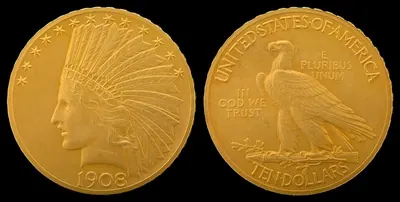
Indian Head $10 gold value: quick answer
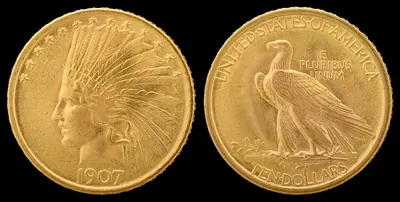
The Indian Head eagle was designed by Augustus Saint-Gaudens and struck from 1907 to 1916, then only in 1920, 1926, 1930, 1932 and 1933. Each coin holds 0.4838 troy ounces of gold (live gold value below).
- Common dates (1926, 1932, many 1909–1915 issues): lower mint-state coins sold for about $780–$1,450 at Heritage in 2019–2024, close to gold value at the time. Gems bring much more: a PCGS MS66 1932 brought $10,980 in March 2026.
- 1907 Wire Rim: experimental first strikes; even an NGC VF30 sold for $22,325.
- Key dates: 1920-S (PCGS MS66 $329,000, 2012), 1930-S (PCGS MS67 $299,000, 2009) and 1933 (PCGS MS65 $822,500, April 2015). Many 1930s eagles were melted by the government in the late 1930s.
How to identify your Indian Head eagle
- Obverse: Liberty wearing a feathered Native American war bonnet, with LIBERTY on the headband.
- Reverse: a standing eagle. Coins from 1908 on carry IN GOD WE TRUST to the left of the eagle.
- Edge: raised stars instead of reeding.
- Mint mark: on the reverse, near the eagle’s talons. D or S; none for Philadelphia.
- Genuine check: 16.718 g and 26.92 mm. Have valuable dates certified by PCGS or NGC.
The 1907 varieties and the edge stars
Saint-Gaudens died on August 3, 1907, and President Roosevelt insisted the eagle be struck that month. Mint Director Cortelyou had 500 coins struck on the high-pressure medal press from the dies on hand. These are the wire rim pieces, named for the sharp angle where the field meets the edge with no raised rim; the Mint sold them at face value until at least 1912. An NGC VF30 wire rim brought $22,325 in April 2015 and a PCGS MS66 $105,000 in December 2018.
The edge of every Indian Head eagle carries raised stars instead of reeding: 46 at first, increased to 48 in 1912 after New Mexico and Arizona became states. Counting the stars is a quick way to tell a 1907–1911 coin from a 1912 or later one.
The 1933 eagle had a mintage of 312,500, but only a handful were paid out before gold coinage ended; virtually all were melted, which is why a PCGS MS65 brought $822,500 in April 2015.
Gold melt value
Each Indian Head eagle holds 0.4838 troy ounces of pure gold. The calculator below multiplies that by today’s gold spot price.
Gold melt value calculator
Indian Head Eagle ($10 gold): 0.4838 troy oz of gold each
Melt value ($1,754.74 each)
Gold spot $3627.00/oz as of November 26, 2026 (gold-api.com)
Melt value today for several gold and silver coins → Gold & silver melt calculator
Melt value is the floor. Condition and mint details decide the rest — check yours in the app.
How to check your coin with CoinLens
Photograph both sides in CoinLens. The app identifies the date and mint from its database of almost 500,000 coins and gives an instant value estimate you can save to your collection. CoinLens gives estimates; for key dates or gem-looking coins, use PCGS or NGC authentication.
Where to sell
Common dates sell to bullion and coin dealers near gold value; compare offers. Certified key dates sell best at Heritage, Stack’s Bowers or GreatCollections.
Frequently asked questions
How much is a $10 Indian Head gold coin worth?
At least its gold value: 0.4838 troy ounces times the spot price. Common dates like 1926 and 1932 in lower mint state sell close to that; key dates such as 1920-S, 1930-S and 1933 sell for tens or hundreds of thousands of dollars.
Who designed the Indian Head eagle?
Augustus Saint-Gaudens, as part of President Theodore Roosevelt’s effort to beautify US coinage. Saint-Gaudens died in August 1907, and Roosevelt insisted the new eagle be finished and struck that month.
Why do some Indian Head eagles lack In God We Trust?
The 1907 and early 1908 coins omitted the motto, which caused public outrage. Congress passed a law requiring it, and it was added to the reverse during 1908.
What is on the edge of an Indian Head eagle?
Stars instead of reeding: 46 stars at first, for the number of states after Oklahoma’s admission in 1907.
Where is the mint mark on an Indian Head $10?
On the reverse, to the left of the eagle’s talons near the arrows. Philadelphia coins have no mint mark.
Sources
- Indian Head eagle (history, motto, edge stars, 1933 rarity)
- NGC Auction Central: 1926 $10
- NGC Auction Central: 1932 $10
- NGC Auction Central: 1912 $10
- NGC Auction Central: 1907 Indian $10
- NGC Auction Central: 1907 Wire Rim $10
- NGC Auction Central: 1920-S $10
- NGC Auction Central: 1930-S $10
- NGC Auction Central: 1933 $10
Values are estimates, not offers. Condition decides the price; for a valuable coin, get a professional grade.