How Much Is a Liberty Head Double Eagle Worth? ($20 Gold Coin Values, 1850–1907)
Every Liberty Head double eagle (1850–1907) holds 0.9675 troy oz of gold, so common late dates like 1904 sell near gold value (live below). Rare dates sell for far more: a 1870-CC in PCGS AU53 brought $411,250 and an 1861 Paquet reverse $1,645,000 at Heritage in 2014.
Have one in hand? Scan it with CoinLens to identify it and see an estimate in seconds.
| Coin | Gold value | Example sales | Notes |
|---|---|---|---|
| 1904 (common Type 3) | $3,509.12 gold melt | PCGS MS61 $2,040; NGC MS63 $2,110 (Heritage, Aug 2023); NGC MS66 $8,235 (Mar 2026) | Most common date |
| 1907 Liberty | $3,509.12 gold melt | PCGS MS64 $1,800 (Heritage, Apr 2019); PCGS MS65 $12,600 (Heritage, Jul 2023) | Last year of the design |
| 1877-CC | — | NGC VF25 $2,760 and VF30 $3,120 (Aug 2020); NGC AU58 $19,907 (Heritage, Jul 2023) | Carson City premium |
| 1879-O | — | PCGS VF35 $34,075 (Sep 2016); NGC MS60 $135,125 (Heritage, Jan 2014) | New Orleans rarity |
| 1870-CC | — | NGC VF25 $89,125 (2001); PCGS AU53 $411,250 (Heritage, Mar 2014) | Rarest Carson City double eagle |
| 1861 Paquet reverse | — | PCGS MS61 $1,610,000 (2006) and $1,645,000 (Heritage, Aug 2014) | Tall reverse lettering |
Which one is yours? Check it with CoinLens →
Sales from NGC Auction Central (Heritage results). Records and rarities are not typical values; gold value updates with the spot price. Gold melt at $3627.00/oz, November 26, 2026.
DEMO
Check your 1850–1907 (1849 pattern only) Liberty Head Double Eagle ($20 gold)
Add a photo of each side
Add a photo of at least one side first.
Demo — photos stay on your device. Nothing is uploaded.
DEMO
Your photos are ready. The identification happens in the CoinLens app.
On the web this is a demo — it can't recognize coins. In the app, the same two photos give you the coin's name, details and a value estimate.
Scan these in the free appEXAMPLE — what CoinLens shows
Value estimate:
Sample from our guide's data, not a result for your photo.
That was a sample. Scan your coin →·
Coin facts
- Coin
- Liberty Head Double Eagle ($20 gold)
- Years
- 1850–1907 (1849 pattern only)
- Mints
- Philadelphia (no mint mark), New Orleans (O), San Francisco (S), Carson City (CC), Denver (D)
- Composition
- 90% gold, 10% copper
- Weight
- 33.436 g
- Diameter
- 34 mm
- Gold (AGW)
- 0.9675 troy oz
- Gold melt
- $3,509.12
- Designer
- James B. Longacre
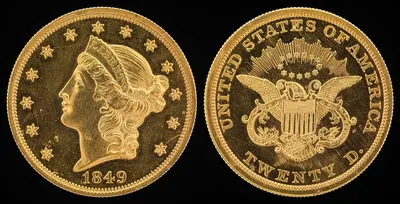
Liberty Head double eagle value: quick answer
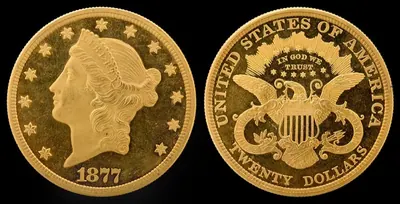
The Liberty Head (or Coronet) double eagle, designed by Chief Engraver James B. Longacre, was struck for commerce from 1850 to 1907. Each coin holds 0.9675 troy ounces of gold, so the gold price sets its floor (live calculator below).
- Common late dates (1904, 1907 and others): PCGS MS61 and NGC MS63 1904s sold for about $2,040–$2,110 at Heritage in 2023, close to gold value. Gems cost more: an NGC MS66 1904 brought $8,235 in March 2026.
- Carson City: even worn 1877-CC coins brought $2,760–$3,120; the rare 1870-CC sold for $411,250 in PCGS AU53 (Heritage, March 2014).
- New Orleans: an 1879-O in NGC MS60 brought $135,125 (January 2014).
- 1861 Paquet reverse: a short-lived reverse with taller letters; PCGS MS61 coins sold for $1,610,000 (2006) and $1,645,000 (2014).
How to identify your double eagle
- Type: look at the reverse.
- Type 1 (1850–1866): no motto, denomination TWENTY D.
- Type 2 (1866–1876): IN GOD WE TRUST in the oval of stars above the eagle, still TWENTY D.
- Type 3 (1877–1907): denomination spelled TWENTY DOLLARS.
- Date: below Liberty’s portrait on the obverse.
- Mint mark: on the reverse below the eagle. CC, O, S or D (1906–1907); none for Philadelphia.
- Genuine check: 33.436 g, 34 mm, not magnetic.
A short history
The California Gold Rush flooded the Mint with gold. In March 1849 Congress authorized the double eagle, the largest US coin of its day, along with the gold dollar. Only one 1849 pattern survives, in the Smithsonian’s National Numismatic Collection. Regular production ran until 1907, when Augustus Saint-Gaudens’ new design replaced it.
Why so many double eagles survive
The double eagle quickly became the workhorse of American gold. From 1850 to 1933, just under half of all US gold coins struck were double eagles, but they used 78% of the gold coined. Bowers calls the $20 “the most efficient way” to turn gold into coin (Wikipedia).
Millions were shipped abroad to settle international payments. Many were melted (most sent to the UK were recoined into sovereigns), but millions stayed in European bank vaults. Those were found from the 1940s and sold back to American buyers, especially after private gold ownership became legal again in 1974. That is why common late dates in mint state are plentiful today and trade close to gold value (Wikipedia).
Shipwreck gold and the Southern mints
Many of today’s top-grade 1850s San Francisco double eagles came from shipwrecks: the SS Central America, which sank in September 1857 with thousands of new 1857-S coins and some 435 people, the SS Brother Jonathan and the SS Yankee Blade (Wikipedia).
New Orleans struck double eagles every year from 1850 to 1861, mostly in small quantities, and only once after the Civil War: 2,325 in 1879. That scarcity is why an 1879-O in NGC MS60 brought $135,125. Carson City, which opened in 1870, struck only 3,789 double eagles in its first year (Wikipedia).
Varieties to look for
- “LLBERTY” (1850–1858). Longacre first cut LIBERTY with a second L, then converted it to an I. The remnant is visible under magnification (Wikipedia).
- 1861 Paquet reverse. Anthony Paquet’s reverse with taller, narrower letters was used briefly in 1861. The rim was too low to protect the design, so the Mint went back to the old reverse; most Philadelphia pieces were melted (Wikipedia).
- 1873 Closed 3 and Open 3. The chief coiner complained that the 3 looked like an 8, so new date punches were made. On the double eagle the difference is small (Wikipedia).
- 1876 Heavy Motto and Light Motto. William Barber strengthened IN GOD WE TRUST on the reverse in 1876 (Wikipedia).
The rare Philadelphia years of the 1880s
From 1881 to 1887, Philadelphia struck only 4,521 double eagles for circulation, and none in 1882, 1883 and 1887. Those dates exist only as proofs, with mintages of 92 (1883), 71 (1884) and 121 (1887). In 1886 just 1,000 circulation strikes and 106 proofs were made (Wikipedia). By contrast, 1904 was the record year, with 6,256,699 struck at Philadelphia and 5,134,175 at San Francisco, which is why the 1904 is the classic “common date” double eagle.
The last Liberty Head double eagles were struck in 1907. In April 1906 the new Denver Mint began striking them, with about a dozen proofs made for dignitaries (Wikipedia).
Gold melt value
Each Liberty Head double eagle holds 0.9675 troy ounces of pure gold. The calculator below multiplies that by today’s gold spot price.
Gold melt value calculator
Liberty Head Double Eagle ($20 gold): 0.9675 troy oz of gold each
Melt value ($3,509.12 each)
Gold spot $3627.00/oz as of November 26, 2026 (gold-api.com)
Melt value today for several gold and silver coins → Gold & silver melt calculator
Melt value is the floor. Condition and mint details decide the rest — check yours in the app.
How to check your coin with CoinLens
Photograph both sides in CoinLens. The app identifies the date, type and mint from its database of almost 500,000 coins and gives an instant value estimate you can save to your collection. CoinLens gives estimates; for any Carson City, New Orleans or pre-1866 coin, use PCGS or NGC authentication.
Where to sell
Common-date double eagles sell to bullion and coin dealers near gold value; compare offers. Certified rare dates sell best at Heritage, Stack’s Bowers or GreatCollections.
Frequently asked questions
How much is a Liberty Head $20 gold coin worth?
At least its gold value: 0.9675 troy ounces times the spot price. Common late dates such as 1904 trade close to that in lower mint state; Carson City, New Orleans and Civil War rarities sell for tens of thousands to over a million dollars.
What are Type 1, Type 2 and Type 3 double eagles?
Type 1 (1850–1866) has no motto and the denomination TWENTY D. Type 2 (1866–1876) adds IN GOD WE TRUST above the eagle. Type 3 (1877–1907) changes the denomination to TWENTY DOLLARS.
Where is the mint mark on a Liberty Head double eagle?
On the reverse, below the eagle and above the denomination. Philadelphia coins have no mint mark.
Why was the double eagle created?
The California Gold Rush brought huge amounts of gold to the Mint, and in March 1849 Congress authorized a gold dollar and a $20 double eagle to coin it efficiently. Only one 1849 double eagle exists, in the Smithsonian.
Are Liberty Head double eagles counterfeited?
Yes. Check weight (33.436 g) and diameter (34 mm), and have any coin worth more than its gold value certified by PCGS or NGC.
Sources
- Liberty Head double eagle (history, types, 1849 pattern)
- NGC Auction Central: 1904 $20
- NGC Auction Central: 1907 Liberty $20
- NGC Auction Central: 1877-CC $20
- NGC Auction Central: 1879-O $20
- NGC Auction Central: 1870-CC $20
- NGC Auction Central: 1861 Paquet $20
Values are estimates, not offers. Condition decides the price; for a valuable coin, get a professional grade.