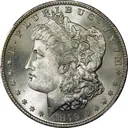
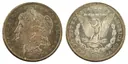
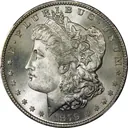
How Much Is an 1881-S Morgan Silver Dollar Worth? (Values by Grade, PL & Records)
The 1881-S Morgan dollar is one of the most common Morgans (12.76 million struck), so circulated coins trade near their 0.7734 oz silver value. It is the classic affordable gem: NGC MS67s sold for $915–$1,128.50 at Heritage on October 28, 2026, and an NGC MS69 brought $51,600 in 2025.
Have one in hand? Scan it with CoinLens to identify it and see an estimate in seconds.
| Grade | Typical sold price | Sales seen | Notes |
|---|---|---|---|
| Circulated (VF–XF) | Silver value to about $70 | — | Trades on silver content |
| AU50–AU58 | $57–$97 | 24 | — |
| MS60–MS62 | $56–$170 | 87 | — |
| MS63–MS64 | $83–$180 | 58 | Heritage MS64 $103–$109 (Oct 2026) |
| MS65 | $172–$258 | 27 | Heritage $154–$183 (2026) |
| MS66 | $310–$395 | 26 | Heritage NGC $280.60–$390.40 (Aug–Oct 2026) |
| MS67 | $833–$1,166 | 25 | Heritage NGC $915–$1,128.50 (Oct 2026) |
| MS68 | $3,294–$6,100 at Heritage (2026) | 9 auction lots | PCGS MS68 CAC $5,368–$6,100 |
| MS68 Prooflike | $7,320–$7,625 (NGC, Heritage, Oct 2026) | 2 | NGC census: 12 in MS68 PL |
| MS69 (record) | $51,600 (NGC, Heritage, Apr 30, 2025) | 1 | Two each at PCGS and NGC |
Which one is yours? Check it with CoinLens →
Middle half of certified sales on PriceCharting (eBay and Heritage, mostly 2025–2026, observed Nov 26, 2026) and Heritage results on NGC Auction Central. Estimates, not a price guide. Melt at silver $43.35/oz, November 26, 2026.
DEMO
Check your 1881 Morgan Silver Dollar
Add a photo of each side
Add a photo of at least one side first.
Demo — photos stay on your device. Nothing is uploaded.
DEMO
Your photos are ready. The identification happens in the CoinLens app.
On the web this is a demo — it can't recognize coins. In the app, the same two photos give you the coin's name, details and a value estimate.
Scan these in the free appEXAMPLE — what CoinLens shows
Value estimate:
Sample from our guide's data, not a result for your photo.
That was a sample. Scan your coin →·
Coin facts
- Coin
- Morgan Silver Dollar
- Years
- 1881
- Mints
- San Francisco (S)
- Composition
- 90% silver, 10% copper
- Weight
- 26.73 g
- Diameter
- 38.1 mm
- Silver (ASW)
- 0.7734 troy oz
- Melt value
- $33.53
- Designer
- George T. Morgan
Mintage
- 1881-S
- 12,760,000
| Date | Grade | Venue | Price |
|---|---|---|---|
| Mar 27, 2024 | NGC MS68* (rainbow toning) | Stack’s Bowers | $7,800 |
| Mar 27, 2024 | PCGS MS68 (rainbow toning) | Stack’s Bowers | $5,760 |
| Mar 29, 2024 | PCGS MS67+ (obverse toning) | Heritage | $4,320 |
| Aug 16, 2024 | NGC MS68* (rainbow toning) | Heritage | $6,600 |
| Aug 16, 2024 | PCGS MS68 (brilliant), two coins | Heritage | $3,600 each |
| Jan 17, 2025 | PCGS MS68 | Heritage | $5,400 |
| Sep 17, 2026 | PCGS MS68 CAC VAM-70 | Heritage | $5,612 |
| Oct 1, 2026 | NGC MS68 Prooflike | Heritage | $7,625 |
Which one is yours? Check it with CoinLens →
2024–2025 results from CoinWeek's 1881-S guide; 2026 results from Heritage listings on PriceCharting. Melt at silver $43.35/oz, November 26, 2026.
| Date | NGC MS68 | NGC MS68+ | NGC MS69 |
|---|---|---|---|
| November 2013 | 225 (7 PL, 2 DPL) | — | 0 |
| March 2025 | 479 (12 PL, 2 DPL) | 21 | 2 |
Which one is yours? Check it with CoinLens →
CoinWeek, citing NGC census data. PCGS also had two MS69 coins as of March 2025. Melt at silver $43.35/oz, November 26, 2026.
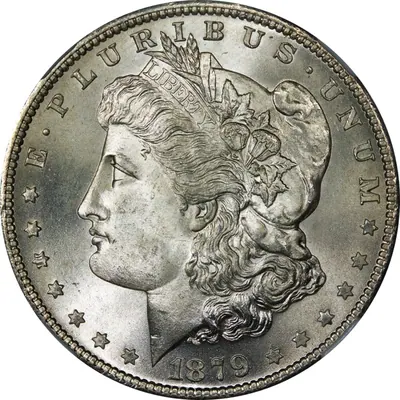
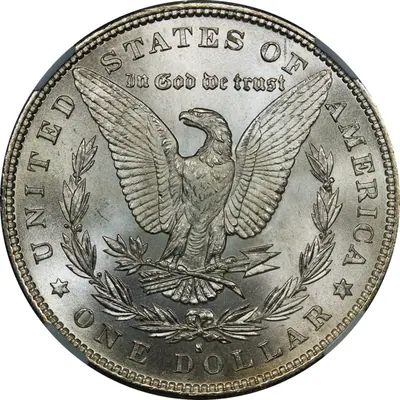
A circulated 1881-S is worth about its silver value: it holds 0.7734 troy ounce of silver (see the live melt calculator on this page). It is one of the most common Morgan dollars, so the premium comes from grade, not rarity:
For a mint state coin, expect to pay roughly $60–$170 from MS60 to MS64, $170–$400 in MS65–MS66 and $830–$1,170 in MS67 (Heritage sold NGC MS67s for $915–$1,128.50 on October 28, 2026). MS68 coins brought $3,300–$6,100 at Heritage in 2026, and prooflike MS68s up to $7,625. Only two MS69s exist at each of PCGS and NGC; one of the NGC coins sold for $51,600 at Heritage on April 30, 2025.
The sweet spot for collectors
Because the 1881-S is so plentiful, it is one of the cheapest ways to own a true gem Morgan dollar. Our reading of the price data, not a dealer rule:
| Goal | Grade to look for | Typical cost |
|---|---|---|
| A nice Morgan for a type set | MS63–MS64 | About $85–$180 |
| A gem with full luster | MS65 | About $170–$260 |
| A showpiece | MS66–MS67, ideally toned or prooflike | About $310–$1,170 |
| Registry competition | MS68 and up | $3,300 to $50,000+ |
The jump from MS64 to MS65 costs only about $100, which makes MS65 the best value for most buyers. Above MS66, prices rise faster than quality you can see without a loupe.
Why the 1881-S is the classic gem Morgan
San Francisco struck 12,760,000 Morgan dollars in 1881. CoinWeek calls the 1881-S “the most attractive issue in the entire series”: most unimpaired coins are brilliant, many were struck with prooflike surfaces, and many of those have frosted devices.
Huge numbers were never circulated. CoinWeek traces their path through the collector market:
| Year | What happened | Price |
|---|---|---|
| April 1948 | Dealer George P. Lang offers uncirculated 1881-S dollars in The Numismatist | $2.50 each |
| February 1951 | Dealer Harry W. Bason lists BU 1881-S dollars among 74 Morgan dates | $1.90 each |
| 1960s | Many more released from storage | — |
| January 1991 | Dealer Dale Williams offers “strictly original” rolls | $500 per roll |
The date was also part of the Lincoln Highway Hoard. CoinWeek estimates that four to six million 1881-S dollars survive in mint state today, which is why even an MS65 costs only a couple of hundred dollars.
The 1881-S among the 1881 Morgan dollars
Four mints struck Morgan dollars in 1881, and the San Francisco coin had the largest output by far:
| Coin | Mint mark | Mintage | Where it stands |
|---|---|---|---|
| 1881 | none (Philadelphia) | 9,163,000 | Common date |
| 1881-O | O (New Orleans) | 5,708,000 | Common date |
| 1881-S | S (San Francisco) | 12,760,000 | The most plentiful in mint state |
| 1881-CC | CC (Carson City) | 296,000 | Lowest mintage of the year |
Mintages from Wikipedia’s Morgan dollar table.
Mintage alone doesn’t set the price, because survival matters more. Many of the 1881-S coins sat in bags until they were released in the 1960s, which is why this one date now supplies so many of the gem Morgans on the market. If your 1881 dollar has a CC below the wreath instead of an S, it is a different and much scarcer coin.
Spotting a prooflike 1881-S
CoinWeek notes that many 1881-S dollars were struck with prooflike surfaces. These coins came from freshly polished dies, and their fields reflect like a mirror. To check yours:
- Hold the coin under a single light and tilt it. On a prooflike coin, the fields reflect clearly, not just flash with luster.
- Look for contrast. The best prooflike coins have frosted, white devices (Liberty’s portrait, the eagle) against mirrored fields.
- Check both sides. Grading services need mirrors on the obverse and reverse to label a coin PL or DMPL.
- Be realistic. Hairlines and bag marks show more clearly on mirrored fields, so many prooflike coins grade lower than their mirrors suggest.
NGC had graded only 12 MS68 PL and two MS68 DMPL coins by March 2025, which is why the label adds so much at the top.
How to identify an 1881-S
- Date and mint mark: 1881 on the obverse, and an S on the reverse, below the wreath and just above the D and O of DOLLAR.
- Look for mirrors. Tilt the coin under a light. If the fields reflect like a mirror, you may have a prooflike (PL) or deep mirror prooflike (DMPL) coin, which carries a premium in high grades.
- Check for wear on Liberty’s cheek and the hair above her ear, and on the eagle’s breast. Rub or flat spots mean an AU grade or lower.
- Avoid cleaned coins. Fine parallel hairlines or a harsh shine reduce value sharply.
- Confirm the weight (26.73 g) if a coin looks too cheap. The 1881-S is common, but counterfeit Morgans of all dates exist.
1881-S Morgan dollar value by grade
The first table above lists sold prices by grade. Three things stand out:
Below MS65, grade barely matters: MS60 to MS64 coins overlap at roughly $60–$170, so a choice MS64 often costs little more than an MS61, and Heritage sold PCGS and NGC MS64s for $103–$109 in October 2026. From MS65 up, each grade step roughly doubles the price, from about $170–$260 in MS65 to $310–$400 in MS66, $830–$1,170 in MS67 and $3,300–$6,100 in MS68.
Eye appeal adds more on top. CoinWeek’s records show rainbow-toned MS68 coins selling for $5,760–$7,800 in 2024, while brilliant PCGS MS68s brought $3,600 in the same Heritage sale. In 2026, CAC-approved PCGS MS68 coins realized $5,368–$6,100.
Top grades: MS68, prooflike and MS69
MS68 is the realistic top for this date, but the population is growing. CoinWeek reports that NGC had certified 225 MS68 coins by November 2013 and 479 MS68s, plus 21 MS68+ and two MS69s, by March 2025. Rising populations tend to hold prices back, as the third table above shows.
The prooflike premium shows clearly in 2026 results. NGC’s census lists only 12 MS68 Prooflike coins; two sold at Heritage in October 2026 for $7,320 and $7,625, well above the $3,300–$6,100 paid for ordinary MS68s that year.
At the very top, PCGS and NGC had each graded just two MS69s as of March 2025, according to CoinWeek. The NGC MS69 that realized $51,600 at Heritage in April 2025 is the highest 1881-S price we found, roughly ten times an MS68.
Beware too-good-to-be-true “MS68” listings
PriceCharting shows dozens of eBay sales of “PCGS MS68” 1881-S dollars for $55 to $99 in mid-2026, while genuine PCGS MS68 coins sold for $3,600 to $6,100 at Heritage. That gap means those cheap coins were almost certainly mislabeled, in counterfeit holders, or graded by a lesser service. Before you buy or sell a high-grade 1881-S:
- Look up the certification number on the PCGS or NGC website and compare the photos.
- Be wary of holders from unfamiliar grading companies that use “MS68” on the label.
- Buy expensive coins from established auction houses or dealers.
1881-S VAM varieties
Collectors who specialize in Morgan die varieties use VAM numbers, from the Van Allen–Mallis catalogue, and PriceCharting tracks sales for several 1881-S VAMs. Few of them trade. Two PCGS MS63 VAM-54 coins sold for $450 and $800 (November 2024 and February 2025), several times a normal MS63. VAM-6 sold for much less: $170 for an ANACS MS63 and $130.69 for an ICG MS64 in 2026. And a PCGS MS68 CAC attributed as VAM-70 brought $5,612 at Heritage in September 2026, no more than other MS68 CAC coins, which shows that at the top the grade outweighs the variety.
Variety premiums on the 1881-S are modest compared with grade. Have a VAM attributed only if the coin is already worth grading.
Melt value
Each 1881-S weighs 26.73 grams at 90% fineness, so it holds 0.7734 troy ounce of silver; the page calculator converts that at today’s spot price. Because millions survive in mint state, an 1881-S in MS60–MS62 often sells for only a modest premium over that metal value.
Silver melt value calculator
Morgan Silver Dollar: 0.7734 troy oz of silver each
Melt value ($33.53 each)
Silver spot $43.35/oz as of November 26, 2026 (gold-api.com)
Melt value today for a pile, a roll or $ face value → Silver melt calculator
Melt value is the floor. Condition and mint details decide the rest — check yours in the app.
How to check your coin with CoinLens
Snap the obverse and reverse with Coin Identifier – CoinLens (iPhone and Android). It confirms you have an 1881-S Morgan, notes its silver composition and minting years, and offers a quick value estimate to save in your collection. For this date the grade is the whole story, so a coin that looks MS66 or better, or shows mirror-like prooflike fields, deserves a trip to PCGS or NGC.
Where to sell an 1881-S Morgan dollar
Worn 1881-S dollars are bullion coins, so a coin shop or precious-metals dealer will pay close to melt. For an uncirculated raw coin, decide first whether it could grade MS66 or better: if not, sell it raw on eBay or locally, because grading fees would eat the premium. Certified gems, prooflike coins and CAC-stickered pieces belong at Heritage, Stack’s Bowers or GreatCollections, where the MS67 and MS68 results above were set.
Frequently asked questions
How much is an 1881-S silver dollar worth?
A circulated 1881-S trades near its silver melt value. Uncirculated coins sell for about $60 to $170 in MS60–MS62, $170 to $260 in MS65, and about $830 to $1,170 in MS67. MS68 coins brought $3,300 to $7,600 at Heritage in 2026.
Is the 1881-S Morgan rare?
No. San Francisco struck 12,760,000, and CoinWeek estimates four to six million survive in mint state. Only top grades, MS68 and MS69, are rare.
Why is the 1881-S so popular?
CoinWeek calls it the most attractive issue in the Morgan series: most uncirculated coins are brilliant and well struck, and many have prooflike surfaces with frosted devices. That makes it a favorite type coin for a high-grade Morgan.
What is a prooflike 1881-S Morgan?
A business strike with mirror-like fields, from freshly polished dies. Grading services label them PL or DMPL (deep mirror prooflike). In top grades they bring a premium: NGC MS68 Prooflike coins sold for $7,320 and $7,625 at Heritage in October 2026.
Where is the mint mark on an 1881-S Morgan?
On the reverse, below the wreath and above the D and O of DOLLAR.
Why do some 'PCGS MS68' 1881-S dollars sell for under $100 on eBay?
Real PCGS MS68 coins sell for $3,000 or more. Listings far below that are likely mislabeled, in fake holders, or graded by a lesser service. Verify the certification number on the grading service’s website before buying.
How much silver is in an 1881-S Morgan?
0.7734 troy ounce. The coin weighs 26.73 grams and is 90% silver, 10% copper.
Sources
- CoinWeek: 1881-S Morgan Dollar — A Collector's Guide (mintage, hoards, populations, auction records)
- NGC Auction Central: 1881-S $1 MS (Heritage results)
- PriceCharting: 1881-S Morgan dollar sold listings (eBay and Heritage)
- PriceCharting: 1881-S VAM-54 sold listings
- PriceCharting: 1881-S VAM-6 sold listings
- Wikipedia: Morgan dollar (mintage table)
Values are estimates, not offers. Condition decides the price; for a valuable coin, get a professional grade.