How Much Is a 1776–1976 Half Dollar Worth? (Bicentennial Kennedy Values)
A circulated 1776–1976 Bicentennial half dollar is copper-nickel clad and worth 50 cents. Only S-mint collector coins were made in 40% silver (0.1479 troy oz each). Value comes from silver S coins and errors: a silver S error coin in PCGS MS64 sold for $3,360 at Heritage in 2019.
Have one in hand? Scan it with CoinLens to identify it and see an estimate in seconds.
| Coin | Typical | Top sales | Notes |
|---|---|---|---|
| 1976 (no mint mark), clad | $0.50 circulated | — | Copper stripe on edge |
| 1976-D, clad | $0.50 circulated | — | D above the date |
| 1976-S clad proof | Small premium | PR70 Deep Cameo examples sell at Heritage | From 1975 and 1976 proof sets |
| 1976-S 40% silver, uncirculated | Silver melt (0.1479 oz) + small premium | PCGS MS66 $235 (Heritage, 2015); PCGS MS67 $376 (Heritage, Sep 2016) | From 3-piece Bicentennial silver sets |
| 1976-S 40% silver, proof | Silver melt + small premium | — | Mirror finish |
| 1976-S silver error (uncirculated) | — | PCGS MS64 $3,360 (Heritage error auction, Sep 2019) | Error type not shown in the source table |
Which one is yours? Check it with CoinLens →
Estimates built from the cited auction results, not a price guide.
DEMO
Check your Dual date 1776–1976 (struck 1975–1976) Kennedy Half Dollar, Bicentennial reverse
Add a photo of each side
Add a photo of at least one side first.
Demo — photos stay on your device. Nothing is uploaded.
DEMO
Your photos are ready. The identification happens in the CoinLens app.
On the web this is a demo — it can't recognize coins. In the app, the same two photos give you the coin's name, details and a value estimate.
Scan these in the free appEXAMPLE — what CoinLens shows
Value estimate:
Sample from our guide's data, not a result for your photo.
That was a sample. Scan your coin →·
Coin facts
- Coin
- Kennedy Half Dollar, Bicentennial reverse
- Years
- Dual date 1776–1976 (struck 1975–1976)
- Mints
- Philadelphia (no mint mark), Denver (D), San Francisco (S, collector coins)
- Composition
- Copper-nickel clad; S-mint collector versions 40% silver
- Weight
- 11.34 g
- Diameter
- 30.6 mm
- Designer
- Gilroy Roberts (obverse), Seth G. Huntington (Independence Hall reverse)
Mintage
- 1976 (P)
- 234,308,000
- 1976-D
- 287,565,248
- 1976-S clad proof
- 7,059,099
- 1976-S 40% silver uncirculated (struck)
- 11,000,000
- 1976-S 40% silver proof (struck)
- 4,000,000
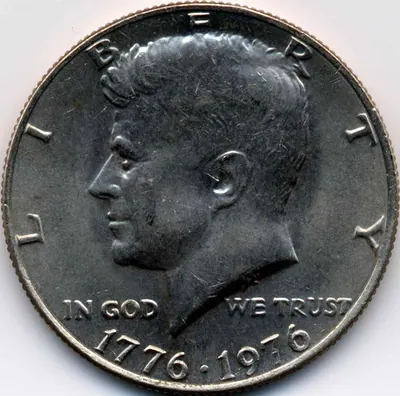
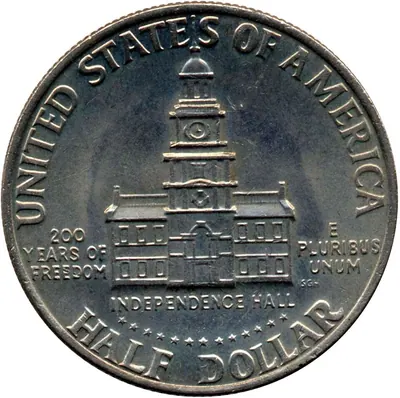
The 1776–1976 Bicentennial half dollar was struck by the hundreds of millions in copper-nickel clad. If yours came from change and has no mint mark or a D, it is worth 50 cents.
Three things make one worth more:
- An S mint mark in 40% silver. The San Francisco Mint struck silver-clad Bicentennial halves for collector sets, in uncirculated and proof finishes. Each holds 0.1479 troy ounces of silver. Uncirculated silver S halves have sold for $235 (PCGS MS66) to $376 (PCGS MS67) at Heritage.
- Exceptional grade. Perfect PR70 Deep Cameo proofs and top-grade business strikes bring premiums.
- Errors. Wrong-planchet, off-center and clipped Bicentennial halves sell to error collectors; a 1976-S silver error coin (PCGS MS64) brought $3,360 at Heritage in 2019.
How to identify your Bicentennial half
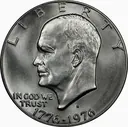
- Front: Kennedy portrait with the dual date 1776–1976.
- Back: Independence Hall instead of the eagle.
- Mint mark: on the obverse above the date. None = Philadelphia, D = Denver, S = San Francisco.
- Silver or clad (S coins only): look at the edge. Silver coins have a silvery edge; clad coins have a copper stripe. Silver coins weigh 11.5 g, clad coins 11.34 g.
Errors worth looking for
- Wrong planchet: a half that is quarter-sized and thin.
- Off-center strikes with the date still showing.
- Clipped planchets: a curved or straight bite missing from the rim.
- Doubled lettering: check the dual date and IN GOD WE TRUST under magnification. Most doubling on these coins is machine doubling, which does not add value.
Melt value
Clad Bicentennial halves have no silver. For a 40% silver S coin, melt value is 0.1479 troy ounces times the spot price.
How to check your coin with CoinLens
Photograph both sides with CoinLens. The app identifies whether you have the clad or silver version from its database, shows mint, composition and an instant value estimate, and saves it to your collection. CoinLens gives estimates; for a possible error or a flawless proof, ask PCGS or NGC to grade it.
Where to sell
Clad Bicentennial halves can be spent or deposited. Silver S coins sell to coin dealers; certified top-grade coins and errors sell best at Heritage, Stack’s Bowers, GreatCollections or on eBay.
Frequently asked questions
Is a 1776-1976 half dollar silver?
Usually not. Bicentennial halves from Philadelphia and Denver, the ones found in change, are copper-nickel clad. Only San Francisco (S) collector coins sold in special three-piece sets were struck in 40% silver.
How do I know if my Bicentennial half dollar is silver?
It must have an S mint mark. Then check the edge: a silver coin shows a solid silvery edge, while a clad S proof shows a copper stripe. A silver coin also weighs 11.5 g versus 11.34 g for clad.
Why does the half dollar say 1776-1976?
Coins struck in 1975 and 1976 carried the dual date and a special reverse to mark the 200th anniversary of American independence. No half dollars are dated 1975.
What is on the back of the Bicentennial half dollar?
Independence Hall in Philadelphia, designed by Seth G. Huntington, who won a public design competition.
Sources
- NGC Auction Central: 1976-S 50C silver MS (Heritage results)
- Kennedy half dollar mintage figures (Red Book data via Wikipedia)
- Kennedy half dollar (Bicentennial coinage, silver collector versions)
- PCGS CoinFacts: 1976-S 50C Silver
Values are estimates, not offers. Condition decides the price; for a valuable coin, get a professional grade.