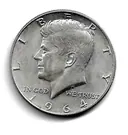
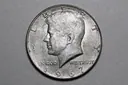
How Much Is a 1964-D Half Dollar Worth? (Kennedy Silver Value & Rare Grades)
A 1964-D Kennedy half dollar is 90% silver with 0.3617 troy oz of pure silver, so a circulated one is worth its melt value (live below). Only top-grade uncirculated coins bring real premiums; the record is $22,325 for a PCGS MS68, the only one graded that high.
Have one in hand? Scan it with CoinLens to identify it and see an estimate in seconds.
| Grade | Typical value | Notes |
|---|---|---|
| Circulated (G–AU) | $15.68 melt | Trades as silver bullion |
| Uncirculated (MS60–MS65) | Melt + modest premium | Common in original rolls |
| MS67 | About $370–$1,440 | PCGS MS67 sales at Heritage, 2019–2026 |
| MS68 (finest known) | $22,325 | PCGS MS68, Legend Rare Coin Auctions, Feb 2016 |
Which one is yours? Check it with CoinLens →
Estimates built from the cited auction records, not a price guide. Circulated value follows the silver spot price. Melt at silver $43.35/oz, November 26, 2026.
DEMO
Check your 1964 Kennedy Half Dollar
Add a photo of each side
Add a photo of at least one side first.
Demo — photos stay on your device. Nothing is uploaded.
DEMO
Your photos are ready. The identification happens in the CoinLens app.
On the web this is a demo — it can't recognize coins. In the app, the same two photos give you the coin's name, details and a value estimate.
Scan these in the free appEXAMPLE — what CoinLens shows
Value estimate:
Sample from our guide's data, not a result for your photo.
That was a sample. Scan your coin →·
Coin facts
- Coin
- Kennedy Half Dollar
- Years
- 1964
- Mints
- Denver (D)
- Composition
- 90% silver, 10% copper
- Weight
- 12.5 g
- Diameter
- 30.6 mm
- Silver (ASW)
- 0.3617 troy oz
- Melt value
- $15.68
- Designer
- Gilroy Roberts (obverse), Frank Gasparro (reverse)
Mintage
- 1964-D
- 156,205,446
| Variety | Grade | Sold | Venue, date |
|---|---|---|---|
| 1964-D quadrupled die obverse (FS-105) | PCGS MS65 | $224.95 and $224 | eBay, Sept 2026 and Aug 2024 |
| 1964-D doubled die obverse (FS-101) | PCGS MS65 | $140 | eBay, Aug 2025 |
| 1964-D doubled die obverse (FS-101) | PCGS MS64 | $159.95 | eBay, Feb 2025 |
| 1964-D tripled die obverse (FS-103) | NGC MS64 | $94 | Heritage, May 2026 |
| 1964-D tripled die obverse (FS-103) | NGC MS65 | $129 | eBay, Mar 2025 |
| 1964-D error coin (type not stated) | NGC MS62 | $2,400 | Heritage Error Coinage auction, Dec 2020 |
Which one is yours? Check it with CoinLens →
Sales recorded by PriceCharting and NGC Auction Central (see sources). Repunched 1964-D/D mint marks are also catalogued, but we found no cited sale. Not a price guide. Melt at silver $43.35/oz, November 26, 2026.
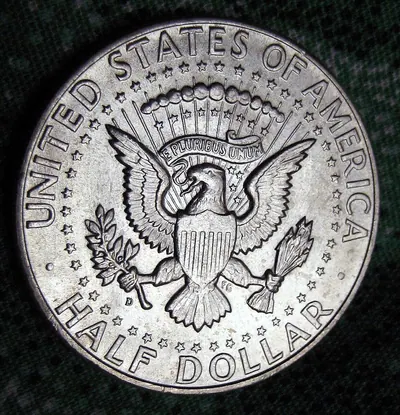
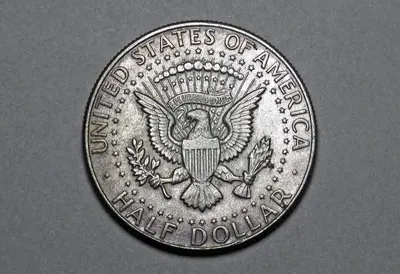
The 1964-D Kennedy half dollar is 90% silver, so its value starts at melt: 0.36169 troy ounces of pure silver multiplied by today’s spot price (calculated live below). With more than 156 million struck, worn and average uncirculated coins carry little premium beyond silver.
Premiums appear only in very high grades. A beautifully toned PCGS MS68, the only 1964-D graded that high, sold for $22,325 at Legend Rare Coin Auctions in February 2016, more than double its estimate.
How to identify a 1964-D
- Date: 1964, under Kennedy’s bust on the obverse.
- Mint mark: a small D on the reverse, left of the eagle’s tail feathers near the olive branch. Coins from 1968 onward carry the mint mark on the obverse instead, so a D on the back is a quick check for 1964.
- Silver check: the edge is solid silver-colored. A visible copper stripe means it is not a 1964 coin.
What makes a 1964-D worth more
- Grade. Full, undisturbed luster, a sharp strike and very few bag marks. Most 1964-D halves were stored loose in bags and show contact marks, which is why MS67 and higher coins are scarce.
- Toning. Attractive original rainbow toning, like the record MS68, can multiply value.
- Errors. Off-center strikes, clipped planchets and wrong-planchet strikes. Doubled die varieties exist but are minor and need magnification to confirm.
Denver struck the first Kennedy halves
The first Kennedy half dollars for circulation were struck at Denver on January 30, 1964, a week before Philadelphia; ceremonial first strikes followed at both mints on February 11. Demand was so intense that by late November 1964 about 160 million had been struck, yet they were rarely seen in change: people kept them as mementos and for their silver. To fight speculation, the Treasury got permission to keep striking 1964-dated coins into 1965. Nearly 430 million 1964-dated halves were made in all, more than every Franklin half dollar struck for circulation. That’s why 1964-D halves are so plentiful today.
No Accented Hair on a 1964-D
The famous Accented Hair variety, with extra hair lines above Kennedy’s ear, exists only on early 1964 proofs, and all 1964 proofs were struck at Philadelphia. A 1964-D therefore can’t be an Accented Hair coin, whatever a listing claims.
Die varieties to look for
The first table above lists the 1964-D varieties with real sales. Using a 5× loupe on the date and IN GOD WE TRUST, look for:
- Quadrupled die obverse (FS-105): the most dramatic; PCGS MS65 coins sold for about $224.
- Doubled die obverse (FS-101): PCGS MS64–MS65 examples brought $140–$160.
- Tripled die obverse (FS-103): NGC MS64–MS65 coins sold for $94–$129.
Error coins pay more: an NGC MS62 1964-D error brought $2,400 at a Heritage Error Coinage auction in December 2020.
The “hammer and sickle” story
When the coin came out, the Denver Mint received complaints that the truncation of Kennedy’s bust showed a hammer and sickle. Designer Gilroy Roberts explained it was his stylized GR monogram.
1964-D vs 1964 Philadelphia
Both are 90% silver with the same 0.3617 troy oz, so a worn 1964-D and a worn 1964 Philadelphia half are worth the same melt value. The differences show up only in high grades and varieties. Denver coins were struck in enormous numbers well into 1965, and with heavy use of dies, which is why so many doubled and tripled die varieties exist for the date. NGC Auction Central alone lists about 640 auction records for 1964-D halves, with an average grade of MS64: plenty of coins, but few truly gem ones.
Error coins
Major errors on a 1964-D are rare but real. Besides the $2,400 Heritage sale, a 1964-D struck on a five-cent planchet in PCGS MS64 has been offered at Heritage. A genuine wrong-planchet half is much smaller and lighter than normal and shows only part of the design; weigh any suspect coin and have it certified before pricing it.
Melt value
The calculator below uses 0.36169 troy ounces of silver per coin. A roll of 20 holds about 7.23 troy ounces.
Silver melt value calculator
Kennedy Half Dollar: 0.3617 troy oz of silver each
Melt value ($15.68 each)
Silver spot $43.35/oz as of November 26, 2026 (gold-api.com)
Melt value today for a pile, a roll or $ face value → Silver melt calculator
Melt value is the floor. Condition and mint details decide the rest — check yours in the app.
How to check your coin with CoinLens
Photograph both sides in CoinLens. The app identifies the coin, confirms the year, mint and silver composition, and gives an instant value estimate you can save to your collection. CoinLens values are estimates. For a coin that looks flawless or shows an obvious error, ask PCGS or NGC to grade it.
Where to sell
Circulated 1964-D halves sell to coin shops and bullion dealers at or near melt; compare offers. Certified high-grade coins and errors do best at specialist auctions (Heritage, Stack’s Bowers, GreatCollections) or on eBay with clear photos.
Frequently asked questions
Is a 1964-D half dollar silver?
Yes. It is 90% silver and 10% copper, the same as the Philadelphia 1964 half. It is the last Denver-minted 90% silver half dollar for circulation.
Where is the D on a 1964 half dollar?
On the reverse, to the left of the eagle’s tail and just above the gap between the eagle’s claw and the olive branch. It is small, so use a magnifier.
Is a 1964-D half dollar rare?
No. The Denver Mint struck 156,205,446 of them. Only coins in exceptional uncirculated condition (MS67 or better) are scarce.
What 1964-D half dollar errors are worth money?
Look for doubled die lettering, off-center strikes and coins struck on the wrong planchet. Any 1964-D half that is the wrong size, weight or color is worth checking with an error specialist.
Is there a 1964-D Accented Hair half dollar?
No. The Accented Hair variety exists only on early 1964 proofs, which were struck only at Philadelphia. A 1964-D is a business strike from Denver, so it can’t be an Accented Hair coin.
Were 1964-D half dollars struck in 1965?
Yes. To fight speculation during the coin shortage, the Treasury was allowed to keep striking 1964-dated coins into 1965. Nearly 430 million 1964-dated halves were made in all, more than every Franklin half struck for circulation.
What 1964-D half dollar varieties are worth money?
Doubled, tripled and quadrupled die obverses. A 1964-D quadrupled die (FS-105) in PCGS MS65 sold for about $224, and a doubled die (FS-101) for $140–$160 in MS64–MS65, in 2024–2026.
Sources
- NGC Auction Central: 1964-D 50C MS (Heritage results)
- Kennedy half dollar mintage figures (Red Book data via Wikipedia)
- Coin World: toned 1964-D Kennedy half in MS68 brings $22,325
- PCGS CoinFacts: 1964-D 50C
- Wikipedia: Kennedy half dollar (first strikes at Denver, frozen 1964 date, proof-only Accented Hair, monogram myth)
- PriceCharting: 1964-D FS-105 quadrupled die sales
- PriceCharting: 1964-D doubled die FS-101 sales
- PriceCharting: 1964-D FS-103 tripled die sales
Values are estimates, not offers. Condition decides the price; for a valuable coin, get a professional grade.