How Much Is a Walking Liberty Half Dollar Worth? (1916–1947 Values & Key Dates)
Walking Liberty half dollars (1916–1947) are 90% silver with 0.3617 troy oz each, so common worn dates sell for melt value (live below). The keys are the 1921, 1921-D and 1921-S: a 1921-S in MS65 sold for $88,920 and a 1921-D in MS66 for $40,950 (Bonhams, 2017).
Have one in hand? Scan it with CoinLens to identify it and see an estimate in seconds.
| Coin | Worn / common | Notable sales | Notes |
|---|---|---|---|
| 1940s common dates | $15.68 melt | — | Most often found; trade as silver |
| 1916-S | Premium | PCGS MS66 $52,800 (Heritage FUN, Jan 2023); PCGS MS65 $5,760–$8,400 (2021–2023) | Mint mark on obverse |
| 1921 | Premium | — | 246,000 struck |
| 1921-D | Premium | PCGS MS63+ CAC $16,200 (Stack’s Bowers, Mar 21 2023); NGC MS66 $40,950 (Bonhams, Sep 5 2017) | Lowest mintage, 208,000 |
| 1921-S | Premium | PCGS MS65 $88,920 (Bonhams, Sep 5 2017) | Rarest in high grades |
| 1938-D | Premium | — | Lowest-mintage late date, 491,600 |
Which one is yours? Check it with CoinLens →
Estimates from the cited auction reports, not a price guide. Key dates carry premiums even when worn; check recent sold results for your grade. Melt at silver $43.35/oz, November 26, 2026.
DEMO
Check your 1916–1947 Walking Liberty Half Dollar
Add a photo of each side
Add a photo of at least one side first.
Demo — photos stay on your device. Nothing is uploaded.
DEMO
Your photos are ready. The identification happens in the CoinLens app.
On the web this is a demo — it can't recognize coins. In the app, the same two photos give you the coin's name, details and a value estimate.
Scan these in the free appEXAMPLE — what CoinLens shows
Value estimate:
Sample from our guide's data, not a result for your photo.
That was a sample. Scan your coin →·
Coin facts
- Coin
- Walking Liberty Half Dollar
- Years
- 1916–1947
- Mints
- Philadelphia (no mint mark), Denver (D), San Francisco (S)
- Composition
- 90% silver, 10% copper
- Weight
- 12.5 g
- Diameter
- 30.6 mm
- Silver (ASW)
- 0.3617 troy oz
- Melt value
- $15.68
- Designer
- Adolph A. Weinman
Mintage
- 1916-S
- 508,000
- 1921
- 246,000
- 1921-D
- 208,000
- 1921-S
- 548,000
- 1938-D
- 491,600
| Issue | Mint mark on obverse | Mint mark on reverse |
|---|---|---|
| 1917-D | 765,400 | 1,940,000 |
| 1917-S | 952,000 | 5,554,000 |
Which one is yours? Check it with CoinLens →
Mintages from CoinWeek. On early 1917 coins the mint mark sat on the front below IN GOD WE TRUST; it was moved to the back because it looked like a die defect and was 'entirely too prominent'. Melt at silver $43.35/oz, November 26, 2026.
| Coin | Grade | Sold | Venue, date |
|---|---|---|---|
| 1919-D | PCGS MS66 | $270,250 | Heritage, Nov 2004 |
| 1919-D | PCGS MS66 | $253,000 | Heritage, Apr 2009 |
| 1917-S obverse mint mark | PCGS MS67 | $152,750 | Heritage, Aug 2015 |
| 1919-D | PCGS MS65 | $114,000 | Heritage, Sept 2020 |
| 1921-S | PCGS MS65 | $117,500 | Heritage, Aug 2015 |
| 1921-D | PCGS MS65 | $46,360 | Heritage, Mar 2026 |
Which one is yours? Check it with CoinLens →
Prices include the buyer's fee, from NGC Auction Central's top-ten results and 1921-D page. These are gem-condition records; circulated key dates sell for far less. Melt at silver $43.35/oz, November 26, 2026.
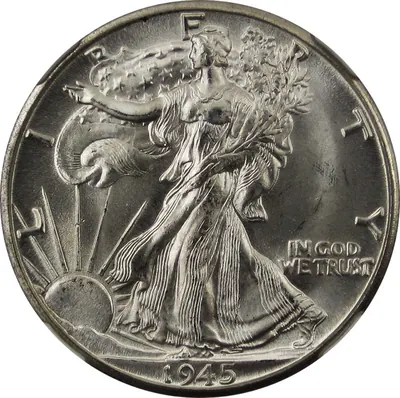
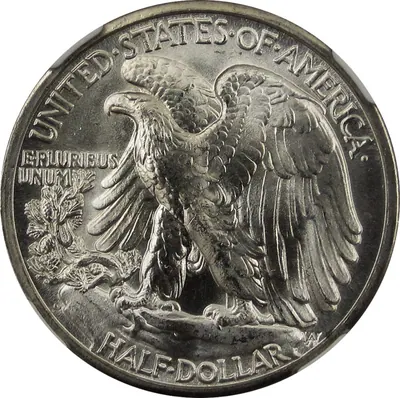
The Walking Liberty half dollar was struck from 1916 to 1947 in 90% silver. Common dates, especially the 1940s coins found most often, are worth their silver melt value when worn (0.36169 troy ounces; see the live calculator below).
Key dates are worth far more, even in low grades:
- 1921-S: rarest in high grades. A PCGS MS65 sold for $88,920 at Bonhams on September 5, 2017.
- 1921-D: lowest mintage of the series (208,000). An NGC MS66 brought $40,950 at the same 2017 Bonhams sale; a PCGS MS63+ CAC sold for $16,200 at Stack’s Bowers in March 2023.
- 1916-S: first-year San Francisco issue with the mint mark on the front; a PCGS MS66 sold for $52,800 at Heritage in January 2023.
- 1921 (Philadelphia, 246,000) and 1938-D (491,600).
How to identify your Walking Liberty half
- Date: at the bottom of the obverse, under Liberty’s feet.
- Mint mark: for 1916 and some 1917 coins, on the obverse below IN GOD WE TRUST. From 1917 on, on the reverse at the lower left, under the pine branch near the rim. No mint mark = Philadelphia.
- Condition clues: on uncirculated coins, Liberty’s left hand and head details and the lines of her skirt are sharp. Wear shows first on her head, hand and the eagle’s breast.
Varieties and errors
- 1917-D and 1917-S, obverse vs. reverse mint mark: both positions exist for 1917 and are collected as separate varieties. Check where the D or S sits.
- Weak strikes: many 1940s branch-mint coins are softly struck. A fully struck head and hand earns a premium.
- Errors: off-center strikes, clipped planchets and doubled dies exist but are uncommon.
How the design was chosen
Mint Director Robert W. Woolley, who took office in 1915, believed the law required new designs once the Barber coins had been in use for 25 years. The Commission of Fine Arts rejected Charles Barber’s own sketches and invited three sculptors: Adolph Weinman, Hermon MacNeil and Albin Polasek. After talks between Woolley and Treasury Secretary William G. McAdoo, Weinman was told on February 28, 1916 that he had won both the dime and the half dollar; MacNeil got the quarter. McAdoo described Weinman’s Liberty “progressing in full stride toward the dawn of a new day,” with the eagle perched on a mountain crag beside a mountain-pine sapling, “symbolical of America.” The New York Sub-Treasury began paying out the new halves on January 9, 1917, two to a customer.
The 1917 mint mark move
When the first branch-mint coins appeared, the mint mark was on the front, below IN GOD WE TRUST. It was the first time since 1839 that a regular half dollar carried its mint mark on the obverse. Former Mint Director F.J.H. von Engelken objected that it “had the appearance of a defect in the die” and was “entirely too prominent,” and the order went out in 1917 to move it to the back. That created two versions of the 1917-D and 1917-S, shown in the first table above. The obverse-mint-mark coins are much scarcer, and a 1917-S of that type in PCGS MS67 sold for $152,750.
Why sharp strikes are scarce
The design “never struck very well,” and it may be one reason the Franklin half replaced it in 1948. High-relief areas sit opposite each other on the two sides, so metal didn’t fill both fully: weakness shows on Liberty’s left hand and leg and on the eagle’s breast and leg feathers. San Francisco coins are noticeably weaker. Die changes in 1918 and 1937–38 helped little. Most 1921-S halves are soft at the head and right hand, and sharply struck examples are scarce, one reason only about 150–210 Mint State 1921-S coins survive and only one PCGS MS66 is known.
From 1947 to the Silver Eagle
Mint Director Nellie Tayloe Ross had John R. Sinnock design the Franklin half, which replaced the Walker from 1948. The design came back in 1986 as the obverse of the American Silver Eagle, with detail strengthened by John Mercanti because Weinman’s original plaster was only six inches across. In 2016 the Mint marked the centennial with a half-ounce gold Walking Liberty from West Point.
Melt value
Each coin contains 0.36169 troy ounces of silver. The calculator below shows today’s value.
Silver melt value calculator
Walking Liberty Half Dollar: 0.3617 troy oz of silver each
Melt value ($15.68 each)
Silver spot $43.35/oz as of November 26, 2026 (gold-api.com)
Melt value today for a pile, a roll or $ face value → Silver melt calculator
Melt value is the floor. Condition and mint details decide the rest — check yours in the app.
How to check your coin with CoinLens
Photograph both sides in CoinLens. The app identifies date and mint from its database, shows composition and silver content, and gives an instant value estimate you can save to your collection. CoinLens gives estimates. Key dates are counterfeited; for any 1916-S, 1921, 1921-D, 1921-S or 1938-D, get authentication and grading from PCGS or NGC before selling.
Where to sell
Common worn Walkers sell to coin shops by silver value. Key dates and uncirculated coins do best at Heritage, Stack’s Bowers, GreatCollections or with a reputable dealer after certification.
Frequently asked questions
Are Walking Liberty half dollars silver?
Yes. Every Walking Liberty half from 1916 to 1947 is 90% silver and 10% copper, with 0.36169 troy ounces of pure silver.
Where is the mint mark on a Walking Liberty half dollar?
On 1916 and some 1917 coins it is on the obverse, below IN GOD WE TRUST. From 1917 onward it is on the reverse, at the lower left near the rim, under the pine branch. Philadelphia coins have no mint mark.
What are the key dates for Walking Liberty halves?
The 1916-S, 1921, 1921-D and 1921-S, plus the 1938-D among later dates. The 1921-D has the lowest mintage at 208,000.
Why are the 1940s Walking Liberty halves worth so little?
They were struck in large numbers and many survive, so worn examples trade close to their silver value. Uncirculated coins with full detail on Liberty’s hand and head still bring premiums.
Is the Walking Liberty design still used?
Yes. Weinman’s Walking Liberty obverse is used on the American Silver Eagle bullion coin, first issued in 1986.
Who designed the Walking Liberty half dollar?
Adolph A. Weinman, who won a 1916 invitational competition against Hermon MacNeil and Albin Polasek; MacNeil’s design became the Standing Liberty quarter. Treasury Secretary William McAdoo described Liberty ‘progressing in full stride toward the dawn of a new day’.
Where is the mint mark on a 1917 Walking Liberty half?
It can be on either side. Early 1917-D and 1917-S coins have it on the front, below IN GOD WE TRUST; it was then moved to the back, at the lower left below the tree. The obverse versions are scarcer: 765,400 1917-D and 952,000 1917-S.
What is the most valuable Walking Liberty half?
Gem key dates. A 1919-D in PCGS MS66 sold for $270,250 at Heritage in 2004, and a 1917-S with the obverse mint mark in PCGS MS67 for $152,750 in 2015.
Sources
- Walking Liberty half dollar (history, designer, scarcity)
- Coin World: 1921-S Walking Liberty half tops Bonhams auction
- Coin World: 1921-D half in MS-63+ brings $16,200
- PCGS CoinFacts: 1921-D 50C (mintage 208,000)
- PCGS CoinFacts: 1921-S 50C
- NGC Auction Central: 1916-S 50C MS (Heritage and Stack's Bowers results)
- Numismatic News: some years only S Walkers struck (1916-S, 1921-S mintages)
- APMEX: Walking Liberty half dollars key dates (1921-S, 1938-D mintages)
- Wikipedia: Walking Liberty half dollar (competition, mint mark move, strike problems, proofs, revival)
- CoinWeek: Why was the mintmark moved on Walking Liberty half dollars? (1917 mintages)
- CoinWeek: Two Mint letters solve the 1917 half dollar mintmark mystery
- CoinWeek: Walking Liberty half dollar, 1916–1947 (strike weakness, mintage range)
- CoinWeek: 1921-S Walking Liberty half dollar, the undisputed key
- NGC Auction Central: top ten Walking Liberty half dollar results
- NGC Auction Central: 1921-D 50C MS
Values are estimates, not offers. Condition decides the price; for a valuable coin, get a professional grade.