How Much Is an 1856 Flying Eagle Cent Worth? (Values, Records & Fakes)
A genuine 1856 Flying Eagle cent is a rare pattern: even worn coins have sold for about $7,800–$12,400, and PR63–PR64 coins for $15,000–$33,600. The proof record is $312,000 for a PCGS PR67+ CAC Snow-3 (Heritage, November 2024). Most raw 1856 cents are altered 1858s.
Have one in hand? Scan it with CoinLens to identify it and see an estimate in seconds.
| Coin | Sold for | Where / when |
|---|---|---|
| PF VF20 (NGC) | $7,800 | Stack’s Bowers, Aug 2021 |
| PF XF45 (PCGS) | $11,400 | Heritage, Jul 2018 |
| PF AU53 (PCGS) | $12,408 | Heritage, Feb 2017 |
| PR63 (PCGS), Snow-9 | $15,000–$21,600 | Heritage, 2025 |
| PR64 (PCGS), Snow-9 | $21,350–$29,890 | Heritage, 2026 |
| PR65 (PCGS, CAC), Snow-9 | $51,240 | Heritage, Jul 2026 |
| MS66 (PCGS), Snow-3, business strike | $192,000 | Heritage, Nov 2024 |
| PR67+ (PCGS, CAC), Snow-3 — record (proof) | $312,000 | Heritage, Nov 21, 2024 |
Which one is yours? Check it with CoinLens →
Individual Heritage and Stack's Bowers results listed by NGC Auction Central and PriceCharting, plus the two Nov 2024 sales reported by Coin World (sources below). Grades and die varieties change prices a lot; reference points, not a price guide.
DEMO
Check your 1856 (pattern); regular issue 1857–1858 Flying Eagle Cent
Add a photo of each side
Add a photo of at least one side first.
Demo — photos stay on your device. Nothing is uploaded.
DEMO
Your photos are ready. The identification happens in the CoinLens app.
On the web this is a demo — it can't recognize coins. In the app, the same two photos give you the coin's name, details and a value estimate.
Scan these in the free appEXAMPLE — what CoinLens shows
Value estimate:
Sample from our guide's data, not a result for your photo.
That was a sample. Scan your coin →·
Coin facts
- Coin
- Flying Eagle Cent
- Years
- 1856 (pattern); regular issue 1857–1858
- Mints
- Philadelphia (no mint mark)
- Composition
- 88% copper, 12% nickel
- Weight
- 4.67 g
- Diameter
- 19 mm
- Designer
- James B. Longacre
Mintage
- 1856 (estimates vary)
- At least 634 distributed (Wikipedia: possibly several thousand); Coin World: around 1,500
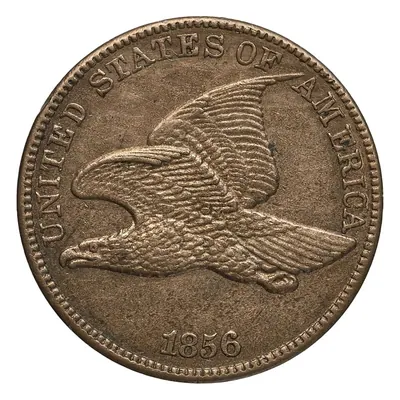
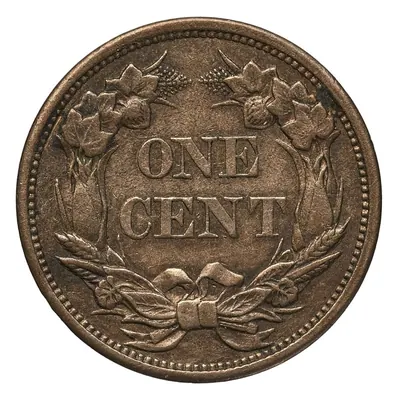
The 1856 Flying Eagle cent is the key to the Flying Eagle series and one of the most famous American cents. It is really a pattern: the Mint struck it in late 1856 to show Congress the proposed small copper-nickel cent, before the coin was authorized in February 1857.
- Worn coins: about $7,800–$12,400 (NGC PF VF20 $7,800, Stack’s Bowers, 2021; PCGS PF XF45 $11,400 and PF AU53 $12,408, Heritage, 2017–2018).
- PR63–PR64: about $15,000–$33,600 in Heritage sales from 2024 to 2026; a PCGS PR65 CAC brought $51,240 in July 2026.
- Business strike: a PCGS MS66 Snow-3 sold for $192,000 at Heritage on November 21, 2024; an MS66 had brought $172,500 back in 2004.
- Record: $312,000 for a PCGS PR67+ CAC Snow-3 at the same November 2024 Heritage sale, beating the previous $240,000 Heritage mark (2020).
How many 1856 Flying Eagle cents were made?
No official figure exists. At least 634 were distributed to congressmen and officials, starting in November 1856, and the Mint later struck more to sell to collectors and to trade for coins it wanted for its cabinet. Wikipedia says possibly several thousand were made; Coin World puts it at around 1,500. Compare that with the 17,450,000 Flying Eagle cents struck for circulation in 1857.
How to identify a genuine 1856 cent
- Date: altered 1858 cents (rarely 1857s) are the most common fake, as Walter Breen and NGC both note. On a genuine 1856, the 5 has a long top bar that tapers to a sharp point; on 1858 cents the bar is shorter with a rounded tip.
- AM in AMERICA: every 1856 cent has the A and M of AMERICA close together. If they are separated, the coin was altered from an 1858 Small Letters cent.
- Color and weight: the coin is copper-nickel, so it is pale tan-brown, not the orange of a bronze cent, and weighs about 4.67 grams (72 grains).
- No mint mark: every Flying Eagle cent was struck at Philadelphia.
Because of fakes, nearly every 1856 cent that sells for real money is certified by PCGS or NGC. Treat an uncertified 1856 as suspect until it is authenticated.
Proof vs. business strike, and Snow varieties
Both proof and business-strike 1856 cents exist, and some circulated, which is why worn coins turn up. Grading services attribute the die pairs by Snow number (from Richard Snow’s references). Snow-3 is tied to the presentation pieces and dominates the records above; Snow-9 is another pairing often seen at auction.
Check, grade and sell
The coin is 88% copper and 12% nickel and weighs 4.67 grams, so its metal is worth only a few cents. Photograph both sides with CoinLens (Coin Identifier - CoinLens on the App Store) for an ID and value estimate, then see our coin grading guide and where to sell coins. See also our Indian Head penny value guide.
Frequently asked questions
Why is the 1856 Flying Eagle cent so valuable?
It was struck before Congress authorized the small cent, as a pattern to show lawmakers the new copper-nickel coin. Only a small number were made: at least 634 were distributed, possibly several thousand per Wikipedia, and Coin World puts production at around 1,500, while the 1857 and 1858 regular issues were struck by the millions.
Is my 1856 Flying Eagle cent real?
Probably not, if it came from a pocket or a raw lot. The most common fake is an 1858 cent with the date altered. Check that the 5 has a long, pointed top bar and that the A and M in AMERICA sit close together, and have the coin authenticated by PCGS or NGC before buying or selling.
Is the 1856 Flying Eagle cent a proof or a business strike?
Both are found. PCGS and NGC certify proof and business-strike (regular finish) examples, and some entered circulation, so worn coins exist. The grading services attribute them by Snow die variety, such as Snow-3 and Snow-9.
What is a Snow-3 or Snow-9 1856 cent?
Snow numbers are die-pair attributions from Richard Snow’s Flying Eagle and Indian cent references. Snow-3, with a repunched 5 in the date, is the variety tied to the 1856 presentation pieces and is the one most often seen in sales; Snow-9 is another common pairing.
What did the 1856 Flying Eagle cent sell for when it was new?
When collectors learned of it, 1856 small cents were selling for as much as $2 each by 1859, according to Richard Snow’s history of the series.
Sources
- Wikipedia: Flying Eagle cent (history, alloy, 72-grain weight, 634 distributed, $172,500 MS66 sale)
- Coin World: Record-setting Flying Eagle cent sold at Heritage ($312,000 PR67+ CAC; $192,000 MS66; around 1,500 produced)
- NGC Auction Central: 1856 Flying Eagle 1C PF auction results (VF–AU and PF64–65 sales)
- PriceCharting: 1856 Flying Eagle cent proof sold listings (Heritage PR62–PR65 sales 2024–2026)
- Heritage lot 1378-3630: 1856 1C Snow-3 PR67 PCGS CAC (presentation-piece notes)
- Heritage lot 1394-26098: 1856 1C Snow-3 PR40 PCGS (Guide Book mintage estimate)
- NGC: Counterfeit Detection — Altered Date Flying Eagle Cent
- Numismatic News: Check Flying Eagle dates for alterations
- PCGS CoinFacts: 1856 1C Flying Eagle (Proof)
Values are estimates, not offers. Condition decides the price; for a valuable coin, get a professional grade.