How Are Coins Graded? The 1–70 Sheldon Scale Explained
Coins are graded on the Sheldon scale from 1 to 70: 1–58 are circulated grades (Poor through About Uncirculated) and 60–70 are Mint State, meaning no wear. Grade drives price — an 1881-S Morgan dollar sells for about $200 in MS65 but realized $6,600 in MS68+.
Have one in hand? Scan it with CoinLens to identify it and see an estimate in seconds.
| Grade band | Numbers | Abbreviation | What you'll see |
|---|---|---|---|
| Poor / Fair / About Good | 1–3 | PO, FR, AG | Worn nearly smooth; type identifiable, date may be partly gone |
| Good | 4–6 | G | Outline of the design and rims visible, most detail flat |
| Very Good | 8–10 | VG | Major design elements clear, fine detail mostly gone |
| Fine | 12–15 | F | Even, moderate wear; all lettering readable |
| Very Fine | 20–35 | VF | Wear only on the high points; most fine detail present |
| Extremely Fine | 40–45 | EF / XF | Light wear on the highest points, sharp detail |
| About Uncirculated | 50–58 | AU | Just a trace of wear; much of the original mint luster remains |
| Mint State | 60–70 | MS (PR/PF for proofs) | No wear at all; grade set by marks, luster, strike and eye appeal |
Which one is yours? Check it with CoinLens →
Numbers follow the modern adaptation of Dr. William Sheldon's 1949 scale used by the ANA and the major grading services. Grading involves judgment; two experts can differ by a point.
DEMO
Check your How Are Coins Graded? The 1–70 Sheldon Scale Explained
Add a photo of each side
Add a photo of at least one side first.
Demo — photos stay on your device. Nothing is uploaded.
DEMO
Your photos are ready. The identification happens in the CoinLens app.
On the web this is a demo — it can't recognize coins. In the app, the same two photos give you the coin's name, details and a value estimate.
Scan these in the free appEXAMPLE — what CoinLens shows
Value estimate:
Sample from our guide's data, not a result for your photo.
That was a sample. Scan your coin →·
| Grade | Result | Source |
|---|---|---|
| NGC MS65 (typical) | about $200 | Coin World, April 2022 |
| NGC MS65 with gold CAC sticker, vintage holder | $5,040 (Heritage, March 7, 2022) | Coin World, April 2022 |
| MS68+ | $6,600 (June 2021 sale) | Coin World, April 2022 |
Which one is yours? Check it with CoinLens →
Same date and mint, different grades. NGC had graded 58,269 examples in MS65 and 4,811 in MS67 as of Coin World's 2022 report, which is why the top grades command a premium.
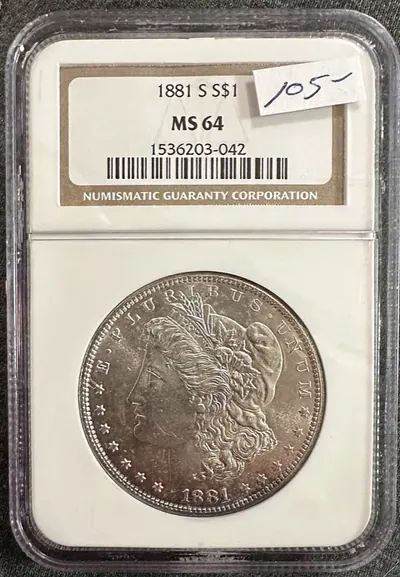
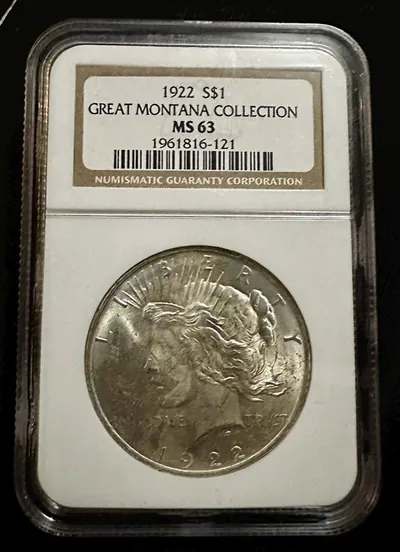
US coins are graded on a 1-to-70 scale. Numbers 1 through 58 describe circulated coins, from barely identifiable (1) to almost uncirculated (58). Numbers 60 through 70 are Mint State — coins that never wore in circulation — where the grade depends on marks, luster, strike and eye appeal. A letter prefix tells you the band: G (Good), VG, F, VF, EF/XF, AU, MS, and PR or PF for proofs.
The scale comes from Dr. William H. Sheldon, who published it in 1949 to price early American large cents. The American Numismatic Association adapted it for all US coins in the 1970s, and today’s grading services use that adapted version.
Why the grade changes the price so much
For a coin that exists in large numbers, condition is almost the whole story. The 1881-S Morgan dollar is the most common Mint State Morgan: Coin World reported that typical NGC MS65 examples sell for about $200, while an MS68+ example realized $6,600 in June 2021. One grade point at the top of the scale can multiply the price; one point lower on a common circulated coin barely matters.
How to estimate a grade at home
You need a 5x–10x magnifier, a single bright lamp and a few minutes. Hold the coin by its edge.
- Find the high points. These are the parts that wear first: cheekbones and hair above the ear on portraits, the breast feathers on eagles, the top of Monticello on nickels.
- Decide: worn or not worn? Tilt the coin under the light. Wear shows as a dull, flattened patch that breaks the luster. If any high point is worn, the coin is 58 or below.
- For circulated coins, judge how much detail survives. Is the lettering complete (Fine or better)? Are fine lines like hair strands visible (Very Fine)? Is wear limited to a trace on the highest points (Extremely Fine / About Uncirculated)?
- For uncirculated coins, count distractions. Bag marks, scratches and dull spots pull an MS coin toward 60–63; clean, lustrous surfaces with a full strike push it toward 65 and above.
- Check for problems. Cleaning, scratches, holes, bends and corrosion don’t fit on the numeric scale. Grading services label these coins “Details” and they sell at a discount.
Be conservative. Most people grade their own coins one or two points higher than a professional would.
Professional grading: PCGS and NGC
The two largest services, PCGS (operating since February 1986) and NGC (founded 1987), authenticate a coin, assign a Sheldon grade and seal it in a tamper-evident plastic holder (a “slab”). The grade is printed on the label with a certification number you can look up online.
NGC’s published 2025 fees start at $20 per coin (Modern tier, for newer coins) and $25 (Economy tier), plus membership and shipping; PCGS publishes a similar schedule, and fees rise with the coin’s value. Grading makes sense when the coin is likely worth clearly more in a holder than raw — key dates, silver and gold in high grades, and suspected errors.
How to check your coin with CoinLens
Before you pay for grading, find out what you have. Photograph the front and back with Coin Identifier – CoinLens (iOS): it identifies the coin from a database of almost 500,000 coins and gives an instant value estimate, plus composition and mintage years. CoinLens doesn’t assign a grade, so use the steps above to estimate condition, then send anything potentially valuable to PCGS or NGC. Free use is limited; Premium unlocks unlimited scans. Get CoinLens on the App Store.
Where to sell graded coins
Graded coins are easiest to sell because buyers can trust the grade without seeing the coin: dealers, major auction houses and online marketplaces all accept them. See where to sell coins for the trade-offs of each option.
Frequently asked questions
What is the highest coin grade?
MS70 (or PR70 for proofs): a coin with no visible post-production imperfections. It’s common for modern bullion and proof coins and essentially unknown for older circulated issues.
What does MS63 mean?
Mint State 63: an uncirculated coin with no wear but noticeable contact marks or a less-than-ideal strike or luster. ‘Choice Uncirculated’ is the usual description.
Can I grade my own coins?
You can estimate a grade range at home with a 5x–10x loupe and good light, especially for circulated coins. For valuable coins, sellers and buyers rely on PCGS or NGC grades because the grade is guaranteed and the coin is sealed.
Is it worth getting a coin graded?
Usually only when the coin is worth clearly more than the grading cost plus shipping. NGC’s published 2025 entry fees were $20 per coin (Modern tier) and $25 (Economy tier), before membership and shipping; PCGS publishes a comparable schedule. Common-date circulated coins rarely justify it.
What is the difference between PCGS and NGC?
Both are major third-party grading companies that authenticate, grade and seal coins in tamper-evident holders. PCGS began grading in February 1986; NGC was founded in 1987. Both are widely accepted by dealers and auction houses.
Should I clean a coin before grading?
No. Cleaning leaves hairline scratches and unnatural color that graders detect; cleaned coins usually receive a ‘details’ grade instead of a numeric grade and sell for much less.
Sources
- Sheldon coin grading scale (Wikipedia)
- Market Analysis: Strong market for vintage slabs — 1881-S Morgan prices and NGC census (Coin World, April 2022)
- PCGS Collector Services & Fees
- NGC Announces Revised Services and Fees for 2025
- PCGS 40th anniversary — began operations February 3, 1986
- Numismatic Guaranty Company (Wikipedia)
Values are estimates, not offers. Condition decides the price; for a valuable coin, get a professional grade.