How Much Is a Half Cent Worth? (1793–1857 Values by Type & Key Dates)
A common half cent from the 1850s sells for about $80–$370 depending on wear, and certified VF Classic Head or Draped Bust coins for $120–$480 (eBay, 2026). The first-year 1793 is the prize: PCGS F12–VF20 coins sold for $10,552–$14,404. Half cents were made from 1793 to 1857.
Have one in hand? Scan it with CoinLens to identify it and see an estimate in seconds.
| Coin | Raw (uncertified) | Certified sales | Notes |
|---|---|---|---|
| 1851 Braided Hair | $84–$235 (VF to AU, Oct–Nov 2026) | — | Common late date |
| 1857 Braided Hair (last year) | $81–$367 (Oct–Nov 2026) | — | 35,180 struck |
| 1828 Classic Head | — | $120–$200 (NGC/ANACS VF20–VF35, 2026) | Common Classic Head date |
| 1804 Draped Bust | — | $295–$480 (PCGS/NGC/ANACS VF20–VF35, 2026) | Highest mintage, many varieties |
| 1793 Liberty Cap (head left) | — | $3,950 (PCGS Fair-2 CAC, 2025); $5,500–$6,000 (VG8, 2023); $10,552 (F12, 2026); $14,404 (VF20, 2026) | First year; 35,334 struck |
| 1796 | — | No genuine sale found | Only 1,390 struck; electrotype copies are sold |
Which one is yours? Check it with CoinLens →
Completed eBay sales recorded by PriceCharting, November 2026. Individual sales, not a price guide. Corrosion, holes and cleaning lower value sharply.
DEMO
Check your 1793–1857 United States half cent
Add a photo of each side
Add a photo of at least one side first.
Demo — photos stay on your device. Nothing is uploaded.
DEMO
Your photos are ready. The identification happens in the CoinLens app.
On the web this is a demo — it can't recognize coins. In the app, the same two photos give you the coin's name, details and a value estimate.
Scan these in the free appEXAMPLE — what CoinLens shows
Value estimate:
Sample from our guide's data, not a result for your photo.
That was a sample. Scan your coin →·
Coin facts
- Coin
- United States half cent
- Years
- 1793–1857
- Mints
- Philadelphia (no mint mark)
- Composition
- Copper
- Diameter
- 23.5 mm
Mintage
- 1793 (Liberty Cap left)
- 35,334
- 1796 (rarest regular date)
- 1,390
- 1804 (highest)
- 1,055,312
- 1857 (last year)
- 35,180
| Date | Mintage | Raw sold range | Note |
|---|---|---|---|
| 1800 Draped Bust | 202,908 | $27–$162 (Oct–Nov 2026) | First Draped Bust year |
| 1806 Draped Bust | 356,000 | $18.50–$223.70 (Nov 2026) | Small 6 and Large 6 varieties |
| 1809 Classic Head | 1,154,572 | $15.85–$79.99 (Nov 2026) | Highest half cent mintage |
| 1811 Classic Head | 63,140 | $54.88–$875 (Sep–Nov 2026) | Key date; Cohen (C-) variety matters |
| 1835 Classic Head | 398,000 | $35.99–$239.98 (Nov 2026) | Common later Classic Head |
| 1853 Braided Hair | 129,694 | $72.85–$449.95 (Nov 2026) | Uncirculated coins at the top |
| 1855 Braided Hair | 56,500 | $62–$570 (Oct–Nov 2026) | $570 for a red-brown gem |
Which one is yours? Check it with CoinLens →
Completed eBay sales recorded by PriceCharting; raw coins in mixed grades as described by sellers. Individual sales, not a price guide. Mintages from Wikipedia.
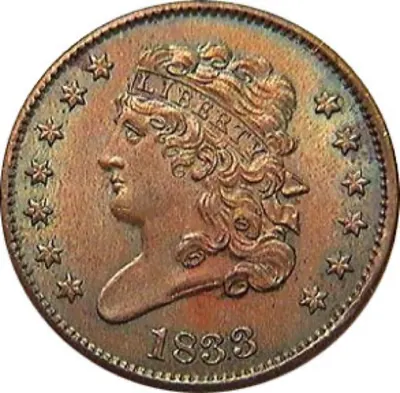
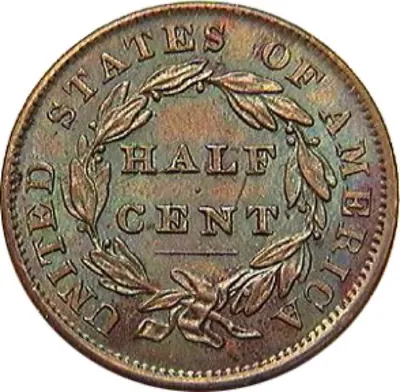
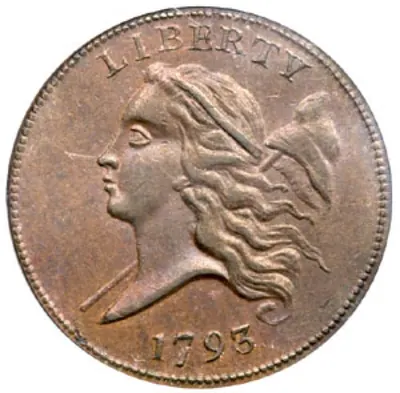
Every genuine half cent is worth well over face value. The half cent was the smallest US coin ever made, struck at Philadelphia from 1793 to 1857 (Wikipedia). Typical recent sales:
- Common 1850s Braided Hair dates: about $80–$370 raw, depending on wear (eBay, 2026).
- Certified VF Classic Head and Draped Bust coins: about $120–$480 (1828 and 1804, 2026).
- 1793, the first year: $3,950 in Fair-2 up to $14,404 in VF20.
Half cent types and how to tell them apart
| Type | Years | How to recognize it |
|---|---|---|
| Liberty Cap, facing left | 1793 | Liberty faces left with a cap on a pole |
| Liberty Cap, facing right | 1794–1797 | Liberty faces right with a cap on a pole |
| Draped Bust | 1800–1808 | Drapery at the neckline, hair tied with a ribbon |
| Classic Head | 1809–1836 | Headband reading LIBERTY, 13 stars around |
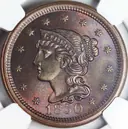
| Braided Hair | 1840–1857 | Hair in a bun with beaded cords |
Look for HALF CENT inside a wreath and the fraction 1/200 on the back. Early coins (1793, 1794, some 1795 and 1797) have the edge lettered TWO HUNDRED FOR A DOLLAR (Wikipedia).
Half cent key dates
- 1793: the only Liberty-facing-left year; 35,334 struck.
- 1796: the rarest regular date, just 1,390 struck. Electrotype copies of the 1796 No Pole variety are sold online (PriceCharting shows one).
- 1802: 20,266 struck.
- 1811: 63,140 struck.
- 1831: 2,200 struck.
- 1836, 1840–1848, 1852: proof-only years and later restrikes; not found in circulation.
A short history of the half cent
The half cent was authorized by the Coinage Act of 1792, alongside the large cent, and first struck in 1793. It was pure copper and worth one two-hundredth of a dollar. That’s why early coins carry the fraction 1/200 and some have the edge lettering TWO HUNDRED FOR A DOLLAR. It was slightly smaller than a modern quarter: 22 mm in 1793, 23.5 mm from 1794 to 1836 and 23 mm from 1840. Every half cent was struck at Philadelphia, so none has a mint mark (Wikipedia).
Production was patchy. The Mint skipped many years entirely, made the 1836 and the 1840–1849 coins only as proofs (with later restrikes), and struck no half cents at all in 1837, when private businesses issued half-cent tokens to fill the gap. The Coinage Act of 1857 ended the half cent and the large cent together and introduced the small Flying Eagle cent (Wikipedia).
Reading mintages: which dates are scarce
Half cent mintages swing enormously from year to year:
- Big years: 1809 (1,154,572) and 1804 (1,055,312) were the only years over a million. These are the most affordable early half cents; a worn 1809 sold for as little as $15.85 on eBay in November 2026.
- Small years: 1796 (1,390), 1831 (2,200), 1802 (20,266), 1793 (35,334), 1825 (63,000) and 1811 (63,140).
- Late Braided Hair dates: 1849 to 1857 run from about 35,000 to 148,000, and recent raw sales of 1853 and 1855 coins ran from about $62 to $570 (table above).
The 1811 shows how much condition and variety matter: raw coins sold anywhere from $54.88 to $875 between September and November 2026, depending on wear and on the Cohen (C-) die variety that specialists attribute.
Missing years are normal. Wikipedia’s mintage list shows no half cents dated 1798–1799, 1801, 1812–1824, 1827 or 1830, and only proofs or restrikes for 1836, 1840–1848 and 1852. A worn coin that seems to read one of those dates is more likely a misread date or a copy. Check it against the type table above before getting excited.
Edges and early varieties
Most half cents have plain edges. The 1793, 1794 and some 1795 coins, and one 1797 variety, have the lettered edge TWO HUNDRED FOR A DOLLAR; another 1797 variety has a gripped (milled) edge (Wikipedia). Early copper specialists collect half cents by die variety, so an unusual edge or date style can be worth a closer look.
Condition matters
Half cents circulated hard and many are corroded, holed or cleaned. A smooth, evenly brown coin with a clear date is worth much more than a rough one. Never clean a half cent.
How to check your coin with CoinLens
Photograph both sides with Coin Identifier – CoinLens. The app identifies the type and date within seconds and shows its history, composition and an instant value estimate. For the 1793, 1796, 1802, 1811 and 1831, get professional authentication before buying or selling.
Where to sell half cents
- Common dates: eBay or a local coin shop.
- Certified key dates: Heritage, Stack’s Bowers or GreatCollections. Specialists in early American copper follow these sales closely.
For the larger copper cents of the same era, see our large cent value guide.
Frequently asked questions
How much is a half cent worth?
Common 1850s half cents sell for about $80–$370 raw depending on wear, and certified VF 1804 or 1828 coins for $120–$480. The first-year 1793 brings thousands: $3,950 in Fair-2 and $14,404 in VF20 in recent sales.
What years were half cents made?
1793 to 1857, all at Philadelphia, so none has a mint mark. Several years were skipped, and 1836, 1840–1848 and 1852 were struck only as proofs or restrikes. The Coinage Act of 1857 ended the half cent.
What is the rarest half cent?
Among regular dates, the 1796, with a mintage of 1,390. The 1831 (2,200 struck) is also very rare. Proof-only years such as 1836 and 1840–1848 are rare too.
Is my 1796 half cent real?
Be careful: electrotype copies of the 1796 No Pole half cent are sold online. A genuine 1796 is a major rarity and should be authenticated by PCGS or NGC before any sale.
How big is a half cent?
About 23 to 23.5 mm across, slightly smaller than a modern quarter, and made of copper.
Sources
- Wikipedia: Half cent (types, diameters, edges, mintage figures 1793–1857)
- PriceCharting: 1851 Braided Hair half cent, completed eBay sales
- PriceCharting: 1857 Braided Hair half cent, completed eBay sales
- PriceCharting: 1828 Classic Head half cent, completed eBay sales
- PriceCharting: 1804 Draped Bust half cent, completed eBay sales
- PriceCharting: 1793 Liberty Cap half cent, completed eBay sales
- PriceCharting: 1796 No Pole half cent (electrotype copy sale)
- PriceCharting: 1800 Draped Bust half cent, completed eBay sales
- PriceCharting: 1806 Draped Bust half cent, completed eBay sales
- PriceCharting: 1809 Classic Head half cent, completed eBay sales
- PriceCharting: 1811 Classic Head half cent, completed eBay sales
- PriceCharting: 1835 Classic Head half cent, completed eBay sales
- PriceCharting: 1853 Braided Hair half cent, completed eBay sales
- PriceCharting: 1855 Braided Hair half cent, completed eBay sales
Values are estimates, not offers. Condition decides the price; for a valuable coin, get a professional grade.