Canadian Pennies Worth Money: Years and Varieties to Look For
Most Canadian pennies are worth one cent; the last was struck on May 4, 2012. The valuable ones are varieties: the 1936 dot cent (three known, record US$402,500 in 2010) and the 1955 no shoulder fold (PCGS AU58 sold for US$488.75), plus low-mintage 1920s dates.
Have one in hand? Scan it with CoinLens to identify it and see an estimate in seconds.
| Coin | How to spot it | Notable sale / note |
|---|---|---|
| 1936 dot cent | Small raised dot below the date | Record US$402,500 (Jan 2010, Canadiana Collection); US$246,750 (Heritage, Apr 2013) |
| 1955 no shoulder fold | No fold line on the Queen’s gown at the shoulder | PCGS AU58 US$488.75 (Heritage, Jan 2004) |
| 1953 no shoulder fold (‘no strap’) | Same missing fold, 1953 first-portrait coins | Two 1953 obverse varieties, collected as a pair |
| 1922–1926 | Lowest-mintage George V dates (about 1–2 million each) | Worth more than later dates, especially without heavy wear |
| 1947 Maple Leaf | Tiny maple leaf after the date | Common (47.9 million made) |
| 2006 P / logo / plain, magnetic and non-magnetic | Mark under the Queen’s bust; test with a magnet | Six varieties exist; most are worth face value |
Which one is yours? Check it with CoinLens →
Sale prices are individual auction results in US dollars, not a price guide. Ordinary pennies, including most 1950s–2012 coins, are worth about one cent.
DEMO
Check your 1920–2012 Canada one cent (small cent)
Add a photo of each side
Add a photo of at least one side first.
Demo — photos stay on your device. Nothing is uploaded.
DEMO
Your photos are ready. The identification happens in the CoinLens app.
On the web this is a demo — it can't recognize coins. In the app, the same two photos give you the coin's name, details and a value estimate.
Scan these in the free appEXAMPLE — what CoinLens shows
Value estimate:
Sample from our guide's data, not a result for your photo.
That was a sample. Scan your coin →·
Coin facts
- Coin
- Canada one cent (small cent)
- Years
- 1920–2012
- Mints
- Royal Canadian Mint
- Composition
- Bronze to 1996; copper-plated zinc 1997–2012; copper-plated steel 2002–2012 (magnetic)
- Weight
- 2.35 g
- Diameter
- 19.05 mm
Mintage
- 1922
- 1,243,635
- 1923
- 1,019,002
- 1924
- 1,593,195
- 1925
- 1,000,622
- 1926
- 2,143,372
- 1936 (incl. dot)
- 8,768,769
- 1947 Maple Leaf
- 47,855,448
| Date | Mintage | Auction results (house, date, grade) |
|---|---|---|
| 1858 | 421,000 | PCGS MS63 BN US$1,020 (Heritage, 4 Jun 2023); NGC MS64 RB US$2,040 (Heritage, 21 Jan 2021); PCGS MS64 BN US$2,280 (Heritage, 6 May 2021) |
| 1859/8 wide 9 | Part of 1859 | NGC XF40 US$336 (Heritage, 16 Mar 2023); PCGS MS64 RB US$2,185 (Heritage, 13 Jan 2003) |
| 1859 brass, narrow 9 | Part of 1859 | Fine details US$9,000 (Heritage, 15 Aug 2019) |
| 1859 narrow 9 (bronze, common) | 9,579,000 (all 1859) | PCGS MS64 BN US$312 (Heritage, 27 Jun 2019) |
| 1891 | 1,452,000 | Large and small leaf/date varieties |
| 1900 (no H) | 1,000,000 | Scarcer than the 1900-H (2,600,000) |
| 1907-H | 800,000 | Lowest Edward VII large-cent mintage |
| 1920 large cent | 6,762,247 | Last large cent; the small cent began the same year |
Which one is yours? Check it with CoinLens →
Mintages from Wikipedia's Penny (Canadian coin) article. Auction results via NGC Auction Central (Heritage), including buyer's premium; the 1859 brass result is reported on Wikipedia. Individual results, not a price guide.
| Coin | Mintage | Lower grade | High grade |
|---|---|---|---|
| 1922 | 1,243,635 | PCGS MS62 BN US$119 (Heritage, 30 Apr 2017) | PCGS MS64 RB US$1,265 (Heritage, 8 Sep 2009) |
| 1923 | 1,019,002 | NGC MS63 BN US$384 (Heritage, 1 Feb 2018) | NGC MS64 Red US$3,450 (Heritage, 13 Jan 2003) |
| 1925 | 1,000,622 | NGC MS63 BN US$324 (Heritage, 17 Sep 2020) | PCGS MS65 RB US$2,640 (Heritage, 15 Aug 2019) |
| 1936 dot | 678,823 struck; 3 known | — | PCGS MS63 Red US$207,000 (Heritage, 12 Jan 2004); record US$402,500 (Jan 2010) |
| 1947 Maple Leaf | 47,855,448 | — | PCGS MS65 Red US$172.50 (Heritage, 13 Jan 2003) |
| 1953 no shoulder fold | 67,806,016 (all 1953 no-strap) | — | PCGS MS66 Red US$345 (Heritage, 2 Jun 2005) |
| 1955 no shoulder fold | Small part of 1955 | NGC AU50 US$216 (Stack’s Bowers, 22 Jun 2021) | PCGS MS64 RB US$4,600 (Heritage, 13 Jan 2003) |
Which one is yours? Check it with CoinLens →
Results via NGC Auction Central, including buyer's premium. Uncirculated coins are graded BN (brown), RB (red-brown) or Red; full red colour multiplies value. Circulated 1920s cents sell for far less than these mint-state results.
| Years | Composition | Weight | Note |
|---|---|---|---|
| 1858–1859 | Bronze | 4.54 g, 25.4 mm | Province of Canada |
| 1876–1920 | Bronze | 5.67 g | Large cent |
| 1920–1941 | Bronze | 3.24 g, 19.1 mm | Small cent begins |
| 1942–1977 | 98% copper, 0.5% tin, 1.5% zinc | 3.24 g | |
| 1978–1979 | 98% copper, 1.75% tin, 0.25% zinc | 3.24 g | |
| 1980–1981 | Same alloy, lighter | 2.8 g | |
| 1982–1996 | Same alloy | 2.5 g | Twelve-sided |
| 1997–2012 | Copper-plated zinc | 2.25 g | Not magnetic |
| 2002–2012 | Copper-plated steel | 2.35 g | Magnetic; zinc and steel both made in some years |
From Wikipedia's Penny (Canadian coin) article. Test any 2000s penny with a magnet to tell steel from zinc.
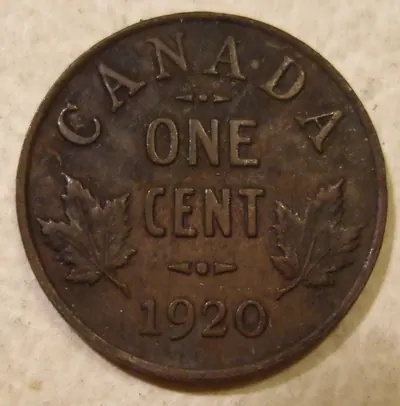
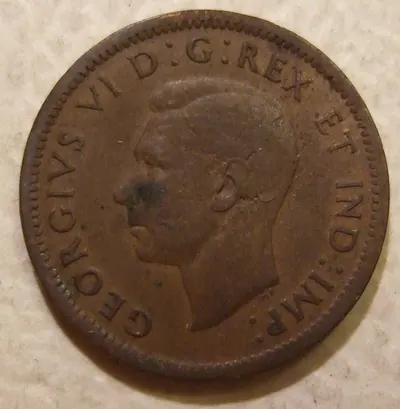
Canada stopped making pennies in 2012. The Royal Canadian Mint struck the last one in Winnipeg on May 4, 2012 and stopped distributing them on February 4, 2013. Billions are still sitting in jars, and almost all are worth about one cent.
The ones worth checking:
- 1936 dot cent: only three known. Record US$402,500 (2010).
- 1955 no shoulder fold: a PCGS AU58 sold for US$488.75 at Heritage.
- 1953 shoulder fold varieties: collectors look for both the “no strap” and “strap” portraits.
- Low-mintage 1920s dates: 1922 to 1926, about 1 to 2 million each.
- 2006 varieties: P, logo or plain, magnetic or not. Mostly worth face value.
How to identify a valuable Canadian penny
- Read the date and look just below it. A raised dot under 1936 is the famous rarity. Genuine examples are known only as three coins, so treat any “dot” with suspicion until a grading service confirms it.
- Check the Queen’s shoulder on 1953 and 1955 coins. On the varieties, the fold line in the gown at the shoulder is missing.
- Look for marks under the bust on 2000s coins. A small P or the RCM logo shows how the coin was plated.
- Try a magnet. Steel-core pennies stick to it; zinc and bronze pennies don’t. This matters for the 2006 varieties.
Varieties and errors worth money
1936 dot cent
George VI took the throne on December 11, 1936, too late for new dies with his portrait to be ready. The Mint kept striking 1936-dated pennies in 1937 and added a dot below the date to mark them. Mint records list 678,823 struck, but only three are known today.
Auction history:
- US$402,500 in January 2010, the record. That coin is now graded PCGS SP65RB.
- US$246,750 at Heritage in April 2013, the ex-Pittman/Krause coin.
1955 no shoulder fold
A die variety on the early Elizabeth II portrait with no fold line at the shoulder. A PCGS AU58 sold for US$488.75 at Heritage in January 2004. Lower-grade examples bring less.
1953 no shoulder fold (“no strap”)
Every 1953 Canadian denomination exists with two versions of Mary Gillick’s first portrait of Elizabeth II. The original model had relief that was too high, so the shoulder-fold lines barely showed (“no shoulder fold” or “no strap”). Later in the year the Mint lowered the relief and strengthened the shoulder (“shoulder fold” or “strap”). Collectors keep both; check recent sold results for your exact variety and grade.
1922 to 1926 low-mintage dates
The lowest George V mintages were 1925 (1,000,622) and 1923 (1,019,002). Next came 1922 (1,243,635), 1924 (1,593,195) and 1926 (2,143,372). These are the key dates in a Canadian large-to-small cent collection. Value depends heavily on wear.
1947 Maple Leaf
After India’s independence, the Latin abbreviation for “Emperor of India” had to come off the King’s titles. New dies were late, so 1948 pennies were struck with the 1947 date and a tiny maple leaf after it. With 47.9 million made, the penny version is common. The 1947 Maple Leaf silver dollar is the rarity.
Large cents (1858–1920)
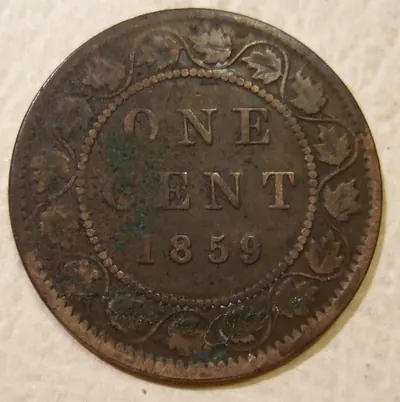
Before 1920, Canada’s cent was a large bronze coin, about 25 mm across, much bigger than the 19 mm small cent that replaced it. The first ones were struck for the Province of Canada in 1858 and 1859; cents for the Dominion followed from 1876. Large cents are where most of the money in older Canadian pennies lies:
- 1858 (421,000 made). The first year, with a low mintage. Uncirculated coins sell for about US$1,000–2,300 at Heritage: PCGS MS63 BN brought US$1,020 in June 2023 and PCGS MS64 BN US$2,280 in May 2021.
- 1859 (9,579,000 made). Common as a date, but it comes with varieties. The 1859/8 overdate (wide 9) shows traces of an 8 under the last 9: NGC XF40 sold for US$336 in March 2023. The rare brass narrow 9 sold for US$9,000 in Fine details condition in August 2019. An ordinary 1859 in PCGS MS64 BN brought just US$312.
- 1891: 1,452,000 made, with large and small leaf and date varieties that collectors separate.
- 1900 without an H (1,000,000) is scarcer than the 1900-H struck at the Heaton Mint in Birmingham (2,600,000).
- 1907-H: 800,000 made, the lowest Edward VII mintage.
- 1920: the last large cent (6,762,247) and the first small cent (15,483,923) share the date. Check the size.
Large cents often turn up dark, corroded or cleaned. Those problems cut the value sharply, even on a key date.
Magnetic pennies and the 2006 and 2012 varieties
From 1997 the cent became copper-plated zinc (2.25 g), and from 2002 the Mint also struck copper-plated steel cents (2.35 g), which stick to a magnet. In several years both kinds were made, and collectors separate them:
- 2006: six varieties, with a P (plated), the RCM logo or nothing under the Queen’s bust, each magnetic or not. The plain 2006 alone ran to 886,275,000 and the 2006 P to 137,733,000.
- 2012: the last year. About 111,375,000 magnetic and 87,972,000 non-magnetic cents were struck.
These are fun to sort with a fridge magnet, but with mintages in the tens or hundreds of millions, almost all are worth one cent. Only uncirculated coins in original rolls or sets bring a premium.
How to check your coin with CoinLens
Photograph both sides with CoinLens (Coin Identifier - CoinLens on the App Store). It identifies the coin within seconds from its database of almost 500,000 coins worldwide, shows an instant value estimate and lets you save it to your collection. Free scans are limited; Premium unlocks unlimited scans. A photo can’t confirm a die variety such as a 1936 dot or a 1955 no shoulder fold. Have those authenticated by PCGS, NGC or ICCS before selling.
Where to sell
- Canadian coin dealers and shows for low-mintage 1920s dates and certified varieties.
- Major auctions (Heritage, Stack’s Bowers, Geoffrey Bell) for anything certified and valuable.
- eBay for 2006 varieties and rolls. Price from sold listings.
- Common pennies keep their legal tender status, even though shops now round cash totals to the nearest five cents.
Frequently asked questions
Are Canadian pennies worth anything now?
Most are worth about face value. The Royal Canadian Mint stopped distributing pennies on February 4, 2013, after striking the last one on May 4, 2012. Cash totals in Canada are now rounded to the nearest five cents. The exceptions are the rare varieties and low-mintage dates on this page.
What is the rarest Canadian penny?
The 1936 dot cent. Mint records show 678,823 were struck in 1937 with a dot added to the 1936 dies, but only three are known to survive. The record is US$402,500, paid in January 2010 for a coin now graded PCGS SP65RB.
How do I spot a 1955 no shoulder fold penny?
Look at the Queen’s shoulder on the portrait side. Normal 1955 coins show a fold line in her gown where the strap meets the shoulder. On the variety, that line is missing. Use a magnifier, because wear can hide the fold on ordinary coins.
Which Canadian pennies are magnetic?
Pennies made of copper-plated steel are magnetic. Steel pennies were made from 2002 to 2012 alongside zinc ones, so many dates, including the six 2006 varieties, come in both magnetic and non-magnetic versions. From 2007 the RCM logo appears under the Queen’s bust.
Is a 1967 Canadian penny with a dove worth money?
The 1967 centennial penny shows a rock dove in flight by artist Alex Colville, dated 1867–1967, for Canada’s 100th anniversary. It was a circulation design struck for general use, so ordinary examples are usually worth little more than face value.
How much is an 1859 Canadian penny worth?
Most 1859 cents are common: 9,579,000 were made, and a PCGS MS64 BN sold for US$312 at Heritage in June 2019. The valuable ones are varieties: the 1859/8 overdate (wide 9), with NGC XF40 at US$336 and PCGS MS64 RB at US$2,185, and the rare brass narrow 9, a Fine details example of which sold for US$9,000 in August 2019.
How much is an 1858 Canadian penny worth?
The 1858 is the first Province of Canada cent and has a low mintage of 421,000. Uncirculated examples sold at Heritage for US$1,020 (PCGS MS63 BN, June 2023), US$2,040 (NGC MS64 RB, January 2021) and US$2,280 (PCGS MS64 BN, May 2021). Worn coins sell for much less.
Sources
- Wikipedia: Penny (Canadian coin), mintages, compositions, 1936 dot story, abolition dates
- Coin World: Canada's 1936 dot cent a puzzling rarity (auction history)
- Paul Fraser Collectibles: Canada 1936 dot cent makes $247,000 at Heritage
- Wikipedia: Canadian silver dollar, 1953 no shoulder fold and shoulder fold obverses (all 1953 denominations)
- NGC Auction Central: 1858 Canada 1c MS (Heritage results)
- NGC Auction Central: 1859/8 Canada wide 9 1c MS
- NGC Auction Central: 1859 Canada narrow 9 bronze 1c MS
- NGC Auction Central: 1922 Canada 1c MS
- NGC Auction Central: 1923 Canada 1c MS
- NGC Auction Central: 1925 Canada 1c MS
- NGC Auction Central: 1936 Canada dot below date 1c MS
- NGC Auction Central: 1947 Canada maple leaf 1c MS
- NGC Auction Central: 1953 Canada no shoulder fold 1c MS
- NGC Auction Central: 1955 Canada no shoulder fold 1c MS
Values are estimates, not offers. Condition decides the price; for a valuable coin, get a professional grade.