Subway Token Value: Are Old NYC Subway Tokens Worth Anything?
Most old NYC subway tokens are worth a few dollars. In its June 2023 collectibles sale, the MTA itself priced Y-cut and special-fare tokens at up to $5, and tens of millions were made of each type. Worth more: rare varieties such as the 1953 token with the Y not cut out.
Have one in hand? Scan it with CoinLens to identify it and see an estimate in seconds.
| Token | In use | Description | Fares | Number made |
|---|---|---|---|---|
| Small ‘Y’ cut-out | 1953–1970 | 16 mm brass, Y cut out of the center | 15¢, 20¢ | 48 million |
| Large ‘Y’ cut-out | 1970–1980 | 23 mm brass, Y cut out of the center | 30¢, 35¢, 50¢ | 50 million |
| Diamond Jubilee | 1979–1980 | Commemorative for the subway’s 75th anniversary | 50¢ | 5.8 million |
| Solid brass ‘NYC’ | 1980–1985 | 22 mm solid brass, no cut-out | 60¢, 75¢, 90¢ | 60 million |
| Bullseye | 1986–1995 | Brass with a steel center (magnetic); ‘SJD’ or plain | $1, $1.15, $1.25 | 90 million (all types) |
| Five Borough pentagon | 1995–2003 | Pentagon cut-out; struck in 1991, held back until 1995 | $1.50 | 60 million |
Which one is yours? Check it with CoinLens →
Dates, sizes, fares and mintages from nycsubway.org and Wikipedia's NYC transit fares article. The subway stopped taking tokens after May 4, 2003; buses took them until the end of 2003.
DEMO
Check your Subway Token Value: Are Old NYC Subway Tokens Worth Anything?
Add a photo of each side
Add a photo of at least one side first.
Demo — photos stay on your device. Nothing is uploaded.
DEMO
Your photos are ready. The identification happens in the CoinLens app.
On the web this is a demo — it can't recognize coins. In the app, the same two photos give you the coin's name, details and a value estimate.
Scan these in the free appEXAMPLE — what CoinLens shows
Value estimate:
Sample from our guide's data, not a result for your photo.
That was a sample. Scan your coin →·
| Variety | How to spot it | Why it's scarcer |
|---|---|---|
| 1953 solid token (Y not cut out) | 16 mm, same design but no Y hole | Used only June–September 1953, before the Y-cut tokens arrived |
| Large Y with large lettering | Compare letter size with a common large Y | One of two lettering varieties; slightly scarcer |
| Diamond Jubilee with no hole | Jubilee design, no cut-out | Rare error |
| Archer Avenue bullseye | Bullseye commemorating the Archer Avenue line, Dec 1988 | Only 100,000 made |
| Bullseye without ‘SJD’ | No initials | 30 million plain vs 60 million with SJD |
Which one is yours? Check it with CoinLens →
Varieties from nycsubway.org's token pages. SJD are the initials of Sylvester J. Dobosz, added without authorization (amNY).
| Item | Price | Context | Date |
|---|---|---|---|
| NYC Y-cut and special-fare tokens | Up to $5 each | MTA’s own collectibles sale | June 2023 |
| Solid brass NYC token (1980–85) | About $2.50 | Estimate quoted by GOBankingRates | May 2024 |
| About 20 million Chicago CTA tokens (132,642 lb) | About $157,000 total, under a cent each | Sold for scrap to Osborne Coinage | April 2004 |
| 1953 NYC token on eBay | $7,000 asking | Listing price only, not a sale | 2024 |
Which one is yours? Check it with CoinLens →
Sold and official prices from the sources cited. Asking prices aren't sales: rare tokens are listed at huge prices that don't sell. We found no public auction record for an individual NYC token.
| City / system | Token era | End of token use |
|---|---|---|
| New York (NYCTA / MTA) | 1953–2003 | Last sold April 2003; not accepted on the subway after May 4, 2003 |
| Boston (MBTA) | From 1919 | Replaced by the CharlieCard; redeemable until July 20, 2012 |
| Chicago (CTA) | Until 1997–99 | Replaced by the Transit Card; about 20 million scrapped in 2004 |
| Philadelphia (SEPTA) | Until 2018–2023 | Sales ended April 30, 2018; not accepted from Jan 1, 2024 |
End dates from WGBH, the CTA, CBS Philadelphia and SEPTA (see sources). For identifying tokens from any US or Canadian system, collectors use the Atwood-Coffee Catalogue.
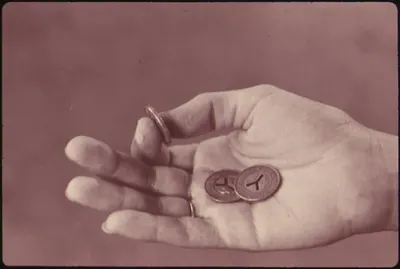
Most old New York City subway tokens are worth a few dollars. Every common type was made in the tens of millions: 48 million small Y tokens, 50 million large Y, 60 million solid NYC tokens, 90 million bullseyes and 60 million pentagons. Many are still in drawers. The MTA itself sold surplus Y-cut and special-fare tokens for up to $5 at a 2023 collectibles sale. That’s the realistic ceiling for an ordinary token.
The exceptions are varieties and errors: the 1953 token made without the Y cut-out, Diamond Jubilee tokens with no hole, the Archer Avenue bullseye and large-letter Y tokens. Pricing on these is thin, so check sold results, not asking prices.
A short history of the NYC subway token
The subway ran for half a century without tokens. From 1904 the fare was a nickel, then a dime from July 1948, both payable in coins. When the fare went to 15 cents on July 25, 1953, there was no 15-cent coin, so the Transit Authority made its own: a small brass token about the size of a dime that fit the existing turnstiles.
That first token, designed by Louis A. Schineller, had a “Y” cut out of the center. The Y-cut tokens weren’t ready in time. For the first few months, from June to September 1953, solid tokens without the hole were used, made by Osborne Coinage and Scoville. Those solid 1953 tokens are the first variety collectors look for.
From then on, a new token tended to arrive with a fare change:
- 1970, large Y (23 mm). The fare jumped to 30 cents, and the small token was replaced by a bigger one with the same Y cut-out, made by Osborne and the Roger Williams Mint. It served at 30, 35 and 50 cents.
- 1979–80, Diamond Jubilee. A commemorative token for the subway’s 75th anniversary, designed free of charge by Bill Bonnell. 5.8 million were made.
- 1980, solid brass “NYC” (22 mm). At 60 cents the Y disappeared. amNY reports the cut-out was dropped because pocket lint clogged the turnstiles. This token carried the 60, 75 and 90 cent fares.
- 1986, bullseye. When the fare hit $1, the token gained a steel center that the turnstiles could check magnetically, to defeat slugs. Most carry the initials SJD, for Sylvester J. Dobosz. amNY says they were added without authorization: 60 million were struck with them, 30 million without.
- 1995, Five Borough pentagon. The $1.50 “Five Borough” token has a five-sided cut-out. nycsubway.org notes it was minted in 1991 and held in reserve until the fare increase of November 1995.
The token era ended in 2003. The last tokens were sold on April 12–13. The fare rose to $2 and the subway stopped accepting tokens after May 4, 2003, though buses took them until the end of the year. According to an MTA spokesperson quoted by Gizmodo, about 45 million leftover tokens were melted for scrap and about 9 million licensed for cufflinks, watches and golf markers.
How to identify your token
- Measure it. 16 mm points to the 1953–70 small Y; 23 mm to the 1970–80 large Y; 22 mm and solid to the 1980–85 NYC token.
- Look at the center. A Y-shaped hole means a Y token. A different-colored, magnetic center means a bullseye (1986–95). A five-sided hole means the 1995–2003 pentagon. No hole on a 16 mm 1953-style token is the scarce solid variety.
- Check the lettering. NYC tokens carry “New York City Transit Authority” or “NYCTA” and usually “Good for one fare”. Compare a large Y’s letter size with a common example; the large-letter variety is slightly scarcer.
- Check for initials and commemorative text. Bullseyes with SJD are the common type; plain ones are fewer. The Archer Avenue bullseye from December 1988 is a 100,000-piece commemorative.
If the token says another city or authority, it isn’t a NYC subway token. Bus companies, bridges, ferries and turnpikes issued tokens too.
Slugs and the Connecticut Turnpike token
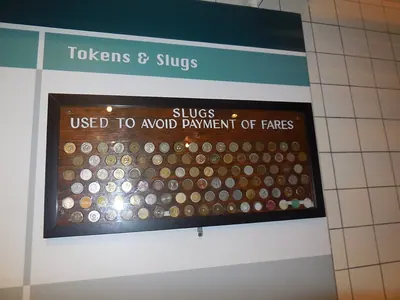
The Transit Museum’s wall of slugs, in the photo above, shows why NYC kept changing designs. In October 1982 Connecticut introduced a 17.5-cent turnpike token that was almost exactly the size and shape of the subway token, from the same maker. Fare-beaters used them widely. TIME reported in December 1982 that slugs were costing the subway up to $1 million a year. When the Connecticut tolls ended in 1985, according to Wikipedia, the MTA was paid 17.5 cents each for more than 2 million it had collected. If you find a Connecticut Turnpike token in a NYC token jar, that’s probably why.
What subway tokens are worth
The value table above shows the few hard numbers available. The pattern is simple:
- Common NYC tokens: a few dollars each. The MTA priced its own surplus at up to $5 in 2023, and a GOBankingRates article quoted an estimate of about $2.50 for the 1980–85 solid token.
- Scrap value is pennies. When Chicago sold about 20 million retired CTA tokens for scrap in 2004, the whole 66-ton lot brought about $157,000, under a cent per token.
Beware of asking prices. Articles about “tokens worth thousands” usually point to eBay listings, such as a 1953 NYC token listed at $7,000 “taking offers”. A listing isn’t a sale. We found no public auction record for a single NYC token selling anywhere near that. Filter eBay for sold items to see what buyers actually pay.
Where rare tokens get value
Collectors of transit tokens, called vecturists, pay premiums for scarce varieties, early tokens from small systems and pieces in top condition. The standard reference is the Atwood-Coffee Catalogue of US and Canadian transportation tokens, published by the American Vecturist Association. Its 7th edition came out in 2016. If you have a token from a small or short-lived system, its Atwood-Coffee number is the first thing a specialist buyer will ask for.
Other US transit tokens
New York wasn’t alone, and most big systems have now retired their tokens:
- Boston (MBTA): tokens from 1919. The CharlieCard replaced them, and the last day to redeem them was July 20, 2012.
- Chicago (CTA): tokens were phased out with the Transit Card in the late 1990s. In 2004, about 20 million were sold for scrap; around 2,000 were kept for jewelry.
- Philadelphia (SEPTA): one of the last big token systems. Sales ended on April 30, 2018 and tokens were refused from January 1, 2024.
Values follow the same rule as New York: common city tokens are worth a dollar or two, and rarities are specific varieties and early issues.
Token or coin?
A subway token is not a coin. It was issued by a transit authority to pay a fare, not by a government as money, so it has no dollar face value. NYC introduced its token precisely because there was no coin for a 15-cent fare. Collectors file tokens under exonumia, alongside medals and other coin-like objects. If you find a coin-like piece with no denomination or country, our foreign coin identifier guide explains how to tell coins, tokens and medals apart.
How to check with CoinLens
Found a jar of mixed coins and tokens? Coin Identifier – CoinLens (iPhone and Android) identifies coins from a photo of both sides and gives an instant value estimate, using a database of almost 500,000 coins worldwide. Use it to identify the real coins, including any silver; anything it can’t match may be a token, which you can price with the guide above. Free scans are limited; Premium unlocks unlimited scans.
Where to sell subway tokens
- Common tokens: sell in lots on eBay or to local collectors. Individually they rarely cover the postage.
- Varieties and errors: list with clear photos of both sides, the diameter in millimeters and the Atwood-Coffee number. Transit token collectors’ clubs and the American Vecturist Association are where specialist buyers are.
- Inherited jars of tokens: check for coins mixed in first. Old silver coins are often worth far more than the tokens around them; see our guide to an inherited coin collection.
Frequently asked questions
Are old NYC subway tokens worth anything?
Usually a few dollars. Each common type was made in the tens of millions (48 million small Y tokens, 90 million bullseyes), and the MTA sold surplus tokens for up to $5 each in 2023. Scarce varieties and errors, such as the 1953 token without the Y cut-out, are worth more to collectors.
How much is a 1953 NYC subway token worth?
The common 1953 small Y-cut token (16 mm) usually sells for a few dollars because 48 million were made. The scarcer 1953 piece is the solid version without the Y hole, used only from June to September 1953. Some sellers list 1953 tokens for thousands of dollars; those are asking prices, not sales.
What does 'Good for one fare' on a token mean?
It’s the standard wording on transit tokens: the token pays one ride at whatever the fare is, instead of carrying a cash value. NYC’s tokens kept working through several fare increases for that reason. Many cities’ tokens use the same phrase, so check the city name or the authority’s initials.
When did NYC stop using subway tokens?
The last tokens were sold in April 2003, and the subway stopped accepting them after May 4, 2003, when the fare rose to $2 and MetroCard took over. Buses took tokens until the end of 2003.
What happened to all the leftover subway tokens?
According to the MTA, about 45 million were melted for scrap and about 9 million were licensed for cufflinks, watches and golf markers. Millions more were never turned in and are still in drawers.
Is a subway token a coin?
No. A token was issued by the transit authority, not a government mint, to pay a fare. It has no face value in dollars and can’t be spent as money. NYC introduced tokens in 1953 because there was no 15-cent coin for the new fare.
Can I still use or redeem old subway tokens?
Not in New York, Boston or Philadelphia: all three systems have ended token acceptance and redemption. They’re collectibles now.
Sources
- nycsubway.org: New York City subway tokens (types, mintages, varieties)
- nycsubway.org: Commemorative tokens and medals (1953 designer, solid 1953 tokens, unredeemed estimates)
- Wikipedia: New York City transit fares (fare history, token sizes and metals)
- amNY (July 2024): What happened here in New York: the token rolls out
- WNYC (April 2018): 15 years ago, the subway token rode into the sunset
- Gizmodo: what really happened to the MTA's leftover subway tokens
- Time Out New York (June 2023): MTA memorabilia collectibles sale, tokens up to $5
- GOBankingRates (May 2024): Could these metro tokens be worth money?
- TIME (Dec 1982): Token exchange (Connecticut Turnpike slugs)
- CTA: Old CTA tokens to sell as scrap metal (2004)
- WGBH (July 2012): MBTA stops accepting T tokens
- CBS Philadelphia: SEPTA ends token sales
- CBS Philadelphia: SEPTA will not accept tokens starting Jan. 1, 2024
- Wikipedia: American Vecturist Association (Atwood-Coffee Catalogue)
- Wikipedia: Token coin (tokens issued by private entities)
Values are estimates, not offers. Condition decides the price; for a valuable coin, get a professional grade.