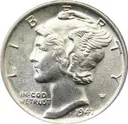
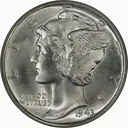
How Much Is a 1916-D Mercury Dime Worth? (Values, Fakes & How to Check)
A genuine 1916-D Mercury dime sells for about $2,200 in VG8 and $3,400–$4,800 in Fine, based on 2026 Heritage auctions. Only 264,000 were struck. The record is $204,000 for an MS67 Full Bands in 2020. Many are fakes made by adding a D, so authenticate before buying or selling.
Have one in hand? Scan it with CoinLens to identify it and see an estimate in seconds.
| Grade | Recent sale | Auction / date |
|---|---|---|
| VG8 (NGC) | $2,196 | Heritage FUN, Jan 2026 |
| VG8 (PCGS) | $2,257 | Heritage, 2026 |
| F12 (ANACS) | $3,416 | Heritage, 2026 |
| F12 (PCGS, CAC) | $4,758 | Heritage FUN, Jan 2026 |
| MS66 Full Bands (PCGS, CAC) | $94,000 | Heritage PNG Invitational, Mar 2015 |
| MS67 Full Bands (PCGS), Pogue coin | $204,000 | Stack’s Bowers, Pogue Part VII, Mar 20, 2020 |
Which one is yours? Check it with CoinLens →
Single sales from the sources cited below, not a price guide. Prices apply only to coins certified genuine by PCGS, NGC or ANACS; a raw 1916-D sells at a steep discount because buyers assume it may be altered. Melt at silver $43.35/oz, November 26, 2026.
DEMO
Check your 1916 Winged Liberty Head (Mercury) Dime
Add a photo of each side
Add a photo of at least one side first.
Demo — photos stay on your device. Nothing is uploaded.
DEMO
Your photos are ready. The identification happens in the CoinLens app.
On the web this is a demo — it can't recognize coins. In the app, the same two photos give you the coin's name, details and a value estimate.
Scan these in the free appEXAMPLE — what CoinLens shows
Value estimate:
Sample from our guide's data, not a result for your photo.
That was a sample. Scan your coin →·
Coin facts
- Coin
- Winged Liberty Head (Mercury) Dime
- Years
- 1916
- Mints
- Denver (D)
- Composition
- 90% silver, 10% copper
- Weight
- 2.5 g
- Diameter
- 17.9 mm
- Silver (ASW)
- 0.0723 troy oz
- Melt value
- $3.14
- Designer
- Adolph A. Weinman
Mintage
- 1916-D
- 264,000
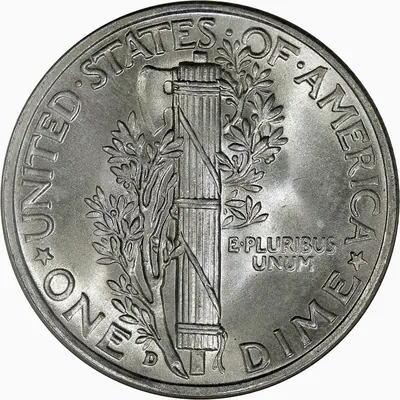
A genuine 1916-D Mercury dime is the key date of the series and is valuable in any grade:
- Very Good: about $2,200. An NGC VG8 sold for $2,196 at Heritage in January 2026, and a PCGS VG8 brought $2,257 at Heritage later in 2026.
- Fine: an ANACS F12 sold for $3,416 and a PCGS F12 with a CAC sticker for $4,758, both at Heritage in 2026.
- Top of the market: a PCGS MS67 Full Bands from the D. Brent Pogue Collection sold for $204,000 at Stack’s Bowers on March 20, 2020.
Those prices are for certified coins. The 1916-D is one of the most faked U.S. coins, so the real question is whether yours is genuine.
Why the 1916-D is rare
The new Weinman dime went into production late in 1916. Philadelphia struck more than 22 million and San Francisco more than 10 million. Denver had just started when, in November 1916, the Mint Director told it to strike only quarters until a large order was filled. Denver’s dime run stopped at 264,000, the lowest of any Mercury dime.
How to check if your 1916-D is real
Most fakes fall into one of two types.
- Added mint mark. A forger cuts a D from a common Denver dime and glues it onto a 1916 Philadelphia dime, which is worth far less. Under 5–10x magnification, an added D often looks like it floats above the surface, with a seam, glue, tool marks or discoloration around it.
- Die-struck counterfeits. These are made from fake dies. NGC has documented copies with raised marks in fields that should be smooth.
What a genuine D looks like, according to PCGS and APMEX: it is boldly struck, nearly square, with strong serifs, and its top tilts to the right. It sits on the reverse near the lower left rim, just after the word ONE. Mint mark position varies slightly between the few dies Denver used, so position alone does not prove anything.
Look at the holder too. Counterfeit PCGS and NGC slabs exist, so check the certification number on the grader’s website.
Value of a 1916 dime with no mint mark
No mint mark means Philadelphia, where more than 22 million were struck. It is a common date. Its value starts at silver melt (shown below) and rises only in Mint State.
Melt value
Every 1916-D contains 0.0723 troy oz of silver. That melt value is irrelevant for a genuine coin, but it is the floor if the “D” turns out to be added to a common 1916 coin.
Silver melt value calculator
Winged Liberty Head (Mercury) Dime: 0.0723 troy oz of silver each
Melt value ($3.14 each)
Silver spot $43.35/oz as of November 26, 2026 (gold-api.com)
Melt value today for a pile, a roll or $ face value → Silver melt calculator
Melt value is the floor. Condition and mint details decide the rest — check yours in the app.
How to check your coin with CoinLens
Snap both sides with the CoinLens app. It identifies the coin within seconds and shows an instant value estimate, the minting year and composition, so you can confirm you have a 1916 Mercury dime and see the gap between the Philadelphia and Denver coins. CoinLens cannot authenticate a mint mark. For any 1916-D, the next step is certification by PCGS, NGC or ANACS.
Where to sell
Get it certified first: a raw 1916-D sells at a deep discount because buyers assume it may be altered. Once certified, consign it to Heritage, Stack’s Bowers or GreatCollections, or offer it to several established dealers. Well-worn certified examples also sell well on eBay.
Frequently asked questions
How rare is a 1916-D Mercury dime?
The Denver Mint struck only 264,000, the lowest mintage of the series. In November 1916 the Mint Director ordered Denver to stop striking everything except quarters, which is why so few were made.
How can I tell if my 1916-D dime is real?
Check the D under magnification. A genuine 1916-D mint mark is boldly struck, nearly square and tilts with its top to the right, and the field around it is smooth. A D that looks glued on, floats above the surface, shows tool marks or discoloration around it, or has a different shape is a red flag. Only PCGS, NGC or ANACS certification settles it.
How much is a 1916 dime with no mint mark worth?
A 1916 Mercury dime with no mint mark was struck at Philadelphia, where more than 22 million were made. It is a common date worth a modest premium over silver melt unless it is in high Mint State.
Is a 1916-D dime with a damaged or worn D still valuable?
Yes, if a grading service confirms it is genuine. Even worn coins are valuable, because the date and mint are what collectors need: Heritage sales of VG8 examples in 2026 were around $2,200.
Should I clean my 1916-D dime?
No. Cleaning leaves hairlines that graders mark as ‘details’ or ‘cleaned’, which cuts the value sharply. Leave it as it is and send it for certification.
Sources
- Wikipedia: Mercury dime (1916-D mintage 264,000; why Denver stopped)
- Coin World: 1916-D Mercury dime brings $94,000 at Heritage PNG auction (MS66 FB CAC, Feb–Mar 2015; 1916-P and S mintages)
- PCGS CoinFacts: 1916-D 10C FB (Pogue Part VII lot 7050, Stack's Bowers Mar 20, 2020, $204,000)
- PCGS Europe: auction record, 1916-D 10C FB MS67FB lot 7050 ($204,000)
- PriceCharting: 1916-D Mercury dime sold listings (Heritage VG8 NGC $2,196, lot 1390-7133; VG8 PCGS $2,257, lot 1396-7117; F12 ANACS $3,416, lot 1394-3509; F12 PCGS CAC $4,758, lot 1390-3793)
- PCGS: 1916-D dime attracts coin doctors and counterfeiters (genuine mint mark shape)
- NGC: Examining an added mintmark
- NGC: Die-struck counterfeit 1916-D Mercury dime
- CoinWeek: Deceptive 1916-D Mercury dimes (fun with fakes)
- APMEX: Mercury dime key dates (genuine 1916-D mint mark slant)
Values are estimates, not offers. Condition decides the price; for a valuable coin, get a professional grade.