How Much Is a Peace Dollar Worth? (1921–1935 Values, Key Dates & High Relief)
Every Peace dollar (1921–1935) is 90% silver with 0.7734 troy oz of pure silver, so common worn dates sell for about melt (live below). Key dates are the 1921 High Relief, the 1928 (360,649 struck) and the 1934-S; a 1921 High Relief matte proof sold for $329,000 in 2014.
Have one in hand? Scan it with CoinLens to identify it and see an estimate in seconds.
| Coin | Worn | Notable sales | Notes |
|---|---|---|---|
| 1922, 1923 and other common dates | $33.53 melt | — | Tens of millions struck |
| 1921 High Relief | Premium | PCGS MS64 $1,342–$1,769 (Heritage, 2026) | First year; deeper, rounder design |
| 1921 High Relief matte proof | — | PF67 Matte $329,000 (Jan 12 2014, per NGC Auction Central) | Only a few proofs made |
| 1922 High Relief matte proof | — | $458,250 (Goldberg Auctioneers, June 2014; grade and service not stated in the source) | Experimental high relief issue |
| 1928 | Premium | — | Lowest mintage, 360,649; many were saved |
| 1934-S | Small premium | Mid-grade uncirculated costs thousands (Red Book via Wikipedia) | Rare in mint state |
Which one is yours? Check it with CoinLens →
Values from the cited auction results, not a price guide. Circulated common dates follow the silver price. Melt at silver $43.35/oz, November 26, 2026.
DEMO
Check your 1921–1928, 1934–1935 (collector issues from 2021) Peace Dollar
Add a photo of each side
Add a photo of at least one side first.
Demo — photos stay on your device. Nothing is uploaded.
DEMO
Your photos are ready. The identification happens in the CoinLens app.
On the web this is a demo — it can't recognize coins. In the app, the same two photos give you the coin's name, details and a value estimate.
Scan these in the free appEXAMPLE — what CoinLens shows
Value estimate:
Sample from our guide's data, not a result for your photo.
That was a sample. Scan your coin →·
Coin facts
- Coin
- Peace Dollar
- Years
- 1921–1928, 1934–1935 (collector issues from 2021)
- Mints
- Philadelphia (no mint mark), Denver (D), San Francisco (S)
- Composition
- 90% silver, 10% copper
- Weight
- 26.73 g
- Diameter
- 38.1 mm
- Silver (ASW)
- 0.7734 troy oz
- Melt value
- $33.53
- Designer
- Anthony de Francisci
Mintage
- 1921 (High Relief)
- 1,006,473
- 1922
- 51,737,000
- 1927
- 848,000
- 1928
- 360,649
- 1928-S
- 1,632,000
- 1934-S
- 1,011,000
- 1935
- 1,576,000
| Year | Philadelphia | Denver (D) | San Francisco (S) |
|---|---|---|---|
| 1921 | 1,006,473 | — | — |
| 1922 | 51,737,000 | 15,063,000 | 17,475,000 |
| 1923 | 30,800,000 | 6,811,000 | 19,020,000 |
| 1924 | 11,811,000 | — | 1,728,000 |
| 1925 | 10,198,000 | — | 1,610,000 |
| 1926 | 1,939,000 | 2,348,700 | 6,980,000 |
| 1927 | 848,000 | 1,268,900 | 866,000 |
| 1928 | 360,649 | — | 1,632,000 |
| 1934 | 954,057 | 1,569,500 | 1,011,000 |
| 1935 | 1,576,000 | — | 1,964,000 |
Which one is yours? Check it with CoinLens →
From Wikipedia's Peace dollar mintage table. A further 316,106 Peace dollars dated 1964 were struck at Denver in 1965 and all are believed destroyed. Melt at silver $43.35/oz, November 26, 2026.
| Coin | Circulated / low mint state | Gem and near-gem |
|---|---|---|
| 1924-S | NGC AU58 $164.70; NGC MS62 $353.80 (Heritage, Aug 2026) | PCGS MS65 $4,026 (Heritage, Jul 2026) |
| 1925 | NGC MS63 $129 (Heritage, Oct 2026) | PCGS MS65 $189.10 (Heritage, Oct 2026) |
| 1926-S | NGC MS60 $114 (Heritage, Jul 2026) | NGC MS64 $402.60 (Heritage, Jul 2026) |
| 1927-D | NGC AU53 $124 (Heritage, Aug 2026) | PCGS MS65 $3,904 (Heritage, Mar 2026) |
| 1928 | NGC AU55 $341.60 (Heritage, Aug 2026) | PCGS MS64 $1,464 (Heritage, Oct 2026) |
| 1928-S | PCGS AU58 $195.20 (Heritage, Jul 2026) | PCGS MS64 $1,037–$1,098 (Heritage, Jul 2026) |
| 1934 | PCGS MS62 $189.10 (Heritage, May 2026) | NGC and PCGS MS64 $335.50–$536.80 (Heritage, 2026) |
| 1934-S | PCGS VF30 $99; NGC AU50 $463.60 (Heritage, 2026) | PCGS MS62 $6,100 and MS64 $7,320 (Heritage, Mar 2026) |
| 1935 | NGC AU58 $139 (Heritage, Aug 2026) | PCGS MS66 $2,562–$5,124 (Heritage, Mar–Apr 2026) |
Which one is yours? Check it with CoinLens →
Individual results from NGC Auction Central, including buyer's premium. Not a price guide. The 1934-S shows how a common worn coin can be expensive uncirculated. Melt at silver $43.35/oz, November 26, 2026.
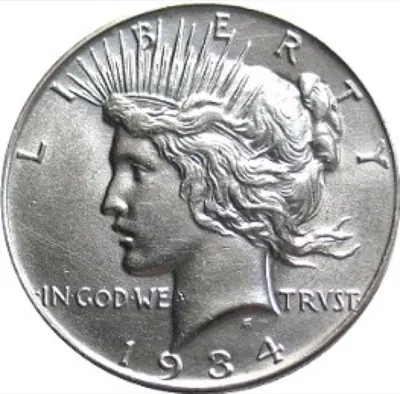
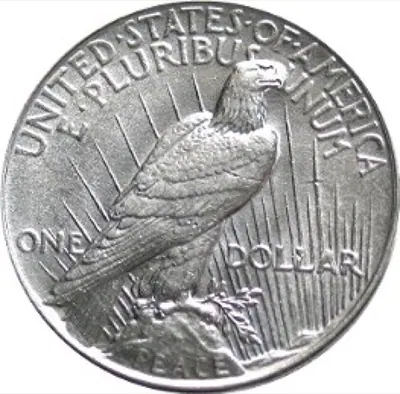
The Peace dollar was struck from 1921 to 1928 and in 1934–1935, all in 90% silver with 0.77344 troy ounces of pure silver. Common dates such as the 1922 and 1923 were made by the tens of millions, so worn examples trade close to melt value (live calculator below).
Coins worth more:
- 1921 High Relief: the first-year design, struck in deep relief at Philadelphia (1,006,473 made). PCGS MS64 coins sold for $1,342–$1,769 at Heritage in 2026. A matte proof PF67 sold for $329,000 in January 2014.
- 1928: the lowest mintage at 360,649. Prices are lower than the mintage suggests because many were saved.
- 1934-S: inexpensive when worn but costly in uncirculated grades.
How to identify your Peace dollar
- Date: at the bottom of the obverse, below Liberty’s portrait with its radiant crown.
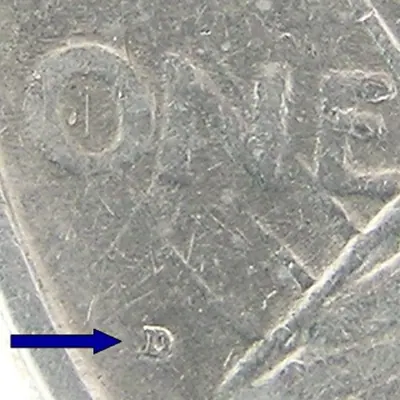
- Mint mark: on the reverse at the lower left, below ONE and near the eagle’s wing tip. None = Philadelphia; D = Denver; S = San Francisco.
- Relief: 1921 coins (and rare 1922 proofs) are high relief, with a noticeably domed, deeper design. From 1922 the relief was lowered so the coins would strike up fully.
- Genuine check: 26.73 g, 38.1 mm, not magnetic.
Why the Peace dollar was made
The Peace dollar exists because of a wartime silver deal. Under the Pittman Act of 1918, the US melted millions of silver dollars to sell silver to Britain, and the law then required the Mint to strike replacements. Collectors saw a chance for a new design. Numismatist Farran Zerbe urged the American Numismatic Association in 1920 to campaign for a coin celebrating the peace after World War I. Officials then realised that the Morgan design, in use for more than 25 years, could be replaced without a new law (Wikipedia).
A competition was judged on December 13, 1921, and Anthony de Francisci, at 34 the youngest entrant, won unanimously. He modeled Liberty on his wife, Teresa de Francisci, who had arrived in America as a child past the Statue of Liberty; the radiate crown recalls the statue (Wikipedia).
The broken sword controversy
As first announced on December 19, 1921, the reverse showed the eagle on a broken sword as well as the olive branch. Newspapers and the public read the broken sword as a symbol of defeat, and letters poured in. On December 23 Chief Engraver George T. Morgan removed the sword from the master hub by hand, under magnification. The first Peace dollars were struck on December 28, 1921, and 1,006,473 were made dated 1921, an output Roger Burdette calls “amazing” for four days. The coins were released on January 3, 1922 (Wikipedia).
Why production stopped, restarted and stopped again
Once the Pittman Act’s requirements were met in 1928, production stopped. That’s why the 1928 Philadelphia coin has the lowest mintage, 360,649. Because the Mint announced it would be a small issue, many were saved, and it costs far less than the mintage suggests (Wikipedia).
A new law in 1934 required the Mint to buy domestic silver while its price was at a historic low. Over seven million Peace dollars were struck in 1934 and 1935. Dies were prepared for 1936, but with no commercial demand none were struck, and the master dies were later ordered destroyed. The 1934-S, unlike the 1928, wasn’t saved in quantity: a PCGS VF30 sold for $99 at Heritage in 2026, but a PCGS MS64 brought $7,320 (Wikipedia; NGC Auction Central).
In 1965 Denver struck 316,106 Peace dollars dated 1964 during a coin shortage, but after objections none were issued and all are believed destroyed. The Mint revived the design for collectors in 2021, struck in 0.858 oz of silver; none were made in 2022.
Varieties and errors
- 1922 High Relief: a small number of 1922 coins were struck in high relief before the design was lowered; a matte proof brought $458,250 at Goldberg in June 2014.
- VAM varieties: many Peace dollar die varieties are cataloged by VAM number, such as doubled dies and die breaks.
- Weak strikes: 1920s branch-mint coins are often softly struck on Liberty’s hair; sharp strikes earn premiums.
- 1964-D: struck in 1965 but all reported melted. See the 1964 Peace dollar story.
Melt value
Each Peace dollar holds 0.77344 troy ounces of silver. The calculator below shows today’s value.
Silver melt value calculator
Peace Dollar: 0.7734 troy oz of silver each
Melt value ($33.53 each)
Silver spot $43.35/oz as of November 26, 2026 (gold-api.com)
Melt value today for a pile, a roll or $ face value → Silver melt calculator
Melt value is the floor. Condition and mint details decide the rest — check yours in the app.
How to check your coin with CoinLens
Photograph both sides with CoinLens. The app identifies date and mint from its database of almost 500,000 coins, shows silver content and gives an instant value estimate you can save to your collection. CoinLens gives estimates. For a 1921, 1928, 1934-S or any uncirculated coin, get professional grading from PCGS or NGC.
Where to sell
Worn common dates sell to coin shops and bullion dealers, usually slightly above melt. Key dates and certified coins sell best at Heritage, Stack’s Bowers, GreatCollections or through a reputable dealer.
Frequently asked questions
How much is a Peace silver dollar worth?
A circulated common date is worth about its melt value, 0.77344 troy ounces of silver times the spot price, often plus a small premium. Key dates and gem uncirculated coins are worth much more.
What is the rarest Peace dollar?
By mintage, the 1928 (360,649 struck). In high grades the 1934-S and the 1921 High Relief are the hardest to find. No 1964-D Peace dollar is known to survive.
Where is the mint mark on a Peace dollar?
On the reverse, at the lower left, just below the word ONE and above the tip of the eagle’s wing. Philadelphia coins have none.
How can I tell a 1921 Peace dollar?
It is the only regular Peace dollar struck in high relief: Liberty’s portrait and the eagle are deeper and rounder, the date is 1921, and it has no mint mark. It is worth much more than later dates.
Why is it called the Peace dollar?
It was issued to commemorate the peace that followed World War I, and the word PEACE appears on the rock under the eagle on the reverse.
Sources
- NGC Auction Central: 1921 $1 High Relief Peace (Heritage results)
- Peace dollar (mintage table, history, 1928 and 1934-S scarcity)
- NGC Auction Central: Peace dollars (top prices realized)
- PCGS CoinFacts: 1921 $1 High Relief Peace
- Numismatic News: Getting a silver dollar education (1922 high relief proofs)
- NGC Auction Central: 1924-S $1 MS (Heritage results)
- NGC Auction Central: 1925 $1 MS (Heritage results)
- NGC Auction Central: 1926-S $1 MS (Heritage results)
- NGC Auction Central: 1927-D $1 MS (Heritage results)
- NGC Auction Central: 1928 $1 MS (Heritage results)
- NGC Auction Central: 1928-S $1 MS (Heritage results)
- NGC Auction Central: 1934 $1 MS (Heritage results)
- NGC Auction Central: 1934-S $1 MS (Heritage results)
- NGC Auction Central: 1935 $1 MS (Heritage results)
Values are estimates, not offers. Condition decides the price; for a valuable coin, get a professional grade.