How Much Is a Seated Liberty Dollar Worth? (1840–1873 Silver Dollar Values)
A Seated Liberty dollar (1840–1873) holds 0.7734 troy oz of silver, but even worn coins sell well above melt: an 1860-O in NGC XF40 brought $576 at Heritage in 2023. Rare dates sell for far more; an 1873-CC in NGC MS61 brought $105,750 at Heritage in May 2015.
Have one in hand? Scan it with CoinLens to identify it and see an estimate in seconds.
| Coin | Example sales | Notes |
|---|---|---|
| 1871 (common) | PCGS G6 $312 (Apr 2023); PCGS F15 $360 (Dec 2022); NGC MS65 $20,740 (Heritage, Mar 2026) | With motto |
| 1860-O | PCGS VF35 $588; NGC XF40 $576 (Heritage, 2023); PCGS MS61 $4,320 (Jan 2022) | Common New Orleans date |
| 1859-O | PCGS VF25–VF30 $456–$485 (2021); PCGS MS64 $7,800 (Stack’s Bowers, Aug 2021) | No motto |
| 1872-S | NGC G4 $540 (2017); PCGS VG10 $840 (2021); PCGS MS63 $25,200 (Heritage, Jan 2022) | San Francisco |
| 1870-CC | PCGS and NGC F12 about $1,326 (2020–2021); PCGS MS63 $27,600 (Heritage, Jan 2022) | First Carson City dollar |
| 1873-CC | PCGS AG3 $7,638 (2014); PCGS VF30 $14,100 (2016); NGC MS61 $105,750 (Heritage, May 2015) | Key Carson City date |
| 1851 | PCGS AU58 $70,500 (Heritage, Aug 2013) | Only 1,300 struck |
Which one is yours? Check it with CoinLens →
Sales from NGC Auction Central (Heritage and Stack's Bowers results). Top sales are not typical values; worn common dates trade at a few hundred dollars. Melt at silver $43.35/oz, November 26, 2026.
DEMO
Check your 1840–1873 Seated Liberty Dollar
Add a photo of each side
Add a photo of at least one side first.
Demo — photos stay on your device. Nothing is uploaded.
DEMO
Your photos are ready. The identification happens in the CoinLens app.
On the web this is a demo — it can't recognize coins. In the app, the same two photos give you the coin's name, details and a value estimate.
Scan these in the free appEXAMPLE — what CoinLens shows
Value estimate:
Sample from our guide's data, not a result for your photo.
That was a sample. Scan your coin →·
Coin facts
- Coin
- Seated Liberty Dollar
- Years
- 1840–1873
- Mints
- Philadelphia (no mint mark), New Orleans (O), San Francisco (S), Carson City (CC)
- Composition
- 90% silver, 10% copper
- Weight
- 26.73 g
- Diameter
- 38.1 mm
- Silver (ASW)
- 0.7734 troy oz
- Melt value
- $33.53
- Designer
- Christian Gobrecht
| Coin | Circulated results | Higher-grade results |
|---|---|---|
| 1841 | NGC VF20 $480 (Heritage, Jan 2023); PCGS VF30 $630 (Heritage, Jul 2023) | PCGS MS64 $28,800 (Heritage, Jan 2023) |
| 1842 | PCGS XF40 $780 (Heritage, Sep 2023); NGC AU50 $1,098 (Heritage, Feb 2026) | — |
| 1844 | PCGS XF40 $1,560 (Heritage, Aug 2023) | PCGS AU58 $4,800–$5,280 (Heritage, Jan 2022) |
| 1847 | PCGS AU53 $1,525 (Heritage, Jul 2026) | PCGS MS64 $10,370 (Heritage, Mar 2026) |
| 1859-S (20,000 struck) | NGC G6 $660 (Heritage, Nov 2023); PCGS XF40 $2,040 (Heritage, Apr 2023) | — |
| 1870-S (mintage unrecorded) | NGC XF40 $420,000 (Heritage, Jan 2023) | PCGS XF40 $763,750 (Heritage, Jan 2014) |
| 1872 (1,105,500 struck) | NGC VF20 $420 (Heritage, Aug 2023); PCGS F15 $610 (Heritage, Jul 2026) | PCGS AU50 $1,140 (Heritage, Aug 2023) |
Which one is yours? Check it with CoinLens →
Individual results from NGC Auction Central, including buyer's premium. Coins with 'Details' grades (cleaned or damaged) sell for less. Not a price guide. Melt at silver $43.35/oz, November 26, 2026.
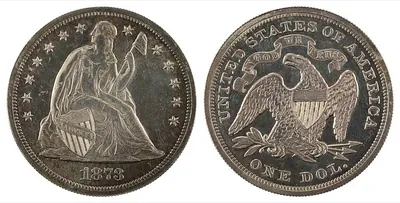
Seated Liberty dollar value: quick answer
The Seated Liberty dollar, designed by Chief Engraver Christian Gobrecht, was struck from 1840 to 1873. Each holds 0.77344 troy ounces of silver, but these coins are scarce enough that collector value is well above melt in every grade.
- Common dates, worn: about $300–$600 (1871 in G6 $312; 1860-O in XF40 $576; Heritage 2023).
- Uncirculated: thousands, from $4,320 for an 1860-O in PCGS MS61 to $20,740 for an 1871 in NGC MS65 (March 2026).
- Carson City: the 1870-CC brought about $1,326 in Fine; the key 1873-CC sold for $7,638 even in AG3 and $105,750 in NGC MS61 (May 2015).
- 1851 and 1852: only 1,300 and 1,100 struck; a PCGS AU58 1851 brought $70,500 in 2013.
How to identify your Seated dollar
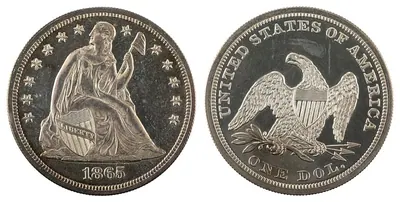
- Obverse: Liberty seated on a rock, holding a shield and a pole topped by a liberty cap, with 13 stars around.
- Reverse: a heraldic eagle with ONE DOL. below.
- Motto: coins from 1866 on have IN GOD WE TRUST on a ribbon above the eagle.
- Mint mark: below the eagle on the reverse: O, S or CC; none for Philadelphia.
- Genuine check: 26.73 g and 38.1 mm. Key dates are counterfeited; certify any CC or 1851–1852 coin.
From Gobrecht’s dollar to the Seated dollar
The design began as the Gobrecht dollar, struck experimentally from 1836 to 1839. Mint Director Robert M. Patterson asked artist Thomas Sully for a Liberty seated on a rock holding a pole topped by a liberty cap, and Chief Engraver Christian Gobrecht engraved it. For the regular dollar of 1840, Patterson dropped Gobrecht’s flying eagle for a standing eagle based on John Reich’s older design. Philadelphia artist Robert Ball Hughes lowered the relief, enlarged Liberty’s head and thickened the drapery. Walter Breen called the result “a sorry mess indeed” compared with the original (Wikipedia).
The first 12,500 coins were struck in July 1840 so bullion depositors could see the new coin. The New Orleans Mint began striking dollars in 1846. San Francisco used its dollar dies only once before 1870, striking 20,000 coins in 1859, which is why the 1859-S is scarce (Wikipedia).
Why so many dates are scarce
Seated dollars were struck only when depositors brought silver, and for much of the series that wasn’t worth doing:
- The Gold Rush. After 1849, gold flooded in and silver rose in value relative to it, so silver coins were exported or melted. Only 1,300 dollars were struck in 1851 and 1,100 in 1852. Mint employees later made secret restrikes of those dates to sell to collectors.
- Exports. Q. David Bowers believes most dollars made after 1853 went to China to pay for tea and silk, while R. W. Julian argued they went to the American West.
- Melting. Large quantities stored at the New York Sub-Treasury were sent to Philadelphia in 1861–1862 and melted for smaller coins (Wikipedia).
The biggest single mintage was 1,105,500 at Philadelphia in 1872. The 1871 also passed a million, which is why those two dates are the most affordable today.
Carson City and the end of the series
The Seated dollar was the first coin struck at the Carson City Mint: the first 2,303 were paid to a Mr. A. Wright on February 11, 1870. Carson City struck dollars from 1870 to 1873, with the largest run, 11,758, in 1870. The Coinage Act of 1873 ended the standard silver dollar and created the trade dollar instead. Silver interests later pushed for its return, which came in 1878 with the Morgan dollar (Wikipedia).
The great rarities
Two Seated dollars are famous rarities that will never turn up in an inheritance by accident:
- 1866 No Motto: the motto IN GOD WE TRUST was added in 1866, but two coins without it are known. One sold for $1,207,500 in 2005.
- 1870-S: San Francisco’s records show no 1870 dollar obverse dies being sent there, yet the coins exist. XF40 examples have sold at Heritage for $420,000 to $805,000 since 2008 (Wikipedia; NGC Auction Central).
Melt value
Each Seated Liberty dollar holds 0.77344 troy ounces of silver. See the calculator below.
Silver melt value calculator
Seated Liberty Dollar: 0.7734 troy oz of silver each
Melt value ($33.53 each)
Silver spot $43.35/oz as of November 26, 2026 (gold-api.com)
Melt value today for a pile, a roll or $ face value → Silver melt calculator
Melt value is the floor. Condition and mint details decide the rest — check yours in the app.
How to check your coin with CoinLens
Photograph both sides in CoinLens. The app identifies the date and mint from its database of almost 500,000 coins and gives an instant value estimate you can save to your collection. CoinLens gives estimates; for Carson City or early-1850s dates, use PCGS or NGC authentication.
Where to sell
Certified Seated dollars sell best at Heritage, Stack’s Bowers, GreatCollections or through a reputable dealer.
Frequently asked questions
How much is a Seated Liberty dollar worth?
Worn common dates sold for about $300–$600 at recent auctions, well above their 0.7734 oz silver value. Uncirculated coins and rare dates such as the 1851, 1852, 1870-CC and 1873-CC sell for thousands to six figures.
Why are 1851 and 1852 Seated dollars so rare?
Rising silver prices during the California Gold Rush made it profitable to export silver, so little was brought to the Mint. Only 1,300 dollars were struck in 1851 and 1,100 in 1852.
When was In God We Trust added to the Seated dollar?
In 1866. Earlier coins have no motto above the eagle on the reverse.
Why did the Seated Liberty dollar end in 1873?
The Coinage Act of 1873 stopped production of the standard silver dollar for commerce and created the trade dollar for foreign trade instead.
Where is the mint mark on a Seated Liberty dollar?
On the reverse, below the eagle. O = New Orleans, S = San Francisco, CC = Carson City; Philadelphia coins have none.
What is the rarest Seated Liberty dollar?
The 1866 dollar without the motto IN GOD WE TRUST: only two are known, and one sold for $1,207,500 in 2005 (Wikipedia). The 1870-S is next; its striking was never recorded in the San Francisco Mint’s records, and XF40 examples have sold for $420,000–$805,000 at Heritage since 2008 (NGC Auction Central).
Sources
- Seated Liberty dollar (history, 1851–1852 mintages, motto, Coinage Act of 1873)
- NGC Auction Central: 1871 $1
- NGC Auction Central: 1860-O $1
- NGC Auction Central: 1859-O $1
- NGC Auction Central: 1872-S $1
- NGC Auction Central: 1870-CC $1
- NGC Auction Central: 1873-CC $1
- NGC Auction Central: 1851 $1
- NGC Auction Central: 1841 $1 MS (Heritage results)
- NGC Auction Central: 1842 $1 MS (Heritage results)
- NGC Auction Central: 1844 $1 MS (Heritage results)
- NGC Auction Central: 1847 $1 MS (Heritage results)
- NGC Auction Central: 1859-S $1 MS (Heritage results)
- NGC Auction Central: 1870-S $1 MS (Heritage results)
- NGC Auction Central: 1872 $1 MS (Heritage results)
Values are estimates, not offers. Condition decides the price; for a valuable coin, get a professional grade.