Error Coins Worth Money: List With Pictures (What to Look For)
Most valuable error coins are either famous die varieties (1955 doubled die cent: a PCGS MS65+RD sold for $287,156 at GreatCollections in January 2023) or dramatic strike errors such as off-centers, mules and wrong-metal coins. Common minor errors like small die cracks usually add little.
Have one in hand? Scan it with CoinLens to identify it and see an estimate in seconds.
| Error coin | How to spot it | Recorded sale (grade, house, date) |
|---|---|---|
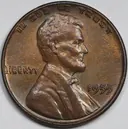
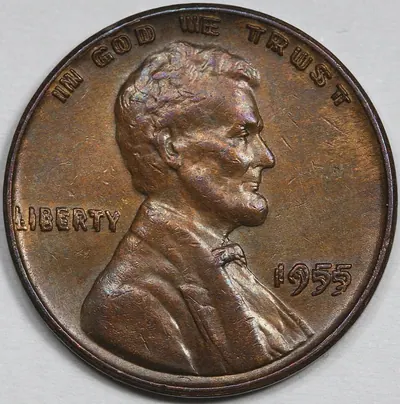
| 1955 doubled die obverse cent | Bold doubled date, LIBERTY and IN GOD WE TRUST | $320,625 (PCGS MS65+RD CAC, GreatCollections, Feb 2025); $287,156 (PCGS MS65+RD, GreatCollections, Jan 2023) |
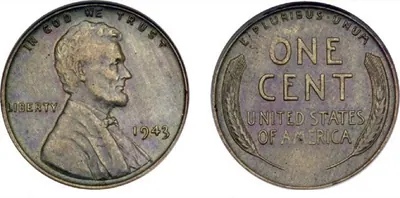
| 1943 cent struck on bronze | Copper-colored 1943 cent that does not stick to a magnet | $298,125 (PCGS AU50 CAC, GreatCollections, Nov 2022); $282,000 (NGC MS62BN, Heritage, Aug 2017) |
| 2000-P Sacagawea dollar / quarter mule | Golden dollar with George Washington quarter obverse | $194,062 (PCGS MS66, GreatCollections, Jan 2024) |
| 1972 doubled die obverse cent | Doubled LIBERTY, IN GOD WE TRUST and date | Strongest variety is FS-101; see the 1972 doubled die penny guide for sales |
| 2004-D Wisconsin ‘extra leaf’ quarter | Extra leaf on the left side of the corn stalk | $432 (NGC MS66, high leaf, Heritage, Jan 2023) |
Which one is yours? Check it with CoinLens →
Single auction results, not price guides. Prices include buyer's premium where the source says so. Your coin's value depends on grade, eye appeal and authentication.
DEMO
Check your Error Coins Worth Money: List With Pictures (What to Look For)
Add a photo of each side
Add a photo of at least one side first.
Demo — photos stay on your device. Nothing is uploaded.
DEMO
Your photos are ready. The identification happens in the CoinLens app.
On the web this is a demo — it can't recognize coins. In the app, the same two photos give you the coin's name, details and a value estimate.
Scan these in the free appEXAMPLE — what CoinLens shows
Value estimate:
Sample from our guide's data, not a result for your photo.
That was a sample. Scan your coin →·
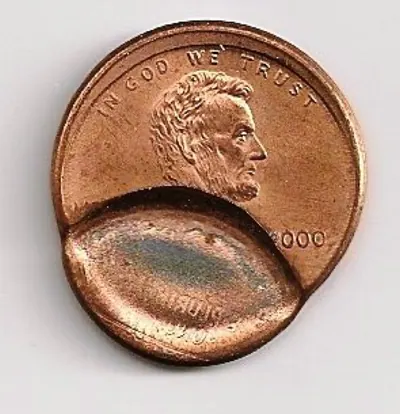
Error coins fall into three groups, and the group mostly decides the price:
- Die varieties — the die itself was made wrong, so every coin it struck shares the mistake. Doubled dies (1955, 1972, 1995 cents), repunched mint marks and the 2004-D Wisconsin “extra leaf” quarter are die varieties. Values run from a few dollars to six figures.
- Planchet errors — something was wrong with the blank: the wrong metal (1943 bronze cents), a clip, a lamination. Wrong-metal coins are among the most valuable errors in US coinage.
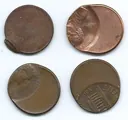
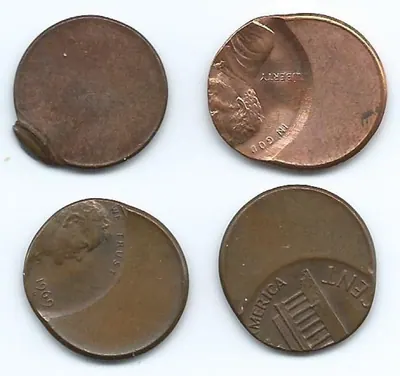
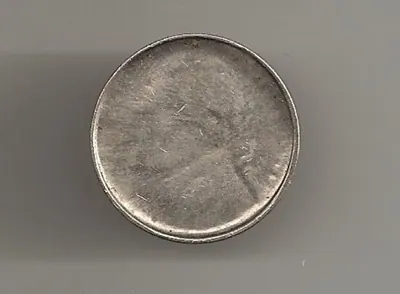
- Striking errors — something went wrong at the moment of the strike: off-center, broadstruck, double-struck, brockage, die cap, mule. The more dramatic and the more visible the date, the higher the value.
The table at the top lists the famous ones with real auction results.
Error coins list with pictures
1. 1955 doubled die obverse cent
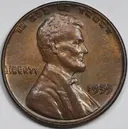
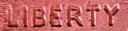
The best-known US error. The date, LIBERTY and IN GOD WE TRUST are strongly doubled, visible without a magnifier. The top public sale is $320,625 for a PCGS MS65+RD CAC at GreatCollections in February 2025; the Stewart Blay PCGS MS65+RD brought $287,156.25 there in January 2023. Beware: it’s one of the most faked US coins, and the much weaker “poor man’s doubled die” 1955 cents are machine doubling, not this variety.
2. 1943 cent struck on bronze
In 1943 cents were struck in zinc-coated steel. A few were struck on leftover bronze blanks. A real one is copper-colored and does not stick to a magnet; most “copper 1943” coins are plated steel cents or altered 1948 dates. A PCGS AU50 CAC sold for $298,125 at GreatCollections in November 2022, and an NGC MS62BN brought $282,000 at Heritage in August 2017. The reverse error, 1944 cents struck on steel, is also valuable.
3. Off-center strikes
The blank sat partly outside the dies, so part of the design is missing and the rest is a blank crescent. Collectors pay most for coins 50–60% off center with the full date visible. Small shifts (under about 5%) bring little premium. See our off-center coin value guide for how the percentage is judged.
4. Mules (two designs that don’t belong together)
A mule pairs dies from different denominations or designs. The famous one is the 2000-P Sacagawea dollar struck with a Washington quarter obverse. A PCGS MS66 sold for $194,062.50 at GreatCollections in January 2024.
5. 1972 doubled die obverse cent
Doubling is clear on LIBERTY, IN GOD WE TRUST and the date. Several different doubled dies exist for 1972; the strongest (FS-101) is the most valuable. A lesser variety, FS-103, sold for $336 in NGC MS65RD at Heritage in April 2023.
6. 2004-D Wisconsin “extra leaf” quarter
An extra leaf appears on the left side of the corn stalk, curving either high or low. An NGC MS66 high-leaf coin sold for $432 at Heritage in January 2023. These were found in circulation in Arizona and still turn up in rolls.
7. Clipped planchets
A curved bite missing from the rim, caused when the blanking punch overlapped an already punched hole. A genuine clip shows the Blakesley effect — a weak rim on the side opposite the clip. Common clipped cents are usually modest; large clips and multiple clips bring more.
8. Die caps and brockages
A die cap is a coin that stuck to the die and was struck again and again until it formed a cap shape. A brockage shows a mirror-image, sunken design on one side, made by a previous coin that stuck to the die. Both are dramatic and collected, and both are easy to fake with damage, so get them authenticated.
9. Die cracks and cuds
A die crack is a raised line across the design; a cud is a raised blob on the rim where a piece of the die broke off. Small cracks are very common and add little value; large cuds that touch the design are worth more.
10. Repunched mint marks (RPM)
Mint marks were punched into dies by hand until the 1990s, and a second punch sometimes landed slightly off the first. Under magnification you see two overlapping letters. Values depend on the specific listed variety.
What is NOT an error
Many coins sold online as “errors” are post-mint damage:
- Plating or color changes (gold-plated quarters, “copper” 1943 cents that are plated steel).
- Scratches, dents and gouges, including “missing” letters that were ground off.
- Machine (strike) doubling — flat, shelf-like doubling caused by die chatter. It looks like a doubled die but adds little or no value.
- Acid or heat damage that makes a coin look thin or misshapen.
If the coin weighs the right amount and the “error” is a scratch or a color, it’s almost always damage.
How to check your coin with CoinLens
Snap the front and back with Coin Identifier – CoinLens (iOS). The AI identifies the coin — year, type, composition — from a database of almost 500,000 coins and shows an estimated value for that issue, so you know exactly which year and variety to compare against. CoinLens does not certify errors; use the “what to look for” notes above and a magnifier, and send anything that looks major to PCGS or NGC. Free scans are limited; Premium unlocks unlimited scans. Get CoinLens on the App Store.
Where to sell error coins
Major errors (doubled dies, wrong metal, mules, big off-centers) sell best after grading, through auction houses such as Heritage, GreatCollections or Stack’s Bowers, or through error-coin specialist dealers. Minor errors sell on eBay; search sold listings for your exact coin and error type to see real prices before you list.
Frequently asked questions
What is the most valuable error coin?
Among US errors, wrong-metal 1943 and 1944 cents and double-denomination mules lead. A unique 1943-D bronze cent (PCGS MS64BN) was reported sold privately for about $1.7 million in 2010 (CoinWeek). The 2000-P Sacagawea dollar / Washington quarter mule reached $194,062.50 at GreatCollections in January 2024.
How do I know if my coin is an error?
Compare it with a normal coin of the same year under a 5x–10x magnifier. Look for doubled letters, a design that is shifted off the edge, a missing chunk of the rim, the wrong color or metal, or raised lumps along the rim. Damage after the coin left the mint (scratches, dents, plating) is not an error and adds no value.
Are error coins worth anything if they are worn?
Yes, major errors keep value in circulated grades: a 1943 bronze cent or 1955 doubled die is valuable even when worn. Minor errors (small die cracks, light doubling) usually need to be uncirculated to bring more than a few dollars.
Where can I find error coins in 2026?
Most finds come from searching rolls of cents and quarters from the bank, old jars and inherited collections. Modern errors still turn up in circulation; famous older ones like the 1955 doubled die are rarely found in change today.
Should I get my error coin graded?
If the error is major (doubled die, wrong metal, mule, off-center over 10%), yes. PCGS and NGC both attribute error types on the holder, and buyers pay much more for authenticated coins. For coins worth under about $50, grading fees usually cost more than they add.
Sources
- 1955 doubled die cent: GreatCollections Jan 2023 $287,156.25 (Blay, PCGS MS65+RD) and auction list (PCGS CoinFacts #2827)
- Lincoln cent collection tops $7.7 million at GreatCollections: 1955 DDO $287,156.25 (CoinNews)
- Error 1943 copper penny sells for nearly $300,000: PCGS AU50 CAC, GreatCollections, Nov 13 2022 (CoinNews)
- 1943 bronze cent NGC MS62BN realizes $282,000 at Heritage ANA 2017 (NGC)
- Someone paid $1.7 million for this penny (CoinWeek)
- Sacagawea / Washington quarter mule record $194,062.50 at GreatCollections (CoinWeek)
- 1972 doubled die obverse NGC MS65RD, Heritage lot 60317-54735 (Apr 2023)
- 2004-D Wisconsin extra leaf high: NGC MS66 $432, Heritage Jan 2 2023 (NGC Auction Central)
- Wisconsin quarter varieties (NGC)
- 1943 bronze cent (CONECA)
Values are estimates, not offers. Condition decides the price; for a valuable coin, get a professional grade.