How Much Is a 1982 Penny Worth? (Copper vs Zinc, Small vs Large Date)
Most 1982 pennies are worth one cent. Weigh yours: 3.11 g is copper (bronze), 2.5 g is zinc. Gems pay, like an NGC MS69 Red small date zinc at $4,636 (Heritage, March 26, 2026). A 1982-D small date on copper sold for $18,800; only two are known.
Have one in hand? Scan it with CoinLens to identify it and see an estimate in seconds.
| Type | Weight | MS66 Red | MS67 Red | MS68 Red and up |
|---|---|---|---|---|
| 1982 Large Date, copper | 3.11 g | $15–$61 | $120–$139 (PCGS) | NGC MS68 $1,344 (Oct 2026) and MS68+ $2,200 (Nov 2024), eBay |
| 1982 Small Date, copper | 3.11 g | $66–$80 (PCGS) | $168–$350 (PCGS) | PCGS MS68 $3,525 (Heritage, Aug 2016); NGC MS68 $1,598 (eBay, Jun 2026) |
| 1982 Large Date, zinc | 2.5 g | $14–$29 | $20–$35 (PCGS) | MS68 $115–$250; MS69 $430–$2,250 |
| 1982 Small Date, zinc | 2.5 g | $25–$37 | $31–$92 | MS68 $90–$500; NGC MS69 $4,636 (Heritage, Mar 2026) |
| 1982-D Large Date, copper | 3.11 g | $30–$49 (NGC) | $63–$370 (NGC, 3 sales) | — |
| 1982-D Large Date, zinc | 2.5 g | $20–$30 | $35–$45 (PCGS) | MS68 $111–$600 (2024–2026) |
| 1982-D Small Date, zinc | 2.5 g | $22–$61 | $44–$51 (PCGS) | NGC MS68 $305.50 (Heritage, 2015) |
| 1982-D Small Date, COPPER (error) | 3.11 g | — | — | Two known, both NGC AU58 BN: $18,800 (2017), $10,800 and $8,400 (2019) |
Which one is yours? Check it with CoinLens →
Middle half of eBay sold listings compiled by PriceCharting (2023–2026, observed Nov 26, 2026), plus Heritage and Stack's Bowers results from NGC Auction Central and CoinWeek. Circulated coins of every regular type are worth about face value. Estimates, not a price guide.
DEMO
Check your 1982 Lincoln Memorial Cent
Add a photo of each side
Add a photo of at least one side first.
Demo — photos stay on your device. Nothing is uploaded.
DEMO
Your photos are ready. The identification happens in the CoinLens app.
On the web this is a demo — it can't recognize coins. In the app, the same two photos give you the coin's name, details and a value estimate.
Scan these in the free appEXAMPLE — what CoinLens shows
Value estimate:
Sample from our guide's data, not a result for your photo.
That was a sample. Scan your coin →·
Coin facts
- Coin
- Lincoln Memorial Cent
- Years
- 1982
- Mints
- Philadelphia (no mint mark), West Point (no mint mark), Denver (D), San Francisco (S, proof only)
- Composition
- 95% copper, 5% zinc (bronze) or 97.5% zinc, 2.5% copper (copper-plated zinc)
- Weight
- 3.11 (bronze) / 2.5 (zinc) g
- Diameter
- 19.05 mm
- Designer
- Victor D. Brenner (obverse), Frank Gasparro (reverse)
Mintage
- 1982 (P, incl. West Point, all types)
- 10,712,525,000
- 1982-D (all types)
- 6,012,979,368
- 1982-S proof
- 3,857,479
| Grade | Typical sold price | Notes |
|---|---|---|
| Raw (from proof sets) | $3–$9 | 43 eBay sales |
| PR69 (PCGS or NGC) | $14–$25 | 27 eBay sales |
| PCGS PR70 DCAM | $1,178–$1,795 (eBay, 2024–2026) | Heritage $504–$930 (2017–2019); $2,115 (2013) |
| NGC PF70 Ultra Cameo | $885–$2,400 (eBay, 2023–2026) | — |
Which one is yours? Check it with CoinLens →
eBay sold listings via PriceCharting and Heritage via NGC Auction Central. Proofs are large date bronze, struck at San Francisco.
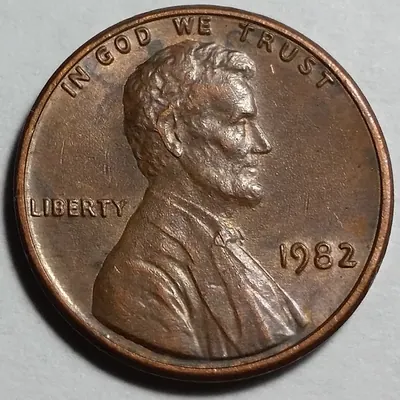
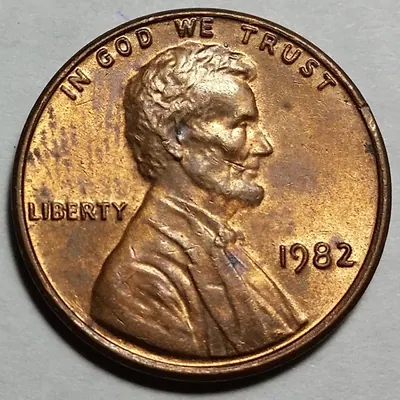
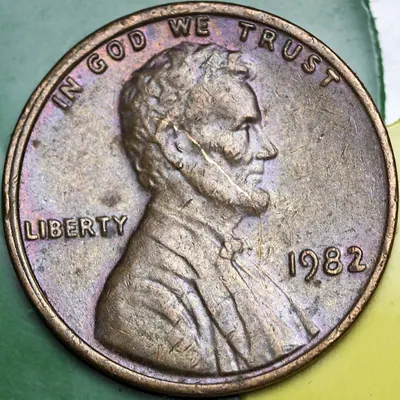
Almost every 1982 penny you find is worth one cent. What makes the year interesting is that the Mint changed two things at once. It switched the cent from bronze (95% copper, 3.11 g) to copper-plated zinc (2.5 g), and partway through the year it introduced a new obverse hub with a smaller date. Two metals, two date styles and two mints produced seven regular business-strike types, plus a large date bronze proof from San Francisco.
Where the money is:
- Gem certified coins. A PCGS MS68 Red copper small date sold for $3,525 at Heritage on August 10, 2016, and an NGC MS69 Red zinc small date for $4,636 on March 26, 2026.
- The 1982-D small date on copper. Denver never meant to make it. Only two are authenticated; one sold for $18,800 at Stack’s Bowers in August 2017.
- Perfect proofs. 1982-S proof cents in PR70 have sold for about $885–$2,400 on eBay.
Why 1982 has seven different pennies
Rising copper prices had pushed the cost of the bronze cent toward its face value. CoinWeek’s history of the change says the Mint tested an aluminum cent in the 1970s, dropped it, and by 1981 had a 97.5% zinc, 2.5% copper composition authorized. The switch then happened mint by mint:
| Date in 1982 | What happened | Source |
|---|---|---|
| January 7 | First zinc cents struck at West Point, followed soon after by Philadelphia | CoinWeek (Coin Analyst) |
| Mid-September | The Mint decides to make a new obverse master hub with a smaller date | CoinWeek (Coin Analyst) |
| October 21 | Denver strikes its last copper cents in the morning, then switches to zinc | CoinWeek, citing David W. Lange |
The result, according to CoinWeek: cents without a mint mark come in all four combinations (large or small date, copper or zinc), while Denver made only three on purpose (large date copper, large date zinc, small date zinc).
Step 1: Copper or zinc? Weigh it
| Composition | Weight | What to look for |
|---|---|---|
| Bronze (95% copper, 5% zinc) | 3.11 g | Even brown patina when worn; rings when dropped |
| Copper-plated zinc (97.5% zinc, 2.5% copper) | 2.5 g | Mottled or spotty color when worn; dull thud when dropped |
Lincoln cent specialist Charles Daughtrey told CoinWeek that he can tell the metals apart by sound: “The copper cent has a light ring to it that resonates after being dropped. Zinc cents don’t ring — there’s just a ‘thud’.” He adds that worn copper cents usually have an even brown patina, while worn zinc cents look splotched. Uncirculated zinc cents can look exactly like copper ones, so for those, weigh. A scale reading to 0.1 g separates 3.1 from 2.5; use one reading to 0.01 g if you are checking a possible error. Our copper vs zinc penny guide covers more tests.
Step 2: Small date or large date?
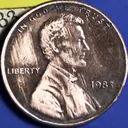
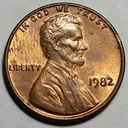
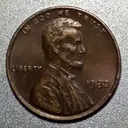
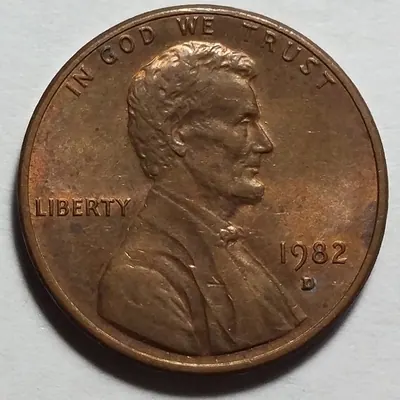
Compare your coin with the photos above:
- Small date: the tops and bottoms of the 1, 9, 8 and 2 line up along a straight line, the 2 has a gently curved stem, and the date sits a little farther from the rim. The upper loop of the 8 is smaller than the lower one.
- Large date: the 8 looks fat and stands taller than the 2, the tops of the 9 and 8 rise above their neighbors, and the 2 has a nearly straight diagonal.
CoinWeek adds that the lettering in LIBERTY and IN GOD WE TRUST is finer on the small date hub, a useful second check on worn coins.
Step 3: Check the mint mark
Denver cents have a D under the date. Philadelphia and West Point cents have no mint mark. The combination you should not find is a 1982-D with the small date that weighs about 3.1 g. That coin is the transitional error described below. Every other combination is a normal coin.
1982 penny value by type and grade
The first table above lists sold prices for each of the seven types. A few things stand out:
- Small dates beat large dates. In nearly every grade, small date coins sell for more than large date coins of the same metal. Daughtrey told CoinWeek in 2018 that the Philadelphia small date zinc was the toughest type, quoting about $30 for an uncirculated 50-coin roll, and that collectors were already hoarding them by 1983–84.
- Copper is worth more in Mint State. PCGS MS66 Red copper small dates sell for $66–$80, against $25–$37 for zinc small dates.
- The very top grades are where the money is. NGC’s single MS69 Red zinc small date result, $4,636 in March 2026, is the highest price for a regular 1982 business strike we found. MS69 large date zinc coins sold for $430–$2,250 on eBay.
- Old registry prices are stale. Heritage sold PCGS MS68 Red 1982-D large date zinc cents for $940–$1,233.75 in 2016, but most PCGS MS68 Red coins brought $282–$376 from February to June 2017, and NGC MS68 Red coins $288–$588 in 2020–2023. Expect today’s prices, not 2016’s.
Daughtrey also noted that most high-grade 1982 cents come from uncirculated sets, not from circulation.
The 1982-D small date copper penny (transitional error)
According to CoinWeek’s account, Minnesota collector Paul Malone was sorting a $50 bank bag of 5,000 cents on November 23, 2016, using a homemade weighing device to pull out copper cents. One 1982-D small date was heavy. NGC authenticated it in February 2017: it weighed 3.08 g and graded AU58 Brown. A second example, 3.07 g, also AU58 Brown, was authenticated later.
| Sale | Coin | Price |
|---|---|---|
| Stack’s Bowers, ANA auction, Aug 3, 2017 | Discovery coin (3.08 g), NGC AU58 BN | $18,800 |
| Heritage, Apr 25, 2019 | Second coin (3.07 g), NGC AU58 BN | $10,800 |
| Heritage, Sep 5, 2019 | Discovery coin again | $8,400 |
The resale shows that even a two-known error does not rise in price with every appearance. Numismatic News reported that the same 2017 Stack’s Bowers session also sold a copper 1983-D cent for $17,625, another coin that should not exist in copper.
To qualify, your coin must pass all three tests: a D mint mark, the small date design, and a weight near 3.11 g. CoinWeek stresses that most heavy 1982-D cents are ordinary large date copper coins, and that millions of 1982-D small dates are normal zinc.
Myth check: “my 1982 penny is worth $10,000”
Viral posts often claim any 1982 penny, or any heavy one, is worth thousands. The sales record says otherwise:
- A 3.1 g 1982 is normal. Philadelphia and Denver struck billions of copper 1982 cents before the switch.
- Raw “1982-D copper small date” listings are unproven. PriceCharting logged more than a dozen uncertified coins sold on eBay in 2023–2024 for $325 to $2,500 each. None of them was certified, and CoinWeek still counts only two authenticated examples. Paying four figures for a raw one is a gamble on the seller’s scale.
- The real five-figure coins are graded. Every 1982 cent above $5,000 in this guide carries an NGC or PCGS grade and an auction record.
If you think you have one, weigh it, check the date and mint mark, and send it to NGC or PCGS. Don’t clean it.
1982 doubled dies and other varieties
Daughtrey estimated in 2018 that there are 19 or 20 known 1982 die varieties, with more likely undiscovered. The main ones in Wexler’s files:
- Copper large date doubled die obverse (WDDO-002, FS-01-1982-101): a clockwise spread on IN GOD WE TRUST and LIBERTY. Certified examples sold for $150 (PCGS MS63 Red, September 2025) and $160 (NGC MS64 Red, May 2026); Daughtrey valued it at about $25 in MS-60 in 2018.
- WDDO-005: a spread on LIBERTY, IN GOD, the date, the ear, the hair behind it and the vest folds.
- Doubled die reverse WDDR-002 (FS-01-1982-801): a strong spread on E PLURIBUS UNUM, UNITED STATES OF AMERICA, ONE CENT and most of the Memorial’s columns.
- Doubled working hub (WWHO-001): mild uneven thickness on LIBER and IN GOD WE TRUST. Wexler reclassified several earlier “doubled die” listings as this hub variety, so check older attributions.
- Zinc small date doubled die reverse: discovered in 2007. Daughtrey said in 2018 that only three had been found and that a choice Red example could bring $15,000.
- 1982-D doubled dies (WDDO-001 to -003): minor extra thickness on LIBERTY, IN GOD WE TRUST and the date; WDDO-003 also shows the lower ear.
1982-S proof penny value
The 1982-S proof is a large date bronze coin struck at San Francisco and sold in proof sets. Raw proofs bring $3–$9 and PR69 coins $14–$25. Perfect PR70 coins are scarce: the second table shows eBay sales of $1,178–$1,795 (PCGS) and $885–$2,400 (NGC), and Heritage sold PCGS PR70 Deep Cameo coins for $504–$930 in 2017–2019.
How to check your coin with CoinLens
Take a photo of both sides with Coin Identifier – CoinLens (iPhone and Android) to identify the coin and get an instant value estimate, composition and minting details. A photo cannot weigh a coin, so use a scale to confirm copper or zinc. If you have a 3.1 g 1982-D small date, send it to PCGS or NGC for authentication.
Where to sell
- Normal 1982 cents: spend them, or keep the copper ones as a curiosity. Melting cents is prohibited (31 CFR Part 82).
- Uncirculated rolls of the 1982 Philadelphia zinc small date: coin dealers and eBay.
- Certified gems, PR70 proofs or the 1982-D copper small date: Heritage, Stack’s Bowers or GreatCollections.
The next year, the first full year of zinc, has its own two big errors: see our 1983 penny value guide.
Frequently asked questions
How do I tell if my 1982 penny is copper or zinc?
Weigh it on a scale that reads 0.01 g. Copper (bronze) 1982 cents weigh 3.11 g and zinc cents weigh 2.5 g. You can also drop it on a hard surface: copper rings and zinc gives a duller thud. Weight is the reliable test.
How do I tell a 1982 small date from a large date?
Look at the 2 and the 8. On the large date the 2 has a nearly straight diagonal and the 8 is fat and taller than the 2. On the small date the tops of the digits line up, the 2 has a curvier stem, and the date sits farther from the rim.
Which 1982 penny is worth the most?
The 1982-D small date struck on a copper planchet: only two are known, and one sold for $18,800 in 2017. Among regular types, top-grade small date coins lead, such as a PCGS MS68 Red copper small date at $3,525 and an NGC MS69 Red zinc small date at $4,636.
Is a 1982-D small date penny rare?
In zinc it is common. In copper (3.11 g) it is a major rarity: only two authenticated examples are known, both NGC AU58 Brown.
Is a 1982 penny that weighs 3.1 grams valuable?
Usually not. Billions of 1982 cents from Philadelphia and Denver were struck in copper, and they weigh about 3.1 g. Only a 3.1 g coin that also has a D mint mark and the small date is the rare error.
Is a 1982 copper penny worth more than face value?
Circulated copper 1982 cents are common and trade near face value. Federal rules (31 CFR Part 82) prohibit melting cents, so copper content does not add cash value.
Why are there so many kinds of 1982 penny?
In 1982 the Mint switched from bronze to copper-plated zinc and also introduced a new obverse hub with a smaller date. Combining two metals, two date styles and two mints produced seven business-strike types, plus the bronze large date proof.
Is there a 1982 doubled die penny?
Yes. The best known is the copper large date doubled die obverse (FS-101), with doubling on IN GOD WE TRUST and LIBERTY; certified MS63–MS64 Red coins sold for $150–$160 in 2025–2026. A rare zinc small date doubled die reverse was discovered in 2007.
Sources
- CoinWeek: The 1982-D Penny That Shouldn't Exist — One Sold for $18,800 (Nov 2026)
- Numismatic News: Cents Bring $35,624.98 Profit to Finders (Aug 2017)
- CoinWeek: 1982 Lincoln Memorial Cent — History and Value
- CoinWeek, The Coin Analyst: 1982 Lincoln Cent Provides Collectors with Challenges, Rewards (2018)
- NGC Auction Central: 1982 Small Date zinc MS sales (NGC MS69 Red $4,636, Mar 2026)
- NGC Auction Central: 1982 Large Date zinc MS sales
- NGC Auction Central: 1982-D Large Date zinc MS sales
- NGC Auction Central: 1982-D Small Date bronze transitional sales
- NGC Auction Central: 1982-S proof sales
- PriceCharting: 1982 Small Date zinc sold listings (other 1982 types linked from the same page)
- PriceCharting: 1982 Large Date bronze sold listings
- PriceCharting: 1982 Small Date bronze sold listings
- PriceCharting: 1982 Large Date zinc sold listings
- PriceCharting: 1982-D Large Date bronze sold listings
- PriceCharting: 1982-D Large Date zinc sold listings
- PriceCharting: 1982-D Small Date zinc sold listings
- PriceCharting: 1982-S proof sold listings
- NGC Auction Central: 1982 Small Date bronze MS sales (PCGS MS68 Red $3,525, Heritage Aug 10 2016, lot 1238-3279)
- PriceCharting: 1982-D Small Date bronze transitional sold listings
- PriceCharting: 1982 Large Date bronze doubled die sold listings
- Wexler's Die Varieties: 1982 doubled dies (WDDO-002 = FS-01-1982-101; WDDR-002 = FS-01-1982-801)
- Wexler's Die Varieties: 1982-D doubled dies
- Wikipedia: Lincoln cent mintage figures (US Mint data)
- 31 CFR Part 82 — prohibition on melting one-cent coins (eCFR)
Values are estimates, not offers. Condition decides the price; for a valuable coin, get a professional grade.