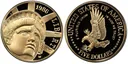
How Much Are 1983 and 1984 Olympic Coins Worth? (Silver Dollars & $10 Gold)
The 1983 and 1984 Los Angeles Olympic silver dollars each hold 0.7734 oz of silver and sold for about $40–$75 on eBay in 2025–2026, proof or uncirculated. The 1984 $10 gold eagle, nearly half an ounce of gold, sold for $1,000–$2,700, with NGC PF70 coins at the top.
Have one in hand? Scan it with CoinLens to identify it and see an estimate in seconds.
| Coin | Silver value | Typical sales | Higher sales |
|---|---|---|---|
| 1983-P, D or S dollar (uncirculated) | $33.53 melt | $44–$65 (2026) | PCGS/NGC MS69 $63–$91 (2026) |
| 1983-S dollar (proof) | $33.53 melt | $44–$60 (2026) | $95.03 (Sep 2026) |
| 1984-P or S dollar (uncirculated) | $33.53 melt | $52.50–$65 (2025–2026) | NGC MS69 $40–$84.99 (2025–2026) |
| 1984-S dollar (proof) | $33.53 melt | $49.99–$75 (2026) | — |
| 1984-W $10 gold (uncirculated) | — | $1,900 (Nov 2025) | — |
| 1984 $10 gold (proof) | — | $1,000 (Dec 2024) | NGC PF70 Ultra Cameo $2,599.99–$2,700 (2026) |
Which one is yours? Check it with CoinLens →
Completed eBay sales recorded by PriceCharting. Gold coin prices move with the gold price. Silver value updates with the live silver price. Melt at silver $43.35/oz, November 26, 2026.
DEMO
Check your 1983–1984 Los Angeles XXIII Olympiad commemorative coins
Add a photo of each side
Add a photo of at least one side first.
Demo — photos stay on your device. Nothing is uploaded.
DEMO
Your photos are ready. The identification happens in the CoinLens app.
On the web this is a demo — it can't recognize coins. In the app, the same two photos give you the coin's name, details and a value estimate.
Scan these in the free appEXAMPLE — what CoinLens shows
Value estimate:
Sample from our guide's data, not a result for your photo.
That was a sample. Scan your coin →·
Coin facts
- Coin
- Los Angeles XXIII Olympiad commemorative coins
- Years
- 1983–1984
- Mints
- Philadelphia (P), Denver (D), San Francisco (S), West Point (W)
- Composition
- Silver dollars: 90% silver, 10% copper; $10 eagle: 90% gold, 10% copper (per Public Law 97-220)
- Weight
- 26.73 g
- Silver (ASW)
- 0.7734 troy oz
- Melt value
- $33.53
Mintage
- 1983 dollar, uncirculated (P/D/S)
- 294,543 / 174,014 / 174,014
- 1983-S dollar, proof
- 1,577,025
- 1984 dollar, uncirculated (P/D/S)
- 217,954 / 116,675 / 116,675
- 1984-S dollar, proof
- 1,801,210
- 1984-W $10 gold, uncirculated
- 75,886
- 1984 $10 gold, proof (P/D/S/W)
- 33,309 / 34,533 / 48,551 / 381,085
| Coin | Specification | Maximum mintage | Surcharge |
|---|---|---|---|
| Silver dollar (two designs, 1983 and 1984) | 26.73 g, 1.50 in, 90% silver | 50,000,000 | At least $10 |
| $10 gold eagle | 16.718 g, 1.06 in, 90% gold | 2,000,000 | At least $50 |
Which one is yours? Check it with CoinLens →
From the text of Public Law 97-220 (July 22, 1982). Surcharges were split 50/50 between the US Olympic Committee and the Los Angeles Olympic Organizing Committee. Melt at silver $43.35/oz, November 26, 2026.
| Coin | Sold (approx.) | Share sold as proofs |
|---|---|---|
| 1983 silver dollar (P, D, S) | 2.22 million | About 76% (both dollars) |
| 1984 silver dollar (P, D, S) | 2.25 million | About 76% (both dollars) |
| 1984 $10 gold (P, D, S, W) | More than 573,000 | About 34% |
| All coins | 5,045,474 | — |
Which one is yours? Check it with CoinLens →
CoinWeek (Commemorative Stories, Part VII) and Coin World. About $73.4–$73.5 million in surcharges was raised, far short of the plan. Melt at silver $43.35/oz, November 26, 2026.
| Coin | Grade | Sold | Date |
|---|---|---|---|
| 1984-P silver dollar | CAC MS70 | $228.99 | Feb 2026 |
| 1984-S silver dollar (proof) | NGC PF70 Ultra Cameo | $199.99 | May 2026 |
| 1984-S $10 gold (proof) | NGC PF70 Ultra Cameo | $1,841 | Apr 2025 |
eBay sales recorded by PriceCharting (see sources). Melt at silver $43.35/oz, November 26, 2026.
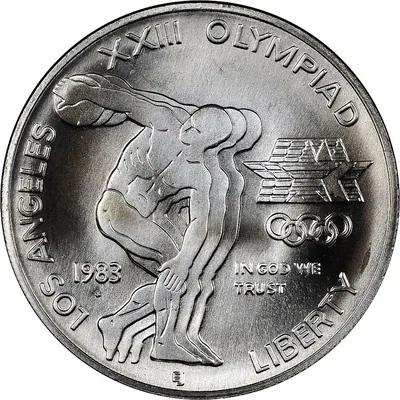
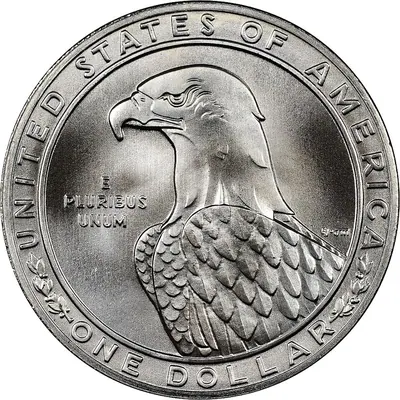
The silver dollars are worth about their silver plus a small premium; the gold eagle is worth about its gold. The US Mint issued three coins for the 1984 Los Angeles Olympics (Wikipedia):
- 1983 silver dollar (discus thrower): about $44–$65 on eBay in 2026; MS69 coins $63–$91.
- 1984 silver dollar (Coliseum gateway): about $50–$75; NGC MS69 coins $40–$85.
- 1984 $10 gold eagle (torch runners): $1,000 to $2,700, the top for NGC PF70 Ultra Cameo coins.
Each silver dollar holds 0.7734 oz of silver (26.73 g at 90% silver, per PCGS and Wikipedia); the live silver value is shown above.
The three coins
| Coin | Design | Mints and finishes |
|---|---|---|
| 1983 $1 | Discus thrower (obverse); eagle’s head (reverse) | Uncirculated P, D, S; proof S |
| 1984 $1 | Statues atop the Los Angeles Memorial Coliseum gateway, by Robert Graham; eagle (reverse) | Uncirculated P, D, S; proof S |
| 1984 $10 gold | Male and female torch runners; eagle with olive branch and arrows | Uncirculated W; proofs P, D, S, W |
The 1983 dollar was the first commemorative dollar since the 1922 Grant Memorial gold dollar (Wikipedia).
Which Olympic coins are scarcest
- 1984 $10 gold proofs from Philadelphia (33,309) and Denver (34,533). These carry mint marks P and D; look for them before treating a coin as an ordinary West Point proof.
- Uncirculated 1983-D and 1983-S dollars (174,014 each) and 1984-D and 1984-S dollars (116,675 each) have lower mintages than the proofs, but sold for similar prices in the eBay results above.
The law behind the coins
Public Law 97-220, the Olympic Commemorative Coin Act, was approved on July 22, 1982. Senator Alan Cranston’s original 1981 bill was far bigger, with 29 designs, and drew objections from the Treasury, Representative Frank Annunzio, the American Numismatic Association and others. The final law authorized up to 50 million silver dollars in two designs, one for 1983 and one for 1984, and up to 2 million $10 gold coins, in both proof and uncirculated finishes. Each dollar carried a surcharge of at least $10 and each gold coin at least $50, split equally between the US Olympic Committee, for athlete training and facilities, and the Los Angeles Olympic Organizing Committee, to stage the Games. The law also required the program to cost the government nothing.
How sales went
Pre-orders opened on October 15, 1982 and sales closed on January 18, 1985. To drum up interest, the Treasury expanded the program from 6 to 13 coins by offering versions from different mints, and Mint Director Donna Pope announced the W mint mark on the gold coin. Even so, only 5,045,474 coins sold, raising about $73.4–$73.5 million in surcharges, far short of the roughly $600 million that selling every authorized coin would have produced. The second table above shows the split. Collectors strongly preferred proofs: about 76% of the dollars sold were proofs, but only about 34% of the gold coins.
That buying pattern explains today’s scarcities. The 1983-P and 1984-P uncirculated dollars were the only uncirculated dollars sold singly; the D and S uncirculated dollars came only in three-coin P-D-S sets.
The firsts on the $10 gold coin
The 1984 $10 was the first gold coin struck by the US Mint since 1933 and the first coin to carry a W mint mark. West Point was still a bullion depository; it became an official mint only in 1988. James Peed designed the eagle reverse, with 13 stars and no shield, and John Mercanti adapted Peed’s torch runners for the obverse.
A long road through Congress
The bill moved slowly: the Senate passed it on December 9, 1981, the House passed an amended version on May 20, 1982, and the Senate agreed on July 1, 1982. The law also barred anyone from suggesting that buying the coins was tax-deductible, and any money left with the Los Angeles organizers after March 31, 1985 went to the US Olympic Committee.
How to check your coins with CoinLens
Photograph each coin with Coin Identifier – CoinLens to identify it and see its composition and an instant value estimate, then save it to your collection. Keep the coins in their Mint capsules and boxes; original packaging helps when you sell.
Where to sell Olympic coins
- Silver dollars: eBay, a local coin shop or a bullion dealer, priced near silver value.
- $10 gold eagles: coin shops and bullion dealers price them on gold; certified PF70 coins sell best on eBay or at auction.
For the next big 1980s commemorative program, see our 1986 Statue of Liberty coins guide.
Silver melt value calculator
Los Angeles XXIII Olympiad commemorative coins: 0.7734 troy oz of silver each
Melt value ($33.53 each)
Silver spot $43.35/oz as of November 26, 2026 (gold-api.com)
Melt value today for a pile, a roll or $ face value → Silver melt calculator
Melt value is the floor. Condition and mint details decide the rest — check yours in the app.
Frequently asked questions
How much is a 1984 Olympic silver dollar worth?
About its silver value plus a small premium: 1984 Olympic dollars sold for roughly $50–$75 on eBay in 2025–2026, and NGC MS69 coins for $40–$85. Each holds 0.7734 oz of silver.
How much is a 1983 Olympic silver dollar worth?
Similar to the 1984: uncirculated and proof 1983 dollars sold for about $44–$65 on eBay in 2026, with PCGS or NGC MS69 coins at $63–$91.
How much is the 1984 Olympic $10 gold coin worth?
Mostly its gold value. Recent eBay sales ranged from $1,000 (proof, December 2024) and $1,900 (uncirculated W, November 2025) to $2,700 for an NGC PF70 Ultra Cameo in 2026.
Which 1984 Olympic $10 gold coins are scarcest?
The proofs from Philadelphia (33,309) and Denver (34,533), followed by San Francisco (48,551). West Point made far more proofs (381,085) plus 75,886 uncirculated coins (Wikipedia).
Are 1983 and 1984 Olympic coins pure silver?
No. The dollars are 90% silver and 10% copper, weighing 26.73 g with 0.7734 oz of pure silver. The $10 eagle is 90% gold.
How much did the Olympic coins raise?
About $73.4–$73.5 million in surcharges for the US Olympic Committee and the Los Angeles organizers, far short of the original hopes; selling every authorized coin would have raised about $600 million. The Mint made a net profit of $10.3 million.
Why is the 1984 $10 gold coin important?
It was the first gold coin struck by the US Mint since 1933 and the first coin to carry a W mint mark for West Point, which wasn’t yet an official mint. It was offered with P, D, S and W mint marks.
Who designed the 1983 and 1984 Olympic dollars?
The 1983 discus thrower was designed by Chief Engraver Elizabeth Jones, based on Myron’s ancient statue. The 1984 dollar, showing the gateway of the Los Angeles Memorial Coliseum, was by sculptor Robert Graham, who also made the Coliseum’s gateway statues.
Sources
- Wikipedia: 1984 Summer Olympics commemorative coins (designs, designers, mintages)
- Wikipedia: List of United States commemorative coins (1980s) (composition and mintage by mint)
- PCGS CoinFacts: 1984-S $1 Olympic (26.73 grams)
- PriceCharting: 1983-P Olympics dollar, completed eBay sales
- PriceCharting: 1983-S Olympics proof dollar, completed eBay sales
- PriceCharting: 1984-P Olympics dollar, completed eBay sales
- PriceCharting: 1984-S Olympics proof dollar, completed eBay sales
- PriceCharting: 1984-S Olympics dollar, completed eBay sales
- PriceCharting: 1984-W Olympics $10 gold proof, completed eBay sales
- PriceCharting: 1984-W Olympics $10 gold, completed eBay sales
- Public Law 97-220 (Olympic Commemorative Coin Act), govinfo
- Wikipedia: 1984 Summer Olympics commemorative coins
- CoinWeek: Commemorative stories, 1983–84 LA Olympics coins, Part VII (sales)
- Coin World: Marketing the 1984 Los Angeles Olympics, Mint innovates to raise interest and money
- CoinWeek: Our best sides, 30 years of modern commemoratives (designers)
- PriceCharting: 1984-P Olympic dollar sales
- PriceCharting: 1984-S Olympic proof sales
Values are estimates, not offers. Condition decides the price; for a valuable coin, get a professional grade.