How Much Are 1986 Statue of Liberty Coins Worth? (Half, Silver Dollar & $5 Gold)
The 1986 Statue of Liberty coins mark the statue's centennial. The clad half sells for about $2–$15, the 90% silver dollar for about $28–$55 and the $5 gold for about $1,000–$1,130 (eBay, 2025–2026). Perfect grades add a premium: a PCGS MS70 dollar sold for $119.95 (eBay, April 2026).
Have one in hand? Scan it with CoinLens to identify it and see an estimate in seconds.
| Coin | Silver value | Recent sales | Notes |
|---|---|---|---|
| 1986-D half dollar (uncirculated) | — | $3.25–$5.95 (2026) | Clad, no silver |
| 1986-S half dollar (proof) | — | $1.80–$15 (2026) | Clad, no silver |
| 1986-P silver dollar (uncirculated) | $33.53 melt | $37.49–$55 (2026) | 723,635 distributed |
| 1986-S silver dollar (proof) | $33.53 melt | $27.99–$49 (2025–2026) | 6,414,638 distributed |
| 1986-W $5 gold (uncirculated) | — | $1,075–$1,129 (2026) | 95,248 struck |
| 1986-W $5 gold (proof) | — | $1,000 (Jun 2026) | 404,013 struck |
Which one is yours? Check it with CoinLens →
Completed eBay sales recorded by PriceCharting. The gold coin tracks the gold price. Silver value updates with the live silver price. Melt at silver $43.35/oz, November 26, 2026.
DEMO
Check your 1986 Statue of Liberty commemorative coins
Add a photo of each side
Add a photo of at least one side first.
Demo — photos stay on your device. Nothing is uploaded.
DEMO
Your photos are ready. The identification happens in the CoinLens app.
On the web this is a demo — it can't recognize coins. In the app, the same two photos give you the coin's name, details and a value estimate.
Scan these in the free appEXAMPLE — what CoinLens shows
Value estimate:
Sample from our guide's data, not a result for your photo.
That was a sample. Scan your coin →·
Coin facts
- Coin
- Statue of Liberty commemorative coins
- Years
- 1986
- Mints
- Philadelphia (P), Denver (D), San Francisco (S), West Point (W)
- Composition
- Half dollar: copper-nickel clad; dollar: 90% silver, 10% copper; $5: 90% gold, 6% silver, 4% copper
- Silver (ASW)
- 0.7734 troy oz
- Melt value
- $33.53
- Designer
- Edgar Z. Steever and Sheryl J. Winter (half); John Mercanti and Matthew Peloso (dollar); Elizabeth Jones ($5, both sides)
Mintage
- Half dollar, uncirculated (D)
- 928,008
- Half dollar, proof (S)
- 6,925,627
- Silver dollar, uncirculated (P)
- 723,635
- Silver dollar, proof (S)
- 6,414,638
- $5 gold, uncirculated (W)
- 95,248
- $5 gold, proof (W)
- 404,013
| Coin | Theme required by law | Specification | Maximum mintage | Surcharge |
|---|---|---|---|---|
| $5 gold | Centennial of the Statue of Liberty | 8.359 g, 0.850 in, 90% gold | 500,000 | $35 |
| Silver dollar | Ellis Island as a gateway for immigrants | 26.73 g, 1.500 in, 90% silver | 10,000,000 | $7 |
| Half dollar | Contributions of immigrants to America | 11.34 g, 1.205 in, copper-nickel clad | 25,000,000 | $2 |
Which one is yours? Check it with CoinLens →
From the text of Public Law 99-61 (July 9, 1985). Surcharges went to the Statue of Liberty-Ellis Island Foundation for the restoration and an endowment. Melt at silver $43.35/oz, November 26, 2026.
| Coin | Grade | Sold | Date | Typical raw coin |
|---|---|---|---|---|
| 1986-D half | NGC MS70 | $56 | Feb 2026 | $3.25–$5.95 |
| 1986-S half (proof) | NGC PF70 Ultra Cameo | $40 | Aug 2026 | $1.80–$15 |
| 1986-P dollar | PCGS MS70 | $119.95 | Apr 2026 | $37.49–$55 |
| 1986-P dollar | NGC MS70 | $90 and $127.50 | Sept and May 2026 | $37.49–$55 |
| 1986-S dollar (proof) | PCGS PR70 DCAM | $100 | Oct 2026 | $27.99–$49 |
| 1986-W $5 gold (proof) | PCGS PR69 DCAM / NGC PF69 UC | $885 / $925 | June–July 2025 | About gold value |
| 1986-W $5 gold (unc) | PCGS MS69 | $950 and $975 | May and Oct 2025 | About gold value |
Which one is yours? Check it with CoinLens →
Completed eBay sales recorded by PriceCharting (pages cited). A 70 grade roughly doubles to triples a silver dollar's price; on the gold coin, grade adds little over metal value. Melt at silver $43.35/oz, November 26, 2026.
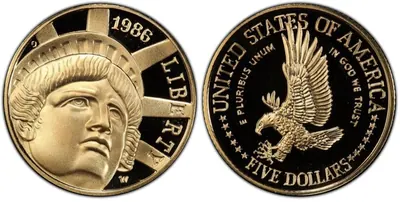
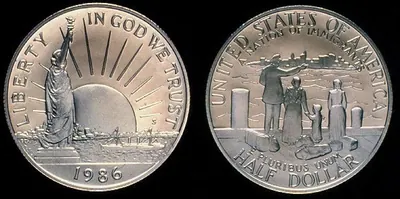
The half and dollar sell for close to their metal value; the $5 gold is the valuable one. The US Mint struck three coins in 1986 for the centennial of the Statue of Liberty (Wikipedia). Recent eBay sales:
- Half dollar (clad): about $2–$15, uncirculated or proof.
- Silver dollar (90% silver, 0.7734 oz): about $28–$55.
- $5 gold: about $1,000–$1,130.
The three coins
| Coin | Obverse | Reverse | Finishes |
|---|---|---|---|
| Half dollar | Statue of Liberty with an immigrant ship (Edgar Z. Steever) | Immigrant family at Ellis Island (Sheryl J. Winter) | Uncirculated D; proof S |
| Silver dollar | Statue of Liberty in front of Ellis Island (John Mercanti) | Liberty’s torch and lines from “The New Colossus” (Mercanti with Matthew Peloso) | Uncirculated P; proof S |
| $5 gold | Close-up of the statue’s face (Elizabeth Jones) | Eagle in flight (Elizabeth Jones) | Uncirculated W; proof W |
Mintages and history
Millions of halves and dollars were sold: 6,925,627 proof halves and 6,414,638 proof dollars (Wikipedia). Unsold dollars were melted, more than 1,215,327 according to Q. David Bowers (PCGS). With such large mintages, the half and dollar carry little premium today.
The law behind the coins
The coins were created by Public Law 99-61, signed on July 9, 1985. Its first part, the Statue of Liberty-Ellis Island Commemorative Coin Act, authorized the three coins. Its second part, the Liberty Coin Act, created the one-ounce American Silver Eagle that followed in late 1986 (see our 1986 Silver Eagle guide). The law gave each coin a theme, which is why the designs differ so much:
- $5 gold: the centennial of the Statue itself.
- Silver dollar: Ellis Island as a gateway for immigrants. The torch reverse quotes Emma Lazarus’s 1883 poem “The New Colossus”.
- Half dollar: the contributions of immigrants to America. The obverse shows the Statue as it looked in 1913, with an immigrant ship.
The law also set mintage caps of 500,000 gold coins, 10 million dollars and 25 million halves, and required the silver to come from the national strategic stockpile. Sales could begin on October 1, 1985, and no coins could be struck after December 31, 1986, which is why every coin is dated 1986. The gold was struck at a single facility, West Point, so every $5 carries a W.
Where the money went
Each coin carried a surcharge on top of its metal and production cost: $35 per $5 gold, $7 per dollar and $2 per half. The money went to the Statue of Liberty-Ellis Island Foundation to restore the Statue and the Ellis Island immigration buildings, and to fund an endowment for their upkeep; the law also let the Government Accountability Office audit the Foundation. CoinWeek puts the total raised at about $78 million. Millions of these coins were sold, which is why so many sit in collections today.
Proof or uncirculated? How to tell
Each coin was made in two finishes, and the mint mark tells them apart:
- Half dollar: uncirculated coins carry a D (Denver); proofs carry an S (San Francisco).
- Silver dollar: uncirculated coins carry a P (Philadelphia); proofs an S.
- $5 gold: both finishes carry a W (West Point). The proof has mirror-like fields and frosted design; the uncirculated coin has an even satin luster.
Proofs were far more popular in 1986: about seven proof halves and nine proof dollars were sold for every uncirculated one. That’s why the uncirculated coins, especially the 723,635 1986-P dollars and the 95,248 uncirculated $5 gold pieces, are the scarcer versions, though the premium for scarcity is modest.
Are perfect-grade coins worth more?
Somewhat. The second table above shows that a PCGS or NGC 70 silver dollar recently sold for about $90–$128, two to three times a raw coin, and a PCGS MS70 with a label signed by designer John Mercanti brought $219.45. Halves in 70 sell for $40–$56. On the $5 gold coin, grading adds little: MS69 and PR69 coins sold for $885–$975, close to the coin’s gold value. If you have a raw set in Mint packaging, grading is usually only worth it for the silver dollar, and only if it looks flawless.
How to check your coins with CoinLens
Photograph each coin with Coin Identifier – CoinLens (iPhone and Android) to identify it, see its composition and an instant value estimate, and save it to a collection that totals its value. Keep the coins in their Mint capsules and boxes; the original packaging helps when you sell.
Where to sell Statue of Liberty coins
- Half dollars and silver dollars: eBay, a coin shop or a bullion dealer. Silver dollars trade close to their silver value, which updates live in the table above.
- $5 gold coins: coin shops and bullion dealers, priced on gold value. Compare two or three quotes.
- Graded 70 coins: eBay or an online auction, with the certification number in the listing.
For the earlier Los Angeles Olympic coins, see our 1983–1984 Olympic coins guide.
Silver melt value calculator
Statue of Liberty commemorative coins: 0.7734 troy oz of silver each
Melt value ($33.53 each)
Silver spot $43.35/oz as of November 26, 2026 (gold-api.com)
Melt value today for a pile, a roll or $ face value → Silver melt calculator
Melt value is the floor. Condition and mint details decide the rest — check yours in the app.
Frequently asked questions
How much is a 1986 Statue of Liberty silver dollar worth?
About its silver value: uncirculated 1986-P dollars sold for $37.49–$55 and proof 1986-S dollars for $27.99–$49 on eBay in 2025–2026. Each holds 0.7734 oz of silver.
Is the 1986 Statue of Liberty half dollar silver?
No. The half dollar is copper-nickel clad, so it sells for a few dollars: $3.25–$5.95 for uncirculated and $1.80–$15 for proofs in 2026.
How much is the 1986 Statue of Liberty $5 gold coin worth?
Mostly its gold value. Uncirculated 1986-W coins sold for $1,075–$1,129 and a proof for $1,000 on eBay in 2026; 95,248 uncirculated and 404,013 proof coins were struck.
How many 1986 Statue of Liberty coins were made?
928,008 uncirculated and 6,925,627 proof halves; 723,635 uncirculated and 6,414,638 proof dollars; and 95,248 uncirculated and 404,013 proof $5 gold coins (Wikipedia).
Who designed the 1986 Statue of Liberty coins?
Edgar Z. Steever (half obverse) and Sheryl J. Winter (half reverse); John Mercanti and Matthew Peloso (dollar); Elizabeth Jones, then Chief Engraver, designed both sides of the $5 gold coin, per Wikipedia.
How much money did the Statue of Liberty coins raise?
The surcharges of $35 per gold coin, $7 per dollar and $2 per half raised about $78 million for the restoration of the Statue of Liberty and Ellis Island, according to CoinWeek.
What did they cost in 1986?
Advance prices were $5 for an uncirculated half, $6.50 for a proof half, $20.50 for an uncirculated dollar and $22.50 for a proof dollar, rising slightly on January 1, 1986 (PCGS, Bowers).
Sources
- Wikipedia: Statue of Liberty commemorative coins (designs and designers)
- Wikipedia: List of United States commemorative coins (1980s) (composition and mintages)
- PCGS / Q. David Bowers, Commemorative Coins of the United States: 1986 Statue of Liberty half dollars (prices and options)
- PCGS / Q. David Bowers, Commemorative Coins of the United States: 1986 Statue of Liberty silver dollars (distribution, prices, melted coins)
- PriceCharting: 1986-D Statue of Liberty half, completed eBay sales
- PriceCharting: 1986-P Statue of Liberty dollar, completed eBay sales
- PriceCharting: 1986-S Statue of Liberty proof, completed eBay sales
- PriceCharting: 1986-W Statue of Liberty $5 gold proof, completed eBay sales
- PriceCharting: 1986-W Statue of Liberty $5 gold, completed eBay sales
- PCGS CoinFacts: 1984-S $1 Olympic (26.73 g, the standard 90% silver commemorative dollar weight)
- Public Law 99-61 (Statue of Liberty-Ellis Island Commemorative Coin Act and Liberty Coin Act), govinfo
- CoinWeek: Six United States coins that honor the Statue of Liberty ($78 million in surcharges)
Values are estimates, not offers. Condition decides the price; for a valuable coin, get a professional grade.