How Much Are Old German Coins Worth? (Mark, Reichsmark, Pfennig)
Most old German coins are worth little: pfennigs and post-war Deutsche Mark coins were made by the hundred million. The money is in silver (2, 3 and 5 Mark, 1873–1915; 5 Reichsmark, 1927–1939) and gold: a Prussia 20 Mark 1888 A hammered for €550 at Künker on 26 June 2020.
Have one in hand? Scan it with CoinLens to identify it and see an estimate in seconds.
| Era / coin | Years | Metal | Fine silver or gold (troy oz) | Value driver |
|---|---|---|---|---|
| Kaiserreich 2 Mark | to 1915 | 90% silver, 11.111 g | 0.3215 silver | Silver; scarce states and dates add premium |
| Kaiserreich 3 Mark | 1908–1918 | 90% silver, 16.667 g | 0.4823 silver | Silver; low-mintage state issues |
| Kaiserreich 5 Mark | to 1915 | 90% silver, 27.778 g | 0.8038 silver | Silver; scarce states and dates |
| Kaiserreich 10 Mark (gold) | to 1915 | 90% gold, 3.9825 g | 0.1152 gold | Gold value plus premium for scarce states |
| Kaiserreich 20 Mark (gold) | to 1915 | 90% gold, 7.965 g | 0.2305 gold | Gold value plus premium for scarce states |
| Weimar 3 Reichsmark | 1931–1933 | 50% silver, 15 g | 0.2411 silver | Silver |
| Weimar 5 Reichsmark | 1927–1933 | 50% silver, 25 g | 0.4019 silver | Silver; commemoratives sell higher |
| Third Reich 5 Reichsmark | 1934–1939 | 90% silver, 13.889 g | 0.4019 silver | $17.42 melt |
| Third Reich 2 Reichsmark | 1933–1939 | Silver (62.5% on the 1933–34 commemoratives) | — | Silver |
| Reichspfennig (1, 2, 5, 10, 50) | 1924–1945 | Bronze, aluminium-bronze, aluminium, wartime zinc | — | Low; rare mint/date pairs only |
| 5 Deutsche Mark | 1951–1974 | 62.5% silver, 11.2 g | 0.2250 silver | Silver |
| Other Deutsche Mark and pfennig coins | 1948–2001 | Base metal | — | Face value at the Bundesbank, except rare dates |
Which one is yours? Check it with CoinLens →
Weights and fineness from German and English Wikipedia (Kaiserreich silver list, German gold mark, Reichsmark, Bargeld der Deutschen Mark). Fine metal is our calculation (weight × fineness ÷ 31.1035). The =melt cell uses today's silver price. Melt at silver $43.35/oz, November 26, 2026.
DEMO
Check your 1935–1939 Germany 5 Reichsmark (Hindenburg, 1936 type)
Add a photo of each side
Add a photo of at least one side first.
Demo — photos stay on your device. Nothing is uploaded.
DEMO
Your photos are ready. The identification happens in the CoinLens app.
On the web this is a demo — it can't recognize coins. In the app, the same two photos give you the coin's name, details and a value estimate.
Scan these in the free appEXAMPLE — what CoinLens shows
Value estimate:
Sample from our guide's data, not a result for your photo.
That was a sample. Scan your coin →·
Coin facts
- Coin
- Germany 5 Reichsmark (Hindenburg, 1936 type)
- Years
- 1935–1939
- Mints
- A Berlin, D Munich, E Muldenhütten, F Stuttgart, G Karlsruhe, J Hamburg
- Composition
- 90% silver, 10% copper
- Weight
- 13.889 g
- Diameter
- 29 mm
- Silver (ASW)
- 0.4019 troy oz
- Melt value
- $17.42
Mintage
- 10 Reichspfennig zinc 1943 J (rare)
- 1,821,000
- 10 Reichspfennig zinc 1940 A
- 212,948,000
- 50 Pfennig 1950 G 'Bank deutscher Länder'
- 30,000
| Coin | Grade | Result (house, sale, date) |
|---|---|---|
| Prussia 20 Mark 1888 A (gold) | Extremely fine+ | €550 hammer (Künker 338, lot 4259, 26 Jun 2020) |
| Hamburg 20 Mark 1913 J (gold) | Nearly extremely fine | €420 hammer (Künker eLive 77, lot 4984, 19 Apr 2023) |
| Baden 10 Mark 1888 (gold) | Very fine+ | €260 hammer (Künker eLive 77, lot 4974, 19 Apr 2023) |
| Prussia 10 Mark 1895 A (gold, scarce year) | Very fine | €700 hammer (Künker 338, lot 4263, 26 Jun 2020) |
| Hesse 5 Mark 1877 (silver) | Very fine | €775 hammer (Künker eLive 77, lot 4986, 19 Apr 2023) |
| Saxony 3 Mark 1909 (silver) | Proof | €875 hammer (Künker eLive Premium 390, lot 4114, 24 Jun 2023) |
| 5 Reichsmark 1936 A Hindenburg | Proof | €675 hammer (Künker eLive Premium 390, lot 4142, 24 Jun 2023) |
| 5 Reichsmark 1936 F Hindenburg | Proof | €1,850 hammer (same sale, lot 4143) |
| 5 Reichsmark 1934 F Schiller | Proof | €775 hammer (same sale, lot 4138) |
| 50 Pfennig 1950 G ‘Bank deutscher Länder’ | Very fine | €100–€110 hammer (Künker eLive 60, lots 7496–7497, 27 May 2020); €105 (Künker eLive 31, 30 Oct 2014) |
Which one is yours? Check it with CoinLens →
Künker results are hammer prices before buyer's premium, as shown on each archived lot page. Proofs and top-grade coins are far above what ordinary circulated coins bring. This is not a price guide. Melt at silver $43.35/oz, November 26, 2026.
| Letter | Mint | Notes |
|---|---|---|
| A | Berlin | Largest mint; most common letter |
| B | Hannover (1872–1878); Vienna (1938–1944) | B on a Reichsmark coin means Vienna, after the annexation of Austria |
| C | Frankfurt (1872–1879) | Kaiserreich only |
| D | Munich | Bavaria |
| E | Dresden (to 1887), then Muldenhütten | Saxony |
| F | Stuttgart | Württemberg |
| G | Karlsruhe | Baden; often one of the scarcer letters |
| H | Darmstadt (1872–1882) | Kaiserreich only |
| J | Hamburg | From 1875 |
Which one is yours? Check it with CoinLens →
From Wikipedia's mint mark lists for the Kaiserreich silver coins and the Reichsmark. Melt at silver $43.35/oz, November 26, 2026.
German coins come from four very different eras, and the era decides most of the value:
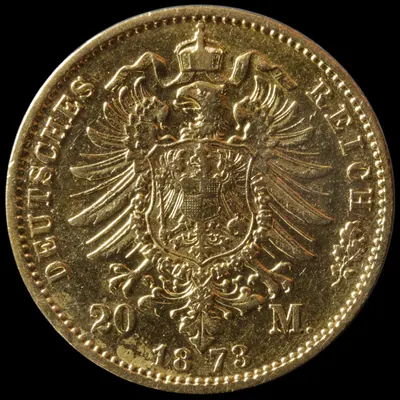
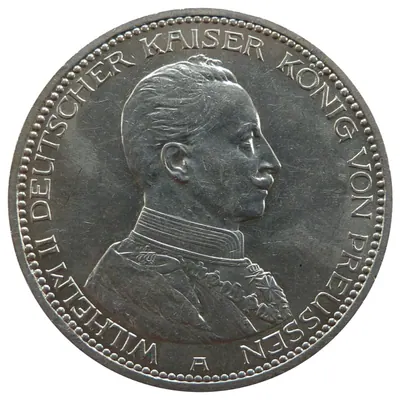
- German Empire (Kaiserreich), 1871–1918. Silver 2, 3 and 5 Mark coins and gold 10 and 20 Mark coins. These are the most valuable old German coins most people find. A Prussia 20 Mark 1888 A in extremely fine+ hammered for €550 at Künker on 26 June 2020.
- Weimar Republic, 1919–1933. Inflation-era coins are common. The 3 and 5 Reichsmark coins of 1927–1933 are 50% silver.
- Third Reich, 1933–1945. The 2 and 5 Reichsmark coins are silver. Pfennigs are bronze, aluminium or wartime zinc, and most are worth very little.
- Post-war, 1948–2001. Deutsche Mark and East German coins are mostly worth face value or less. The silver 5 DM of 1951–1974 and a few rare dates are exceptions.
If you only remember one rule: sort out the silver and gold first, then look at mint letters and dates.
How to tell which era your coin is from
Read the legend:
- DEUTSCHES REICH with a value in MARK (for example “20 MARK” or “5 MARK”) and a king or duke on the other side: Kaiserreich, 1871–1918. Each German state put its own ruler on the coins, and the other side shows the imperial eagle.
- DEUTSCHES REICH with REICHSMARK or REICHSPFENNIG: Weimar or Third Reich, 1924–1945. Coins from 1936 onward add a swastika under the eagle.
- BANK DEUTSCHER LÄNDER or BUNDESREPUBLIK DEUTSCHLAND with DEUTSCHE MARK or PFENNIG: West Germany, from 1948.
- DDR or DEUTSCHE DEMOKRATISCHE REPUBLIK: East Germany, light aluminium coins.
Then find the mint letter (A, D, E, F, G or J; see the table above). On Kaiserreich and Reichsmark coins it’s usually under the eagle or near the date. Mint output was very uneven, so the same date can be common from Berlin (A) and scarce from Karlsruhe (G) or Hamburg (J).
Not sure which coin you have? Scan both sides with CoinLens to identify it and see an estimated value.
Kaiserreich gold: 10 and 20 Mark
The German Empire struck 10 Mark (3.98 g) and 20 Mark (7.97 g) coins in 90% gold from the 1870s until 1915. They contain about 0.115 and 0.230 troy ounces of gold, so even a worn coin is worth its gold.
Above that, value depends on the state. Prussia (mint A) struck the most, which makes its coins the cheapest above bullion. Smaller states and short runs carry premiums, and individual results show the range:
- Baden 10 Mark 1888, VF+: €260 hammer (Künker, April 2023)
- Hamburg 20 Mark 1913, nearly EF: €420 hammer (Künker, April 2023)
- Prussia 20 Mark 1888 A, EF+: €550 hammer (Künker, June 2020)
- Prussia 10 Mark 1895 A, a scarce year, VF: €700 hammer (Künker, June 2020)
Kaiserreich silver: 2, 3 and 5 Mark
All three are 90% silver, with 1 Mark equal to 5 g of fine silver. A 5 Mark coin holds about 0.80 oz of silver, more than a US silver dollar.
The real money is in the small states. German Wikipedia’s list of Kaiserreich silver coins shows tiny mintages for some:
- Saxony 3 Mark 1917 E: only 100 proofs
- Bavaria 3 Mark 1918 D: 130 struck plus 5 proofs
- Brunswick 5 Mark 1915: about 1,400
- Waldeck 5 Mark 1903: 2,000
- Schaumburg-Lippe 5 Mark 1898 and 1904: 3,000 each
Ordinary Prussian and Bavarian coins of common dates are worth silver plus a modest premium. Better coins sell well at German auctions: a Hesse 5 Mark 1877 in VF hammered for €775 and a Saxony 3 Mark 1909 proof for €875.
The Prussia 3 Mark 1913 pieces for the Wars of Liberation centenary and the Kaiser’s 25-year jubilee are common commemoratives, with about 2 million of each.
Reichsmark silver (1927–1939)
Weimar 3 and 5 Reichsmark
These 50% silver coins (15 g and 25 g) circulated from 1927 to 1933. Each holds 0.24 or 0.40 oz of silver. Weimar commemoratives from 1925 to 1932, such as the Rhineland millennium and Goethe issues, used the same alloy and sell for more.
Third Reich 2 and 5 Reichsmark
Both are silver: the 5 Reichsmark is 90% silver, and the 1933–1934 commemorative 2 Reichsmark coins are 62.5% silver. The common type shows Paul von Hindenburg. Other types include the Garrison Church of Potsdam and the 1933–1934 commemoratives for Martin Luther, the Day of Potsdam and Friedrich Schiller.
A Hindenburg 5 Reichsmark weighs 13.889 g and holds about 0.40 oz of silver, so a circulated coin trades close to its melt value. Proofs and top grades are a different market:
- 1936 A Hindenburg proof: €675 hammer
- 1934 F Schiller proof: €775 hammer
- 1936 F Hindenburg proof: €1,850 hammer
All three sold at Künker in June 2023.
Pfennigs and Reichspfennigs
The small change of 1924–1945 was made in bronze (1 and 2 Rpf), aluminium-bronze (5 and 10 Rpf, golden in colour), aluminium (50 Rpf) and, during the war, zinc. Zinc coins are dull grey and often corroded.
Mintages ran to tens or hundreds of millions, so most are worth cents. For the zinc 10 Reichspfennig, Wikipedia’s mintage tables show how wide the spread is:
| 10 Rpf zinc | Mintage |
|---|---|
| 1940 A | 212,948,000 |
| 1943 F | 24,804,000 |
| 1943 G | 3,618,000 (rare) |
| 1943 J | 1,821,000 (rare) |
| 1945 E | 4,897,000 (rare) |
| 1945 A | 7,112,000 (rare) |
Even a “rare” zinc coin needs good condition to bring real money, because zinc corrodes badly.
Two oddities are worth knowing. The 4 Reichspfennig of 1932, Chancellor Brüning’s attempt to push prices down, was demonetized the next year. The holed zinc 5 and 10 Reichspfennig of 1940–1941 were struck for the Reichskreditkassen in occupied territories.
Deutsche Mark coins: mostly face value
West German coins from 1948 to 2001 were made in huge numbers, and the Bundesbank still exchanges them at 1.95583 DM per euro. The exceptions:
- 5 DM, 1951–1974. 62.5% silver (11.2 g, about 0.225 oz). They were withdrawn on 1 August 1975, so check every pre-1975 5 DM coin.
- 50 Pfennig 1950 G “Bank deutscher Länder”. The Karlsruhe mint kept striking the old legend after the change to “Bundesrepublik Deutschland”, producing 30,000 coins. In VF they hammer around €100–€110 at Künker; uncirculated coins bring more.
- Low-mintage dates such as the 1 DM 1954 and 1955 G and the 5 DM 1958 J. Check these against recent sold results.
Fakes and restrikes to watch for
The most famous case is official. In the early 1970s the Karlsruhe mint director and others secretly restruck collector rarities: the 50 Pfennig 1950 G “Bank deutscher Länder”, a 2 Pfennig 1967 proof, a 5 DM 1951 proof and a 2 DM 1959 that was never ordered. About 1,650 to 1,700 pieces were made before a collector spotted them in 1974.
The tells:
- They carry mint mark G.
- One side was struck from an original die and the other from a newer one.
- Some have edge reeding that didn’t exist in the stated year.
For silver Reichsmark and Kaiserreich coins, the simplest check is the weight. A 5 Reichsmark should weigh 13.889 g and a Kaiserreich 5 Mark 27.778 g. A coin that is light, magnetic or has a seam on the edge is not genuine.
How to check your coin with CoinLens
Photograph both sides with CoinLens (Coin Identifier - CoinLens, for iPhone and Android). It identifies the coin within seconds from its database of almost 500,000 coins worldwide, shows its composition, minting years and an instant value estimate, and lets you save coins to a collection with a running total. Free scans are limited; Premium unlocks unlimited scans. For gold coins, scarce state issues and anything that looks like a proof, get a dealer or grading service to confirm before selling.
Where to sell old German coins
- German auction houses such as Künker, which sell thousands of Kaiserreich and Reichsmark coins and publish archived results you can compare against.
- Coin and bullion dealers for common silver and gold, priced against the metal.
- eBay for mixed lots and common Reichspfennigs. Price from sold listings, not asking prices.
- The Bundesbank for unwanted Deutsche Mark coins, at the fixed euro rate.
Silver melt value calculator
Germany 5 Reichsmark (Hindenburg, 1936 type): 0.4019 troy oz of silver each
Melt value ($17.42 each)
Silver spot $43.35/oz as of November 26, 2026 (gold-api.com)
Melt value today for a pile, a roll or $ face value → Silver melt calculator
Melt value is the floor. Condition and mint details decide the rest — check yours in the app.
Frequently asked questions
Are old German coins worth anything?
Common pfennigs, Reichspfennigs and Deutsche Mark coins are worth very little. The valuable ones are silver (Kaiserreich 2, 3 and 5 Mark; Weimar 3 and 5 Reichsmark; Third Reich 2 and 5 Reichsmark; 5 DM of 1951–1974) and gold (10 and 20 Mark of 1871–1915). Scarce mint and date combinations and proof coins sell for much more.
How much is a 1936, 1937 or 1938 5 Reichsmark coin worth?
The Hindenburg 5 Reichsmark weighs 13.889 g and is 90% silver, about 0.402 troy ounces, so an ordinary circulated coin is worth roughly its silver value (see the melt calculator above). Proofs sell far higher: a 1936 F proof hammered for €1,850 at Künker in June 2023. The mint letter matters, with G usually the scarcest.
Are Kaiserreich gold coins worth more than their gold?
Usually a little, and sometimes a lot. A 20 Mark coin holds about 0.230 troy ounces of gold and a 10 Mark about 0.115, so that sets the floor. Common Prussian coins trade near it; scarce states and years bring more, such as a Prussia 10 Mark 1895 A in VF that hammered for €700 at Künker in June 2020.
Can I still exchange Deutsche Mark coins?
Yes. The Deutsche Bundesbank exchanges Deutsche Mark notes and coins indefinitely at 1.95583 DM per euro. Only a few DM coins are worth more to collectors, such as the 50 Pfennig 1950 G with ‘Bank deutscher Länder’ and the silver 5 DM coins of 1951–1974.
What is the rarest Reichspfennig?
Among the wartime zinc 10 Reichspfennig coins, the 1943 J (1,821,000 struck) and 1943 G (3,618,000) are listed as rare, as are the 1945 A and 1945 E issues. Compare that with 212,948,000 for the 1940 A. Rare dates still need good condition to bring real money.
What does the letter on a German coin mean?
It’s the mint mark. A is Berlin, D Munich, E Dresden or Muldenhütten, F Stuttgart, G Karlsruhe and J Hamburg. B means Hannover on early Kaiserreich coins but Vienna on 1938–1944 Reichsmark coins. On the same date, the scarcer mint letter can be worth several times more.
My grandfather brought German coins back from the war. What are they worth?
Sort out the silver first: 2 and 5 Reichsmark coins (and any older Mark coins) are worth their silver. Zinc and aluminium pfennigs are usually worth very little unless they are a rare mint and date. Holed zinc 5 and 10 Reichspfennig coins dated 1940–1941 are Reichskreditkassen issues made for occupied territories.
Sources
- Wikipedia (de): Liste der Silbermünzen des deutschen Kaiserreichs (weights, fineness, mint marks, state mintages)
- Wikipedia: German gold mark (10 and 20 Mark gold specifications)
- Wikipedia (de): Reichsmark (Weimar 500 silver; 1933–34 commemoratives in 625 and 900 silver)
- Wikipedia (de): Liste der Reichsmark-Münzen der Weimarer Republik (3 RM and 5 RM specifications)
- Wikipedia: Reichsmark (1948 currency reform, zinc 10 Rpf mintages, mint marks, Reichskreditkassen coins)
- Wikimedia Commons: 5 RM 1936 description (29 mm, 13.889 g, .900 silver)
- Wikipedia (de): Bargeld der Deutschen Mark (5 DM 62.5% silver 1951–1974, 50 Pf 1950 G Bank deutscher Länder)
- Wikipedia: Deutsche Mark (Bundesbank exchange at 1.95583 DM per euro)
- Wikipedia (de): Karlsruher Münzskandal (secret restrikes of 1950 G 50 Pfennig and other DM coins)
- Künker auction 338, lot 4259: Prussia 20 Mark 1888 A, EF+, €550
- Künker auction 338, lot 4263: Prussia 10 Mark 1895 A, VF, €700
- Künker eLive 77, lot 4984: Hamburg 20 Mark 1913, nearly EF, €420
- Künker eLive 77, lot 4974: Baden 10 Mark 1888, VF+, €260
- Künker eLive 77, lot 4986: Hesse 5 Mark 1877, VF, €775
- Künker eLive Premium 390, lot 4114: Saxony 3 Mark 1909, proof, €875
- Künker eLive Premium 390, lot 4142: 5 RM 1936 A Hindenburg, proof, €675
- Künker eLive Premium 390, lot 4143: 5 RM 1936 F Hindenburg, proof, €1,850
- Künker eLive Premium 390, lot 4138: 5 RM 1934 F Schiller, proof, €775
- Künker eLive 60, lot 7497: 50 Pfennig 1950 G Bank deutscher Länder, VF, €110
- Künker eLive 60, lot 7496: 50 Pfennig 1950 G Bank deutscher Länder, VF, €100
- Künker eLive 31, lot 1603: 50 Pfennig 1950 G Bank deutscher Länder, VF+, €105
Values are estimates, not offers. Condition decides the price; for a valuable coin, get a professional grade.