Clipped Planchet Coin Value: Is a Coin With a Bite Missing Worth Money?
A clipped planchet is a blank punched over the strip's edge or a previous hole, leaving a curved or straight bite. Real clips show a weak rim opposite the clip (Blakesley effect) and weigh less: a 1945-P nickel with a 5% clip weighed 4.75 g, not 5.00 g (CAC MS63).
Have one in hand? Scan it with CoinLens to identify it and see an estimate in seconds.
| Clip type | What it looks like | Cause | Notes |
|---|---|---|---|
| Curved clip | A round ‘bite’ out of the edge | Punch overlapped a hole already punched in the strip | Shows the Blakesley effect opposite the clip |
| Straight clip | A straight edge across part of the rim | Punch overlapped the end or side of the metal strip | Edge looks flat across the clip |
| Ragged clip | An irregular, jagged edge | Punch hit the ragged end of a strip | Irregular edge with metal flow |
| Multiple clips | Two or more bites | Several overlaps | More dramatic |
Which one is yours? Check it with CoinLens →
Definitions from the Mint-made errors reference cited below. Value depends on clip size, number of clips, coin type and grade; check sold listings for your exact error.
DEMO
Check your Clipped Planchet Coin Value: Is a Coin With a Bite Missing Worth Money?
Add a photo of each side
Add a photo of at least one side first.
Demo — photos stay on your device. Nothing is uploaded.
DEMO
Your photos are ready. The identification happens in the CoinLens app.
On the web this is a demo — it can't recognize coins. In the app, the same two photos give you the coin's name, details and a value estimate.
Scan these in the free appEXAMPLE — what CoinLens shows
Value estimate:
Sample from our guide's data, not a result for your photo.
That was a sample. Scan your coin →·
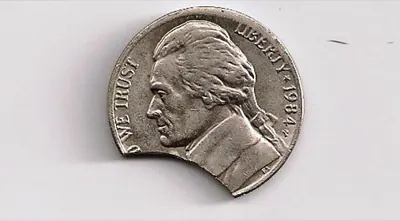
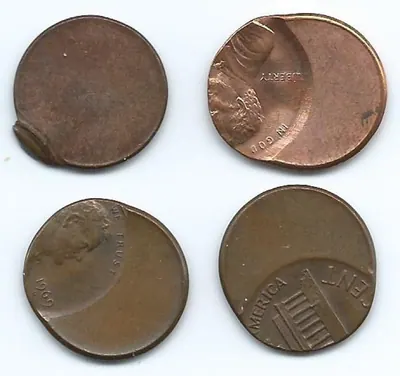
A clipped planchet coin is missing part of its edge because the blank (planchet) was punched from the metal strip in the wrong place. The coin was then struck normally, so the design is complete except where metal is missing.
- Curved clips look like a round bite.
- Straight clips look like a flat edge across the rim.
- Value rises with clip size, the number of clips, the coin type (silver and older coins bring more) and grade.
How clipped planchets happen
Blanks are punched from long strips of coin metal. If the punch overlaps a hole that was already punched, the blank comes out with a curved bite. If it overlaps the end or edge of the strip, the clip is straight or ragged. The clipped blank then goes through the upsetting mill and press like any other.
How to tell a real clip from damage
Check these four things:
- Blakesley effect — the rim opposite the clip is weak or missing. This is the strongest sign of a genuine curved clip.
- Edge of the clip — smooth and slightly rounded or tapered, with metal flow, not sharp or tool-marked.
- Design near the clip — letters near the clip are often weak or flow toward the edge; on cut coins, the design is cut off sharply.
- Weight — a clipped coin weighs less in proportion to the missing metal. CoinWeek described a 1945-P war nickel with a 5% curved clip that weighed 4.75 g versus the normal 5.00 g.
If the bite has sharp edges, scratches or distortion around it, it’s almost certainly post-mint damage.
What makes a clipped coin worth more
- Bigger clips (a large share of the coin missing) and multiple clips.
- A clip combined with another variety or error, like the 1945-P doubled die reverse nickel above.
- Older, silver or larger coins, which collectors find less often with errors than modern cents.
- Uncirculated condition and certification by PCGS or NGC with the error attributed.
Our error coins list with pictures covers the other major mint errors.
How to check your coin with CoinLens
Coin Identifier – CoinLens (iOS) identifies the coin’s type, year and composition from photos of both sides and gives an estimated value for the normal coin, so you know its correct weight and baseline value. It doesn’t detect or certify clips; use the four checks above and a scale. Free scans are limited; Premium unlocks unlimited scans. Download CoinLens on the App Store.
Where to sell clipped coins
Error-coin dealers and error sections of auction houses handle dramatic clips; ordinary clipped cents sell on eBay. In a listing, show the Blakesley effect and give the coin’s weight. Price against sold listings, not asking prices.
Frequently asked questions
How much is a clipped penny worth?
Clipped Lincoln cents are among the more common errors, so most bring modest premiums. Larger clips, multiple clips, clips on older or silver coins and uncirculated, certified examples bring more. Compare sold listings for your coin and clip size.
How can I tell if a clipped coin is real?
Look for the Blakesley effect: a weak or missing rim directly opposite the clip, caused by the upsetting mill not pushing up a full rim. A real clip also has a smooth, slightly tapered edge with metal flow, and the coin weighs less in proportion to the missing metal.
Is a coin with a piece cut off a clipped planchet?
Not necessarily. Coins cut or ground after leaving the mint show sharp, tool-marked edges, no Blakesley effect and often a distorted design near the cut. Those are damaged coins with no error premium.
What is the Blakesley effect?
On a curved clip, the rim opposite the clip is weak or missing because the planchet didn’t press evenly against the upsetting mill. It’s the most reliable sign that a clip is genuine.
Should I grade a clipped coin?
Only large, multiple or otherwise dramatic clips, clips combined with another variety, or clips on scarce coins. For ordinary clipped cents, grading fees usually exceed the premium.
Sources
- Mint-made errors: clipped planchet, Blakesley effect (Wikipedia)
- One war nickel, two mint mistakes: 1945-P FS-801 doubled die with a 5% curved clip, 4.75 g, CAC MS63 (CoinWeek, Sep 2026)
- Jefferson nickel specifications, 5.00 g (Wikipedia)
Values are estimates, not offers. Condition decides the price; for a valuable coin, get a professional grade.