Missing Clad Layer Quarter: Value, Weight Test and Real vs Fake
A quarter missing one clad layer shows bare copper on one side and weighs about 4.7 g instead of the normal 5.67 g. Certified examples usually sell for roughly $65–$600: a 1967 quarter missing its obverse layer, NGC MS63, sold for $139 (Heritage, December 2022). Same weight as normal? It's damage, not this error.
Have one in hand? Scan it with CoinLens to identify it and see an estimate in seconds.
| What you have | Expected weight | What the faces look like | Source of the figure |
|---|---|---|---|
| Normal clad quarter (1965–today) | 5.67 g | Both sides nickel-gray | US Mint specification |
| Missing ONE clad layer (full layer) | about 4.7 g | One side solid copper, other side normal | Coin World; auction lot descriptions |
| Missing BOTH clad layers | about 3.8 g (calculated) | Both sides copper | Calculated: cladding is one-third of the weight |
| Rolling error (layer missing from the strip before final rolling) | near normal, e.g. 5.57 g | Copper face, but little weight lost | Coin World (2005-P example weighed 5.57 g) |
| 90% silver quarter (1964 and earlier) | 6.25 g | Silver on both sides and the edge (no copper stripe) | Wikipedia / US Mint |
| Acid-stripped or plated quarter (damage) | anything; often near 5.67 g or erratically low | Grainy, pitted, soft details | See ‘real vs damage’ below |
Which one is yours? Check it with CoinLens →
The one-layer and two-layer figures follow from the published alloy: the two 75/25 outer layers make up one-third of the coin's 5.67 g, about 0.95 g each. Real coins vary a little with wear and how cleanly the layer came off. Use a scale that reads to 0.01 g.
DEMO
Check your 1965–present Clad Washington quarter (1965–today)
Add a photo of each side
Add a photo of at least one side first.
Demo — photos stay on your device. Nothing is uploaded.
DEMO
Your photos are ready. The identification happens in the CoinLens app.
On the web this is a demo — it can't recognize coins. In the app, the same two photos give you the coin's name, details and a value estimate.
Scan these in the free appEXAMPLE — what CoinLens shows
Value estimate:
Sample from our guide's data, not a result for your photo.
That was a sample. Scan your coin →·
Coin facts
- Coin
- Clad Washington quarter (1965–today)
- Years
- 1965–present
- Composition
- Outer layers 75% copper, 25% nickel bonded to a pure copper core (8.33% nickel overall)
- Weight
- 5.67 g
- Diameter
- 24.26 mm
| Coin | Missing side | Grade | Sold | Date |
|---|---|---|---|---|
| 1967 Washington quarter | Obverse | NGC MS63 | $139 | Dec 21, 2022 |
| 1971-D Washington quarter | Obverse | PCGS MS64 | $114 | Oct 10, 2022 |
| 1980-P Washington quarter | Reverse | PCGS AU55 | $132 | Oct 10, 2022 |
| 1985-P Washington quarter | One side | ANACS AU55 | $65 | Jan 2, 2023 |
| 2000-D Maryland state quarter (4.7 g) | Reverse | NGC MS64 | Lot listed by GreatCollections (see sources) | — |
Which one is yours? Check it with CoinLens →
Individual sales read from PriceCharting's record of Heritage results, plus lot pages that state the weight. Not a price guide. State quarters missing a full layer on either side have often sold for about $200–$600 at Heritage, with reverse-missing coins bringing more (Numismatic News, 2018).
| Factor | Lower value | Higher value |
|---|---|---|
| How much is missing | Partial strip or patch | Full layer gone, clean copper face |
| Which side (most series) | Reverse missing | Obverse-missing examples often bring roughly twice the price of reverse examples (CoinWeek/PCGS) |
| Which side (State and America the Beautiful quarters) | Obverse missing | Reverse-missing examples sell for about 5–10× the price of obverse examples (CoinWeek/PCGS) |
| Both layers missing | — | Extremely rare: about 5–10 Washington quarters known; $1,000–$5,000 (CoinWeek/PCGS) |
| Condition | Worn, scratched copper face | Uncirculated, original color |
| Certification | Raw (uncertified) | NGC, PCGS or ANACS slab stating the error |
Which one is yours? Check it with CoinLens →
Multipliers and the dual-layer range are from Jon Sullivan's PCGS article on CoinWeek (February 2026).
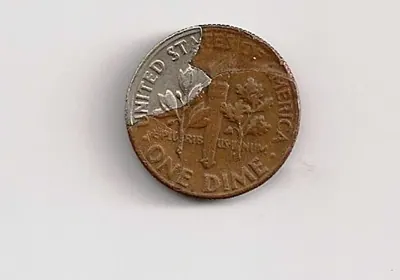
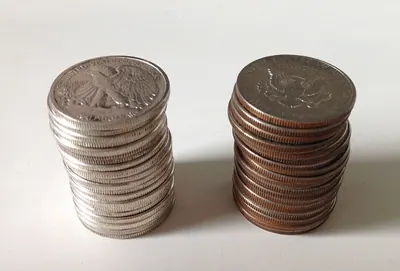
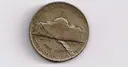
A missing clad layer quarter is a real mint error: one of the two copper-nickel “sandwich” layers wasn’t on the coin when it was struck, or came off right after, so one face shows the solid copper core. The test is weight, not colour:
- A normal clad quarter weighs 5.67 g.
- A quarter missing one full layer weighs about 4.7 g (Coin World’s example: 4.7 g).
- A quarter missing both layers should weigh about 3.8 g, and is very rare.
If your copper-looking quarter weighs 5.6 g or more, it almost certainly still has its layers and something else (toning, acid, heat, plating or a partial lamination) explains the colour. Typical certified one-layer examples have sold for about $65–$140 in 2022–2023. State quarters missing a full layer on either side have often brought $200–$600, with reverse-missing coins selling for more.
How a quarter loses its clad layer
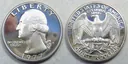
Since 1965, US dimes, quarters and half dollars have been made from clad strip: two outer layers of 75% copper / 25% nickel bonded to a core of pure copper. You can see the core as a copper stripe on the edge of any modern quarter. The outer layers make up one-third of the coin’s weight, which is why the overall alloy is 8.33% nickel.
The error happens when that bond fails. Coin World’s error columnist Mike Diamond describes three routes:
- Bonding failure before the strike. If the strip was rolled with too little pressure or wasn’t clean, an outer layer can separate and fall away from the blank. The blank is then struck with copper on one side, so the design on the copper face is fully struck and the coin is light.
- Separation after the strike. The layer is struck in place but loose, then peels off. The exposed core can show a blurred or “ghost” version of the design pressed through from the layer above.
- Rolling error (the rarest). Here a gap in the clad layer occurs at the bonding mill, before the strip is rolled down to its final thickness, so the core fills the space and the coin can be close to normal weight. Diamond’s example, a 2005-P West Virginia quarter, weighed 5.57 g, and it may show a tapered edge.
PCGS’s Jon Sullivan (CoinWeek) adds that which side loses its layer is “completely random”. Full-layer coins are the most common form, partial layers come second, and coins missing both layers are extraordinarily rare, with only about 5–10 Washington quarters known.
Numismatic News (Ken Potter) described one unusual coin, a 2007-D Idaho quarter weighing 5.2 g, where cladding lost before the strike left the opposite side weakly struck. That was a one-off combination, not a general rule; a coin that lost its layer after striking usually shows a full, sharp design on both sides.
The weight test, step by step
This is the single most useful check, and it costs nothing if you have a kitchen or jewellery scale.
- Use a scale that reads to 0.01 g. A 1 g scale can’t separate 4.7 from 5.67 reliably.
- Check the scale by weighing a normal quarter first. It should read about 5.6–5.7 g; worn coins run a little light.
- Weigh the suspect coin. About 4.7 g with one clean copper face fits a full missing layer. About 3.8 g with both faces copper fits a double missing layer.
- 5.5 g or more? It isn’t missing a full layer. The copper colour is from something else. See the next section.
- 6.25 g and no copper stripe on the edge? You have a silver quarter: dated 1964 or earlier, or a silver proof from a collector set. Coin World reported a quarter whose finder thought it was a wrong-planchet error; it was a 2007-S Montana silver proof, with no copper on the edge.
Why these numbers? The Mint’s published alloy fixes the mass of the cladding. With 25% nickel in the outer layers and 8.33% nickel overall, the outer layers must be one-third of 5.67 g, which is 1.89 g, or about 0.95 g per side. Take one off and you get about 4.72 g; take both off and you get about 3.78 g. Coin World’s example of a one-layer quarter weighed 4.7 g, and a GreatCollections 2000-D Maryland weighed 4.7 g.
Real error vs acid, heat and environmental damage
Most “copper quarters” found in change are not errors. People strip quarters with acid, heat them, or plate them for fun or to fool buyers, and long burial or chemical contact can also discolour a quarter. Use this checklist.
| Check | Genuine missing clad layer | Damage or alteration |
|---|---|---|
| Weight | About 4.7 g (one layer) | Usually near 5.67 g; or erratically low if heavily etched |
| Copper face texture | Smooth, even, like a new penny’s surface | Grainy, pitted, bubbly or frosty all over |
| Design on the copper side | Fully struck and sharp (or a ghost image if it separated after striking) | Softened, eaten-away details; letters rounded |
| The normal side | Original surface and lustre | Often damaged too; acid works on both sides |
| Rim and edge | Edge shows the step where the layer is gone; the reeding is intact | Thinned, rough or uneven rim; reeding blurred |
| Colour | Even salmon-copper of the core | Blotchy, reddish-brown or plated-looking; may rub off |
Two points matter most. First, acid doesn’t choose one face. A coin that’s eaten away evenly on both sides and still weighs about 5.6 g is damaged, not an error. Second, the copper face of a real error was either struck by the die or was a separate layer, so it is flat and detailed, not rough. When collectors debate a coin on the NGC and PCGS forums, these are the usual tests. Those posts are opinion; a grading service has the final word.
Partial missing layers and laminations
A partial missing clad layer is a strip or patch of copper where part of the layer flaked off. It is related to the lamination error, where impurities in the metal cause cracks and peels. NGC treats it as a separate attribution. Partial coins weigh close to normal, so the scale won’t prove them. Look for a clean, flaky boundary between the nickel layer and the copper beneath, with no corrosion at the edges. They sell for less than full-layer coins.
What missing clad layer quarters sell for
The value table above lists individual certified sales. The pattern is clear:
- Ordinary Washington quarters (eagle reverse, 1965–1998), one full layer missing, AU to MS64: about $65–$140 at Heritage in 2022–2023.
- State quarters (1999–2008) missing a full layer on either side: often about $200–$600 at Heritage, and reverse-missing coins sell for more (Numismatic News, 2018). A missing reverse layer means the state design is entirely copper, which collectors prefer.
- Dual missing layers (both faces copper): $1,000–$5,000 according to PCGS’s Jon Sullivan, but very few exist.
Which side matters for price, and it flips by series. On most series, obverse-missing examples often bring roughly twice the price of reverse examples. On State and America the Beautiful quarters, reverse-missing examples sell for 5 to 10 times the price of obverse examples. PCGS also names the Oklahoma and Arizona state quarters among the rarest with this error.
Treat these as rough ranges built from a handful of sales, not a price guide. Condition, eye appeal and the size of the missing area move prices a lot.
Which years turn up most?
Any clad quarter from 1965 onward can show the error. People search for 1965, 1967, 1995 and the 1976 bicentennial quarter by name, and the sales above include 1967, 1971-D, 1980-P and 1985-P. No single date is especially known for it. The error depends on a bonding failure in a batch of strip, not on a particular year’s dies.
Missing clad layers on other coins
The same error happens on every clad denomination:
- Dimes (1965–today): a normal clad dime weighs 2.268 g, so a missing layer takes off well under half a gram. You need a precise scale.
- Half dollars (1971–today): the copper face is dramatic on the large Kennedy portrait.
- Sacagawea and Presidential dollars have manganese-brass outer layers over a pure copper core, so a missing layer there also exposes copper, under a golden face on the other side.
- Zinc cents (1982–today) are copper-plated zinc, not clad. A cent showing silver-gray zinc is usually plating loss or corrosion, not this error.
How to check your coin with CoinLens
Not sure what the coin is to begin with? Snap both sides with Coin Identifier – CoinLens on iPhone or Android. The AI identifies the coin within seconds and shows its year, composition and an instant value estimate for the normal coin, so you know your baseline. CoinLens doesn’t detect errors or test weight, so use the scale test above for the clad layer itself, and send a strong candidate to a grading service. Free scans are limited; Premium unlocks unlimited scans.
Getting it certified and selling it
If your quarter weighs about 4.7 g and has a smooth, fully struck copper face, it is worth certifying:
- Grading: NGC, PCGS and ANACS all attribute missing clad layer errors on the label. NGC charges $20 (Modern) to $45 (Standard) per coin plus a $10 handling fee per submission (read November 25, 2026). See how to get coins graded.
- Selling: certified error quarters sell well at Heritage, GreatCollections and on eBay. Uncertified “copper quarters” sell for little because buyers can’t rule out acid. In any listing, give the exact weight, with a photo of the coin on the scale.
- Don’t clean it. Polishing the copper face to make it look brighter leaves hairlines that can get the coin a “details” grade.
Frequently asked questions
How much is a quarter missing a clad layer worth?
Certified Washington quarters missing one full layer have sold for about $65 to $140 in AU and MS grades at Heritage in 2022–2023. State quarters missing a full layer have often brought about $200 to $600, with reverse-missing coins at the higher end. Coins missing both layers are much rarer and sell for $1,000 or more.
How much does a quarter missing a clad layer weigh?
About 4.7 grams, compared with 5.67 grams for a normal clad quarter. Coin World’s documented example weighed 4.7 grams. A quarter missing both layers should weigh about 3.8 grams.
Why does my quarter look copper on one side?
Either the copper-nickel outer layer is missing (a mint error), or the coin was damaged by acid, heat or corrosion, or it was plated or toned. Weigh it: only a coin that lost real metal from the face will be clearly under 5.67 grams with sharp, smooth details on the copper side.
Is a copper quarter rare?
A quarter with one clean copper face and the right low weight is a genuine but fairly scarce error; one with both faces copper is very rare. Most ‘copper quarters’ people find are toned, stained or acid-damaged coins worth 25 cents.
Can you get a missing clad layer quarter from circulation?
Yes. Many of the certified examples sold at auction are ordinary dates from 1965 onward, and state quarters with the error have turned up in rolls and change.
Is a 1965 quarter with copper showing silver?
No. 1965 was the first year of clad quarters, so a 1965 quarter with copper on the edge is normal. Silver quarters are dated 1964 or earlier and weigh 6.25 grams. A copper face on a 1965 quarter can be a missing clad layer error; weigh it like any other.
Should I get a missing clad layer quarter graded?
If it passes the weight test and the copper side is smooth and fully detailed, yes: buyers pay for certified errors. NGC charges $20 (Modern tier) to $45 (Standard) per coin plus $10 handling per submission (read November 25, 2026), so it pays off for coins in the $100+ range.
Sources
- US Mint coin specifications: quarter 5.670 g, 24.26 mm, cupro-nickel clad, 8.33% Ni
- Wikipedia: Quarter (United States coin), clad layers one-third of weight, silver quarter 6.25 g
- Coin World (Mike Diamond, May 2012): Missing clad layer does not always imply missing weight
- CoinWeek / PCGS (Jon Sullivan, Feb 2026): Missing clad layer mint error coins
- Numismatic News (Ken Potter, 2018): Missing top layer makes quarter rare
- NGC: Learn grading mint errors, part 4 (missing clad layer, lamination)
- Coin World: circulated 'clad' quarter is actually a silver proof
- PriceCharting: 1967 Washington quarter sales (missing clad obverse, NGC MS63, $139, Heritage Dec 2022)
- PriceCharting: 1971-D Washington quarter sales (obverse clad missing, PCGS MS64, $114)
- PriceCharting: 1980-P Washington quarter sales (reverse clad missing, PCGS AU55, $132)
- PriceCharting: 1985-P Washington quarter sales (missing clad, ANACS AU55, $65)
- Wikipedia: Sacagawea dollar (manganese-brass clad over pure copper core)
- GreatCollections lot: 2000-D Maryland quarter missing clad layer on reverse, 4.7 g, NGC MS64
- NGC grading services and fees
Values are estimates, not offers. Condition decides the price; for a valuable coin, get a professional grade.