Struck-Through Error Coins: What They Are and What They're Worth
A struck-through coin had something between die and blank (grease, cloth, wire, a staple), leaving a sunken outline or missing area. CoinWeek says most sell for $1–$50, coins with the object still attached for roughly 5–10 times more, and large strike-throughs covering 25% or more for much more.
Have one in hand? Scan it with CoinLens to identify it and see an estimate in seconds.
| Struck through | What you see | Notes |
|---|---|---|
| Grease (die filled with grease) | Soft, weak or missing letters and details | Very common; small premiums at most |
| Cloth | Fine woven texture pressed into the surface | Popular with error collectors |
| Wire or thread | Thin sunken curved line | Wire leaves a sharp groove |
| Staple or metal fragment | Sharp sunken outline of the object | Most valuable if the object is retained |
| Another coin (brockage) | Mirror-image, sunken design | Collected as its own error type |
Which one is yours? Check it with CoinLens →
Value guidance from CoinWeek (cited): most strike-throughs sell for about $1–$50, retained-object pieces for roughly 5–10 times more, and strike-throughs covering 25% or more for much more.
DEMO
Check your Struck-Through Error Coins: What They Are and What They're Worth
Add a photo of each side
Add a photo of at least one side first.
Demo — photos stay on your device. Nothing is uploaded.
DEMO
Your photos are ready. The identification happens in the CoinLens app.
On the web this is a demo — it can't recognize coins. In the app, the same two photos give you the coin's name, details and a value estimate.
Scan these in the free appEXAMPLE — what CoinLens shows
Value estimate:
Sample from our guide's data, not a result for your photo.
That was a sample. Scan your coin →·
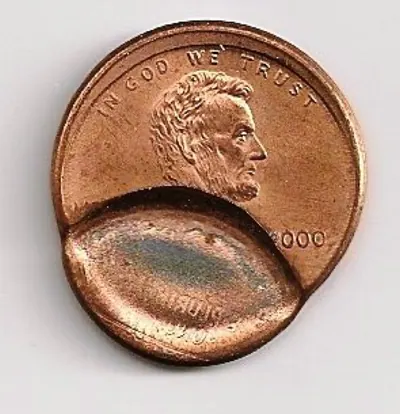
A struck-through error forms when an object is trapped between the die and the blank at the moment of striking. The object’s outline is pressed into the coin, or it blocks part of the design. Value guidance from CoinWeek:
- Most strike-throughs: about $1–$50.
- Object still attached (retained): roughly 5–10 times more.
- Large strike-throughs (25%+ of the coin): much more.
Types of strike-throughs
Grease
The most common. Old grease and dirt fill recesses in the die, so letters, dates or details come out weak or missing. A “missing” mint mark or date digit is often a grease strike-through.
Cloth
A piece of cloth, such as a rag, gets between die and blank, leaving a fine woven pattern pressed into the surface.
Wire, thread and staples
Thin objects leave sharp, sunken lines or outlines. If the object stays embedded, the coin is a retained strike-through, the most valuable kind.
Other coins and fragments
A previously struck coin stuck to the die produces a brockage with a mirror-image design, collected as its own error type. Metal fragments leave irregular sunken shapes.
How to tell a strike-through from damage
- The mark is sunken, and the original luster continues inside it.
- The edges are smooth, not raised or torn.
- Design elements near the mark are weak or missing, not cut or gouged.
If the mark cuts through the luster or has raised edges, it happened after the coin left the mint.
When a strike-through hurts value
On rare or high-grade coins, a strike-through can lower value: series collectors want a perfectly minted coin, and error collectors won’t usually pay a key-date price for an error type. See our error coins list with pictures for the errors that consistently bring premiums.
How to check your coin with CoinLens
Coin Identifier – CoinLens (iOS) identifies the coin and year from photos of both sides and shows an estimated value for the normal coin, a useful baseline before deciding whether an error is worth pursuing. It doesn’t detect strike-throughs. Free scans are limited; Premium unlocks unlimited scans. Download CoinLens on the App Store.
Where to sell
Retained and large strike-throughs sell through error specialists and auctions, usually certified. Ordinary grease strike-throughs sell for small sums on eBay or in error lots.
Frequently asked questions
What does struck-through grease mean?
Grease or dirt filled part of the die, so that part of the design didn’t press into the coin. The result is a weak or missing letter, date digit or detail. It’s one of the most common errors and usually adds only a small premium.
What is a retained strike-through?
When the object that got between die and blank stayed stuck in the coin after striking. CoinWeek says retained strike-throughs are usually worth about 5 to 10 times more than ones where the object fell away.
Can a strike-through lower a coin's value?
Yes. On a rare or high-grade coin, a strike-through can be a distraction: series collectors want a perfect coin, and error collectors may not pay a key-date price for the error, per CoinWeek.
How do I tell a strike-through from damage?
A strike-through mark is sunken and has the coin’s original luster inside it, because it was formed during the strike. Post-mint scratches and dents cut through the luster, push metal up at the edges and look rougher.
Are struck-through errors rare?
Grease strike-throughs are very common. Large strike-throughs, retained objects, and strike-throughs on scarce series are much harder to find.
Sources
- The two types of struck-through error coins: value guidance (CoinWeek)
- Mint-made errors: strike-through (Wikipedia)
Values are estimates, not offers. Condition decides the price; for a valuable coin, get a professional grade.