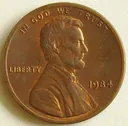
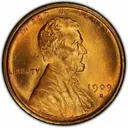
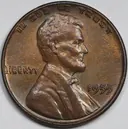
How Much Is a 1958 Penny Worth? (1958 & 1958-D Values)
Most 1958 wheat pennies sell for about $1 to $3.50 each as single raw coins on eBay. The famous exception is the 1958 doubled die obverse, with three known: a PCGS MS65 Red CAC sold for $1,136,250 at GreatCollections in January 2023.
Have one in hand? Scan it with CoinLens to identify it and see an estimate in seconds.
| Coin | Raw single coins (eBay sold) | Certified example | Record / top sale |
|---|---|---|---|
| 1958 (no mint mark) | About $1–$3.50 | MS67 Red PCGS $793 (Nov 2026) | MS67+ Red PCGS CAC $7,015 (Jan 2026) |
| 1958-D | About $1–$3 | MS67 PCGS CAC $525 (Aug 2026) | MS68 Red NGC $9,499.99 (Jun 2024) |
Which one is yours? Check it with CoinLens →
Raw ranges are the middle half of the 30 most recent raw eBay sales per coin collected by PriceCharting, observed November 2026; worn coins from change often sell for less in bulk lots. Certified and top sales are individual dated results (mostly Heritage auction lots) from the same sold archive. Records are for perfect coins, not typical values. Estimates, not a price guide.
DEMO
Check your 1958 Lincoln Wheat Cent
Add a photo of each side
Add a photo of at least one side first.
Demo — photos stay on your device. Nothing is uploaded.
DEMO
Your photos are ready. The identification happens in the CoinLens app.
On the web this is a demo — it can't recognize coins. In the app, the same two photos give you the coin's name, details and a value estimate.
Scan these in the free appEXAMPLE — what CoinLens shows
Value estimate:
Sample from our guide's data, not a result for your photo.
That was a sample. Scan your coin →·
Coin facts
- Coin
- Lincoln Wheat Cent
- Years
- 1958
- Mints
- Philadelphia (no mint mark), Denver (D)
- Composition
- 95% copper, 5% tin and zinc
- Weight
- 3.11 g
- Diameter
- 19.05 mm
- Designer
- Victor David Brenner
Mintage
- 1958
- 252,525,000
- 1958-D
- 800,953,300
- 1958 Proof
- 875,652
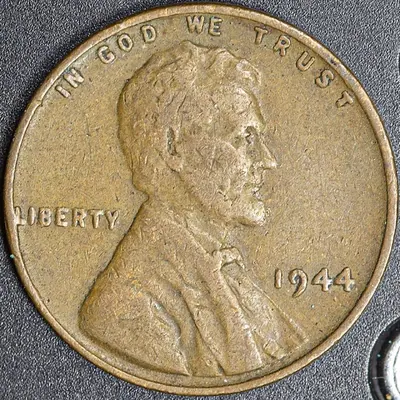
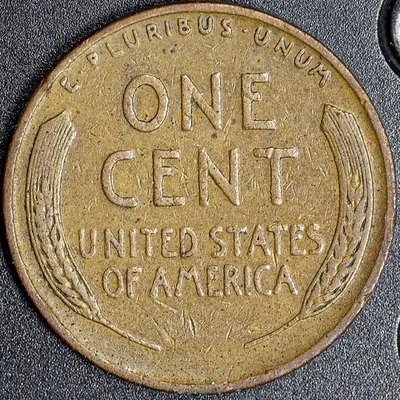
A little over 1,053 million cents dated 1958 were struck for circulation at Philadelphia and Denver only. What yours is worth depends on mint mark and condition:
- Raw single coins: about $1 to $3.50 in recent eBay sales (PriceCharting, autumn 2026). Worn coins sold in bulk lots go for less.
- Red gems: certified MS67 Red coins sell for hundreds of dollars.
- Record: the 1958 doubled die obverse (three known); a PCGS MS65 Red CAC sold for $1,136,250 at GreatCollections on January 22, 2023. For normal 1958 cents, the top sale we found is in the table below.
1958 penny with no mint mark and D
| Mint mark | Mint | Mintage | Raw eBay sales (middle half) |
|---|---|---|---|
| none | Philadelphia | 252,525,000 | about $1–$3.50 |
| D | Denver | 800,953,300 | about $1–$3 |
What makes a 1958 penny different
The least common 1958 cent is the 1958 (no mint mark) from Philadelphia, with 252,525,000 struck, about 24% of the year’s 1,053,478,300 circulation cents. The 1958 total was lower than 1957 (1,334 million) and lower than 1959 (1,889 million), so 1958 is a middle-of-the-road date by mintage. 1958 pennies were made only at Philadelphia and Denver (Wikipedia notes that San Francisco stopped striking cents after 1955), so there is no 1958-S. 1958 is the last wheat-reverse year. Philadelphia struck only 252,525,000, one of the lower postwar totals, which David Lange attributed to the Mint’s heavy production of coins for other countries and the 1958 recession; Denver made more than 800 million (CoinWeek). Nobody outside the Mint knew it was the final year: the new Lincoln Memorial reverse was announced only on December 21, 1958. Roll hoarding and ‘last of its type’ status left plenty of red uncirculated 1958 cents; circulated coins are worth about five cents and uncirculated 50-coin rolls sell for about $10 to $20 (CoinWeek). The typical certified 1958 grades MS66 Red. Denver’s 1958-D rolls sell for about $20 to $30 per bank-wrapped roll on eBay (CoinWeek). Philadelphia also struck 875,652 proofs for collectors; proof cents had returned in 1936 after a gap since 1916.
What to look for on a 1958 penny
- Mint mark under the date: none (Philadelphia), D (Denver). The 1958 is the one to set aside first.
- Listed varieties for this year: Minor 1958-D doubled dies (unattributed); 1958 proofs.
- Color: untouched red color; that is where the big prices in the table come from.
- Weight: 3.11 g on a scale. A very different weight can mean a wrong-planchet error or a fake.
The 1958 doubled die story
The 1958 doubled die obverse shows obvious doubling on all of the obverse lettering, weakest on the date. Expert consensus, as reported by CoinWeek, is that the few known pieces were smuggled out of the Philadelphia Mint after staff noticed the doubling. The variety stayed unknown to collectors until 1983 or 1984, when Lincoln cent variety expert John Wexler included it in his 1984 book The Lincoln Cent Doubled Die; it has been listed in the Red Book for decades. For ordinary coins, David Lange wrote that 1958 Philadelphia cents “are readily available in any and all grades through fully Red Gem,” though most uncirculated pieces are of average quality.
Varieties and errors worth money
- Minor 1958-D doubled dies (unattributed): coins listed this way are mostly minor or unconfirmed varieties; raw coins sold for about $1.50 to $18; an MS65 Red NGC sold for $152 (Nov 2025).
- 1958 proofs (875,652 struck): mirror-like fields and sharp rims; raw coins sold for about $5 to $9; a PR68 Red PCGS sold for $7,930 (Sep 2026).
- Mint errors such as off-center strikes and clipped planchets are valued as errors; damage after striking adds nothing.
- 1958 doubled die obverse (FS-101): one of the most famous Lincoln cent varieties, with only three examples known according to CoinWeek. The finest, a PCGS MS65 Red CAC, sold for $1,136,250 at GreatCollections on January 22, 2023, and a PCGS MS64 Red brought $336,000 at Stack’s Bowers in March 2018. Ordinary 1958 cents with machine doubling are often mislabeled as this variety online; any candidate needs PCGS or NGC authentication.
Grading, melt value and selling
Their copper is worth only a few cents, and melting cents is prohibited (31 CFR Part 82). Grading basics: coin grading guide; selling options: where to sell coins.
How to check your coin with CoinLens
Photograph both sides with CoinLens for an instant ID and value estimate; confirm a red gem or suspected variety with PCGS or NGC.
Frequently asked questions
How much is a 1958 penny worth?
Single raw 1958 cents sold for about $1 to $3.50 on eBay in autumn 2026, and worn coins in bulk lots for less. Certified MS67 Red gems bring hundreds, and the top sale we found is $9,499.99 for a 1958-D MS68 Red NGC (Jun 2024).
How much is a 1958 penny with no mint mark worth?
A raw 1958 Philadelphia cent sold for about $1–$3.50 on eBay. Top-grade examples: MS67+ Red PCGS CAC $7,015 (Jan 2026).
Where is the mint mark on a 1958 penny?
On the obverse, directly under the date. No letter means Philadelphia, D means Denver, S means San Francisco.
Is a 1958 penny copper?
Yes. 1958 cents are 95% copper, 5% tin and zinc and weigh 3.11 grams.
Is my 1958 penny the doubled die?
Almost certainly not. CoinWeek counts only three known 1958 doubled die obverse cents, the finest of which sold for $1,136,250 in 2023. Coins listed online as 1958 doubled dies are usually machine doubling. Have any candidate authenticated by PCGS or NGC.
Sources
- Lincoln cent mintage figures (Wikipedia)
- PriceCharting: 1958 Lincoln wheat penny sold listings
- PriceCharting: 1958-D Lincoln wheat penny sold listings
- PriceCharting: 1958 d double die sold listings
- PriceCharting: 1958 proof sold listings
- CoinWeek: 1958 Lincoln cent collector's guide (1958 DDO FS-101, three known; PCGS MS65RD CAC $1,136,250, GreatCollections, Jan 22, 2023)
- Lincoln cent history: compositions, wartime alloy, 1959 redesign (Wikipedia)
- CoinWeek: 1958 Lincoln cent collector's guide
- CoinWeek: 1958-D Lincoln wheat cent collector's guide
Values are estimates, not offers. Condition decides the price; for a valuable coin, get a professional grade.