How Much Is a 1979 Penny Worth? (1979, 1979-D, 1979-S Proofs & the 'Wide Date' Myth)
A circulated 1979 penny is worth one cent; raw uncirculated coins sell for $1–$8. Condition is what pays: two NGC MS68 Red 1979 cents brought $439.20 and $488 at Heritage on June 22, 2026, and PCGS PR70 1979-S proofs have sold for about $800–$2,500 since 2024.
Have one in hand? Scan it with CoinLens to identify it and see an estimate in seconds.
| Grade | Typical sold price | Sales seen | Notes |
|---|---|---|---|
| Circulated | Face value (1¢) | — | Over 6 billion struck without a mint mark |
| Raw, uncertified (eBay) | $1–$8 | 38 | Mostly 2024–2026; includes raw proofs |
| PCGS MS65 Red | $14–$20 | 20 | Median about $17 |
| PCGS MS66 Red | $21–$30 | 22 | Median about $22 |
| PCGS / NGC MS67 Red | $39–$125 | 24 | NGC MS67+ Red $276 (Sep 2026) |
| NGC MS68 Red | $308–$488 | 8 eBay + 2 Heritage | Heritage $439.20 and $488 (Jun 22, 2026) |
| PCGS MS68 Red (top Heritage sales found) | — | — | $2,820 (Sep 2016); $1,320 (Jun 2019) |
Which one is yours? Check it with CoinLens →
Ranges are the middle half of eBay sold listings compiled by PriceCharting (observed Nov 26, 2026) plus Heritage results listed on NGC Auction Central. Estimates, not a price guide.
DEMO
Check your 1979 Lincoln Memorial Cent
Add a photo of each side
Add a photo of at least one side first.
Demo — photos stay on your device. Nothing is uploaded.
DEMO
Your photos are ready. The identification happens in the CoinLens app.
On the web this is a demo — it can't recognize coins. In the app, the same two photos give you the coin's name, details and a value estimate.
Scan these in the free appEXAMPLE — what CoinLens shows
Value estimate:
Sample from our guide's data, not a result for your photo.
That was a sample. Scan your coin →·
Coin facts
- Coin
- Lincoln Memorial Cent
- Years
- 1979
- Mints
- Philadelphia (no mint mark), West Point (no mint mark), San Francisco (no mint mark on circulation coins; S on proofs), Denver (D)
- Composition
- 95% copper, 5% zinc
- Weight
- 3.11 g
- Diameter
- 19.05 mm
- Designer
- Victor David Brenner (obverse), Frank Gasparro (reverse)
Mintage
- 1979 Philadelphia
- 3,560,940,000
- 1979 West Point (no mint mark)
- 1,705,850,000
- 1979 San Francisco (no mint mark)
- 751,725,000
- 1979-D
- 4,139,357,254
- 1979-S Proof (Type 1 and Type 2)
- 3,677,175
| Grade | Typical sold price | Sales seen | Notes |
|---|---|---|---|
| Circulated | Face value (1¢) | — | 4,139,357,254 struck |
| Raw uncirculated (eBay) | $1–$3 | 31 | Median about $1.80 |
| PCGS MS65 Red | $18–$28 | 16 | NGC MS65 Red sold for $5–$9 |
| NGC MS66 Red | $15–$22 | 18 | PCGS MS66 Red $28–$50 |
| PCGS MS67 Red | $190–$306 | 5 eBay | Heritage 2015–2019: $144–$423 |
| Records | — | — | PCGS MS67 Red $3,995 (Heritage, Feb 2016) and $3,055 (Jan 2017); NGC MS68 Red $1,600 (eBay best offer, Jul 2026); NGC MS67+ Red $1,120 (eBay, Jun 2025) |
Which one is yours? Check it with CoinLens →
Same sources and method as above. The 2016–2017 records were registry-set bids; later PCGS MS67 Red coins sold for a few hundred dollars.
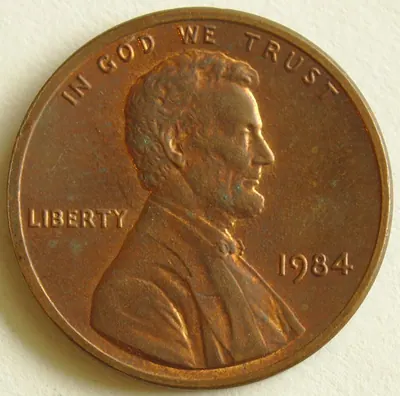
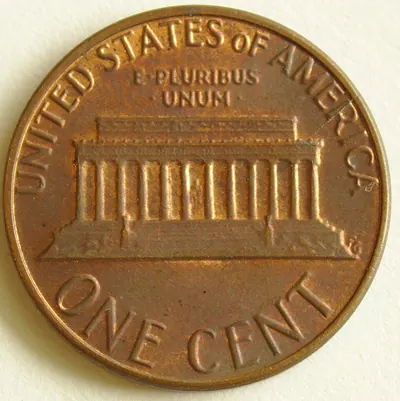
Face value, if it has been in circulation. Four Mint facilities turned out roughly 10.16 billion cents dated 1979, so finding one proves nothing on its own. What separates a one-cent coin from a several-hundred-dollar coin is condition:
- Raw uncirculated 1979 and 1979-D cents sell for about $1–$8 on eBay.
- Certified MS67 Red coins bring roughly $35–$300, depending on mint and grading service.
- NGC MS68 Red 1979 cents sell for $308–$488. That grade is the top of the realistic market for the date.
- 1979-S proofs from collector sets are worth a few dollars, except perfect PR70 coins at about $800–$2,500.
Two other things people ask about are not what they seem. The “1979 wide date penny” is a mix-up with a 1979 dollar coin (see below), and every 1979 cent is copper, so copper color alone means nothing.
1979 penny mintage: three mints with no mint mark
1979 is one of the years when Philadelphia, West Point and San Francisco all struck cents for circulation, and none of them added a mint mark. US Mint figures, as compiled on Wikipedia:
| Mint | Mint mark | Mintage | Share of circulation cents |
|---|---|---|---|
| Philadelphia | none | 3,560,940,000 | 35% |
| West Point | none | 1,705,850,000 | 17% |
| San Francisco | none | 751,725,000 | 7% |
| Denver | D | 4,139,357,254 | 41% |
| San Francisco proofs (Type 1 + Type 2) | S | 3,677,175 | Proof sets only |
Nothing on the coin reveals whether a no-mint-mark 1979 came from Philadelphia, West Point or San Francisco, and collectors pay no premium for any of them. Treat any 1979 cent without a mint mark as one coin type, the “1979 (P)”.
How to identify your 1979 penny
- Find the mint mark. It sits just below the date on the front. A D means Denver. No letter means Philadelphia, West Point or San Francisco. An S means a proof struck for collector sets.
- Check the finish. Proofs have mirror-like fields and frosted portraits. If an “S” coin looks like normal pocket change, look again: an S cent with a satin finish and no mirror is not a 1979 proof.
- Judge the color. Grading services label copper cents Red (RD), Red-Brown (RB) or Brown (BN). Almost all the money in the tables above is for full Red coins.
- Look for marks. An MS68 coin has no visible contact marks without magnification. A coin from a roll that shows nicks on Lincoln’s cheek is unlikely to grade above MS65.
1979 penny value by grade
The two tables near the top of this page list sold prices for the 1979 (no mint mark) and the 1979-D. A few patterns stand out:
- Up to MS66, you are paying for the holder. A PCGS MS65 Red 1979 trades around $13–$20 and an MS66 Red around $21–$30, close to what grading costs. Submitting an ordinary 1979 that will not reach MS67 is a losing trade.
- Denver coins are harder to find in gem condition. On eBay, PCGS MS67 Red 1979-D cents went for $190–$306, about two to three times the roughly $100 median for a Philadelphia-type 1979 in the same holder. The only MS68 1979-D sale we found, an NGC MS68 Red, went for $1,600 on an accepted best offer in July 2026.
- Registry money has cooled. Heritage sold two PCGS MS67 Red 1979-D cents for $3,995 (February 2016) and $3,055 (January 2017). In the same grade, later Heritage lots brought $144–$329, and recent eBay sales top out near $306. The 1979 (no mint mark) shows the same drop: PCGS MS68 Red coins brought $2,232.50 and $2,820 in 2016, then $1,320 in 2019.
- NGC and PCGS differ. For many modern cents, NGC and PCGS coins of the same grade sell for different prices. Compare like with like before you price a coin.
1979-S proof penny: Type 1 vs Type 2
Every 1979 proof set holds six coins, cent through Susan B. Anthony dollar. CoinWeek notes that the 1979 set was the first to include a proof Anthony dollar. Each of the six exists with two styles of S mint mark:
- Type 1 (Filled S): the older, blobby S that, according to CoinWeek, had been used on proofs since 1974.
- Type 2 (Clear S): a new, well-defined S with stronger serifs. CoinWeek’s proof-set history dates its debut to mid-1979, and the PCGS article it republished says the latter months of 1979. The same punch served through 1980 and into early 1981.
The Mint never published separate mintages, but CoinWeek calls the Type 2 coins “considerably scarcer.”
| 1979-S proof cent | Raw | PCGS PR69 | PCGS PR70 |
|---|---|---|---|
| Type 1 (Filled S) | $3–$9 | about $8–$12 (28 sales) | about $800–$1,200 in 2026; $1,400–$2,500 in 2024–2025 |
| Type 2 (Clear S) | $8–$18 | about $20 (16 sales) | about $1,500–$2,000 in 2026; Heritage $1,200 (May 15, 2024) |
eBay sold listings via PriceCharting (observed November 26, 2026) and Heritage via NGC Auction Central. Estimates, not a price guide.
Type 2 is the scarcer coin and usually brings more. Raw and in PR69, Type 2 cents sell for roughly 1.7 to 2 times the Type 1 price. In PR70 the gap holds in 2026: PCGS PR70 Type 2 coins sold for about $1,500–$2,000, against about $800–$1,200 for Type 1. Type 1 PR70s did reach $1,400–$2,500 in 2024–2025, so individual results vary. Recent individual sales swing by hundreds of dollars, so compare several before you price a PR70. A PCGS PR70 sale listed for a few dollars is almost always mislabeled.
How to check the S: use a 5x–10x loupe. On a Type 1, the openings of the S are small and partly clogged, and the letter looks like a blob. On a Type 2, the S is crisp, with clear openings and sharp serifs at both ends.
The “1979 wide date penny” myth
Search for 1979 penny values and you will meet claims of a valuable wide date or narrow date 1979 cent, where the 9 “touches the rim.” We checked Wexler’s die variety files for 1979 and 1979-D cents. They list one doubled die reverse and three repunched mint marks for Denver, and no date-position variety for either year.
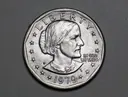
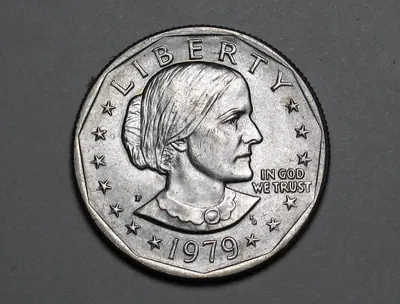
The coin people are thinking of is the 1979-P Susan B. Anthony dollar. As Coin World explains, the Mint widened the dollar’s rim during 1979. The scarcer Wide Rim coins, also called Near Date, have the date almost touching the rim. The common Narrow Rim (Far Date) coins have a clear gap. Coin World cites a Wide Rim MS-67 at $1,527.50 (Heritage, April 2017) against $89 for a Narrow Rim MS-67 (Heritage, January 2017). See our 1979 Susan B. Anthony dollar guide for that coin.
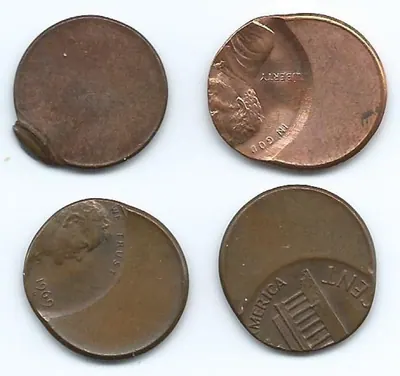
If the date on your 1979 cent looks crowded against the edge, the likely causes are wear on the rim or a slightly off-center strike. An off-center strike is a real error, but its value depends on how far off center it is, not on the date.
1979 penny errors and varieties
The 1979 cent has no famous doubled die. What exists, according to Wexler’s Die Varieties:
- 1979-D WDDR-001: a thickened reverse legend, most visible on the bottom serifs of the letters in the national name, plus thickened dots beside E PLURIBUS. Minor, and easy to miss without 10x magnification.
- 1979-D WRPM-001: a D punched over another D, shifted southeast (CONECA RPM #1).
- 1979-D WRPM-002 and WRPM-003: tilted D over D.
- A false RPM: some 1979-D cents show an apparent split serif on the D. Wexler says this came from a damaged mint mark punch and is not a repunched mint mark.
Mint errors are a separate category: off-center strikes, clipped planchets, struck-through errors and the like. Heritage auctioned a well-known error collection (Don Bonser’s) in 2020–2021, and two of its 1979 cents, a PCGS MS64 Brown and a PCGS AU55 Brown, realized $1,020 and $1,200 in May 2021, according to NGC Auction Central. That listing gives grades but not the type of error. PriceCharting’s separate “1979 double die” listing shows only two raw sales, at $4.99 and $11.99, a sign that most such claims are machine doubling.
Is a 1979 penny copper? Weight and melt value
Yes. A 1979 cent is 95% copper and 5% zinc and weighs 3.11 grams. The Mint switched to copper-plated zinc (2.5 g) only in 1982, so every 1979 cent you find is the heavier copper alloy.
That means the metal in a 1979 cent is worth a little more than one cent. Federal rules (31 CFR Part 82) prohibit melting or exporting one-cent coins for their metal, so there is no legal way to cash in on that premium. Some collectors set aside pre-1982 copper cents anyway.
How to check your coin with CoinLens
Sorting a jar of 1970s cents is faster with an app. Snap the front and back of each 1979 with Coin Identifier – CoinLens (iPhone and Android) and it names the coin, its mint, composition and minting years, with an instant value estimate. The estimate is a starting point, not a grade: a bright Red 1979-D that might reach MS67, or a proof that looks flawless under a loupe, still needs PCGS or NGC before it is worth real money.
Where to sell a 1979 penny
- Worn 1979 cents: they are copper, so many collectors simply keep a roll of pre-1982 cents. Otherwise, spend them.
- Unsearched rolls and raw proof cents: a coin shop or an eBay lot, at a few dollars a coin at most.
- Slabbed MS67–MS68 Red business strikes and PR70 proofs: eBay or a Heritage weekly auction, where every high price in this guide was paid.
Before submitting anything, read our coin grading guide. The rest of the decade, 1971 to 1978, is covered in our 1970s penny values guide.
Frequently asked questions
Is a 1979 penny worth anything?
A circulated 1979 penny is worth one cent. Uncirculated coins sell raw for about $1 to $8, and only certified MS67 and MS68 Red coins or perfect PR70 proofs bring hundreds of dollars or more.
How much is a 1979 penny with no mint mark worth?
The same as a normal 1979 penny: one cent if circulated. Philadelphia, West Point and San Francisco all struck 1979 circulation cents without a mint mark, more than six billion in total, so a missing mint mark is normal.
What is a 1979 wide date penny?
No ‘wide date’ or ‘narrow date’ 1979 cent is listed in the variety references we checked. The 1979 coin with the date close to the rim is the 1979-P Susan B. Anthony dollar, known as the Wide Rim or Near Date.
How much is a 1979-D penny worth?
A circulated 1979-D is worth one cent. Certified PCGS MS65 Red coins sell for about $18 to $28 and MS67 Red coins for about $190 to $306. Two PCGS MS67 Red coins brought $3,055 and $3,995 at Heritage in 2016 and 2017.
How do I tell a 1979-S Type 1 from a Type 2 proof?
Look at the S below the date with a 5x to 10x loupe. Type 1 has a blobby, filled S. Type 2 has a sharper Clear S with open loops and distinct serifs.
Is a 1979 penny copper?
Yes. Every 1979 cent is 95% copper and 5% zinc and weighs 3.11 grams. The switch to copper-plated zinc came in 1982.
What 1979 penny errors are worth money?
Major mint errors such as off-center strikes, clips and struck-through errors can carry premiums. Two 1979 error cents brought $1,020 and $1,200 at Heritage in May 2021. Die varieties are minor: Wexler lists one 1979-D doubled die reverse and three 1979-D repunched mint marks.
Sources
- Wikipedia: Lincoln cent mintage figures (1979 incl. West Point, San Francisco, Filled/Clear S proofs)
- PriceCharting: 1979 Lincoln Memorial penny sold listings
- PriceCharting: 1979 double die penny sold listings
- PriceCharting: 1979-D Lincoln Memorial penny sold listings
- PriceCharting: 1979-S Type 1 proof penny sold listings
- PriceCharting: 1979-S Type 2 proof penny sold listings
- NGC Auction Central: 1979 1C MS auction results
- NGC Auction Central: 1979-D 1C MS auction results
- NGC Auction Central: 1979-S Type 2 1C PF auction results
- NGC Auction Central: 1979-S Type 1 1C PF auction results
- CoinWeek: US Coins: 50 Years of Modern Proof Sets (1979 Type I and Type II proofs)
- CoinWeek (PCGS): Differences between 1981 Type 1 and Type 2 proof Lincoln cents (Filled S vs 1979 Clear S)
- Coin World: Near Date or Wide Rim 1979-P dollar
- Wexler's Die Varieties: 1979-D doubled dies
- Wexler's Die Varieties: 1979-D repunched mint marks
- eCFR 31 CFR Part 82: prohibition on exporting, melting or treating 5-cent and 1-cent coins
Values are estimates, not offers. Condition decides the price; for a valuable coin, get a professional grade.