1967 Canadian Coins Value: Centennial Penny, Nickel, Dime, Quarter, 50 Cents, Dollar and $20 Gold
The 1967 dove penny and rabbit nickel are worth face value. The dime, quarter, 50 cents and goose dollar are silver and worth their metal or more. The prize is the $20 gold coin (0.529 oz gold): a Specimen-67 example sold for US$1,560 at Heritage on 28 April 2024.
Have one in hand? Scan it with CoinLens to identify it and see an estimate in seconds.
| Coin | Design (Alex Colville) | Mintage | Metal and weight | Fine silver or gold (troy oz) |
|---|---|---|---|---|
| 1 cent | Rock dove | 345,140,645 | Bronze, 3.24 g | — |
| 5 cents | Snowshoe rabbit | 36,876,574 | Nickel, 4.54 g | — |
| 10 cents | Mackerel | 62,998,215 | 80% or 50% silver, 2.33 g | 0.0599 (80%) or 0.0375 (50%) |
| 25 cents | Lynx (bobcat) | 48,855,500 | 80% or 50% silver, 5.83 g | 0.1499 (80%) or about 0.094 (50%) |
| 50 cents | Howling wolf | 4,211,392 | 80% silver, 11.66 g | 0.2999 |
| 1 dollar | Canada goose | 6,767,496 | 80% silver, 23.33 g | 0.6000 |
| 20 dollars (collector issue) | Canadian coat of arms | 337,688 (specimen) | 90% gold, 18.27 g | 0.5287 gold |
Which one is yours? Check it with CoinLens →
Mintages and specifications from Wikipedia's articles on each Canadian denomination and on Canada's commemorative coins; $20 data from the CoinVarieties wiki. Precious-metal weights are our calculation (weight × fineness ÷ 31.1035). The 50% quarter weight is taken as 5.83 g, the figure Wikipedia gives for the 1967 coin. Melt at silver $43.35/oz, November 26, 2026.
DEMO
Check your Canada 1967 centennial silver dollar (Canada goose)
Add a photo of each side
Add a photo of at least one side first.
Demo — photos stay on your device. Nothing is uploaded.
DEMO
Your photos are ready. The identification happens in the CoinLens app.
On the web this is a demo — it can't recognize coins. In the app, the same two photos give you the coin's name, details and a value estimate.
Scan these in the free appEXAMPLE — what CoinLens shows
Value estimate:
Sample from our guide's data, not a result for your photo.
That was a sample. Scan your coin →·
Coin facts
- Coin
- Canada 1967 centennial silver dollar (Canada goose)
- Years
- 1967
- Mints
- Royal Canadian Mint, Ottawa
- Composition
- 80% silver, 20% copper
- Weight
- 23.33 g
- Diameter
- 36 mm
- Silver (ASW)
- 0.6000 troy oz
- Melt value
- $26.01
- Designer
- Alex Colville (reverse)
Mintage
- 1 cent (dove)
- 345,140,645
- 5 cents (rabbit)
- 36,876,574
- 10 cents (mackerel)
- 62,998,215
- 25 cents (lynx)
- 48,855,500
- 50 cents (wolf)
- 4,211,392
- 1 dollar (goose)
- 6,767,496
- $20 gold (specimen)
- 337,688
| Coin | Circulated | Uncirculated / specimen (auction results) |
|---|---|---|
| 1 cent dove | Face value | Small premium only |
| 5 cents rabbit | Face value | Small premium only |
| 10 cents mackerel | Silver value | Small premium for high grades |
| 25 cents lynx | Silver value | NGC SP68: US$646.25 (Heritage, 14 Apr 2016) |
| 50 cents wolf | Silver value | PCGS MS62: US$270.25 (Stack’s Bowers, 7 Jul 2014); PCGS MS63: US$2,300 (Heritage, 27 May 2009, an outlier) |
| 1 dollar goose | $26.01 melt | PCGS MS64: US$851.88 (Stack’s Bowers, 7 Jul 2014); PCGS MS66: US$1,080 (Heritage, 16 Jan 2018); PCGS MS65: US$3,290 (Heritage, 8 Sep 2016) |
| 1 dollar goose, specimen | — | NGC SP66: US$228 (Heritage, 24 Jan 2021); PCGS SP68: US$587.50 (Heritage, 5 Jan 2014) |
Which one is yours? Check it with CoinLens →
Auction results via NGC Auction Central, including buyer's premium. The =melt cell shows the goose dollar's silver value at today's price; the other silver coins scale with their silver weight in the first table. Business strikes (MS) and specimens (SP) are different finishes that sell differently, so compare like with like. Individual results, not a price guide. Melt at silver $43.35/oz, November 26, 2026.
| Item | Grade | Result (house, date) |
|---|---|---|
| $20 gold | NGC SP66 Cameo | US$1,080 (Heritage, 26 Mar 2023) |
| $20 gold | NGC SP69 Cameo | US$1,230 (Heritage, 25 Jun 2023) |
| $20 gold | SP67 | US$1,560 (Heritage, 28 Apr 2024) |
| $20 gold | NGC SP65 Cameo | £1,200 (Spink sale 24006, lot 515) |
| Cased centennial set with $20 gold | Original case | US$850 hammer (Brunk Auctions, 4 Dec 2020) |
Which one is yours? Check it with CoinLens →
The $20 coin's value follows the gold price: it holds 0.5287 troy ounces of gold. Results are individual sales, not a price guide; check today's gold price before selling. Melt at silver $43.35/oz, November 26, 2026.
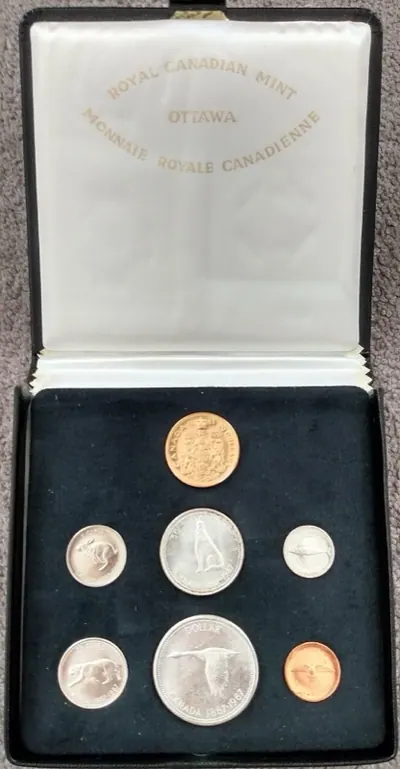
For Canada’s 100th birthday in 1967, every circulating coin carried a one-year animal design by painter Alex Colville. Millions of each were made, so none of the six circulation coins is rare. Value comes from metal and condition:
- Penny (dove) and nickel (rabbit): base metal, worth about face value.
- Dime (mackerel) and quarter (lynx): 80% or 50% silver, worth their silver.
- 50 cents (wolf) and dollar (goose): 80% silver. The dollar holds 0.600 oz of silver.
- $20 gold coin: sold mainly in cased collector sets, with 0.529 oz of gold. It’s worth US$1,000–1,600 in recent Heritage sales.
The real money is in top-grade business strikes. A goose dollar graded PCGS MS65 sold for US$3,290 at Heritage in September 2016, against a few dollars over melt for an ordinary one.
The six centennial circulation coins
1 cent: rock dove, 345,140,645 made
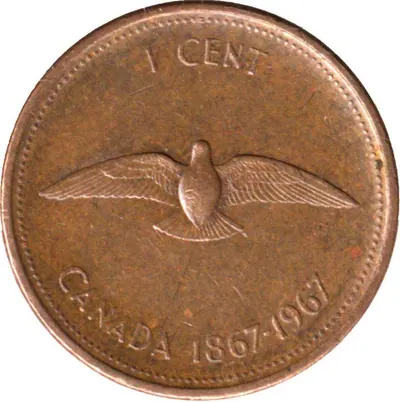
A dove in flight, dated 1867–1967, symbolising peace. It’s bronze (3.24 g) and the most common coin of the set. Expect face value, or a small premium for a bright red uncirculated coin.
5 cents: snowshoe rabbit, 36,876,574 made
A leaping rabbit for new life. The 1967 nickel is pure nickel (4.54 g), so it sticks to a magnet. That’s normal, not a sign of an error.
10 cents: mackerel, 62,998,215 made
Two alloys exist, 80% silver and 50% silver, because Canada was phasing silver out of its coins. Both weigh 2.33 g, so you can’t sort them by weight. The 80% coin holds about 0.060 oz of silver and the 50% coin about 0.038 oz.
25 cents: lynx, 48,855,500 made
A prowling lynx, described by the Royal Canadian Mint as a bobcat. A change authorized on 17 August 1967 cut the silver from 80% to 50% mid-year, so both versions exist. Specimen coins from the sets can sell well: an NGC SP68 brought US$646.25 at Heritage in April 2016.
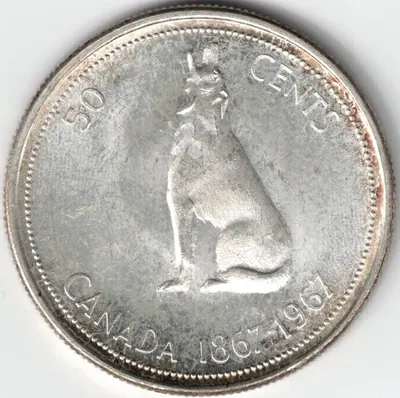
50 cents: howling wolf, 4,211,392 made
The lowest mintage of the six circulation coins. It’s 80% silver (11.66 g, about 0.300 oz of silver). Business strikes in high grade are scarce:
- PCGS MS62: US$270.25 (Stack’s Bowers, July 2014)
- PCGS MS63: US$2,300 (Heritage, May 2009). This is an outlier; don’t count on that price for an MS63 today.
$1: Canada goose, 6,767,496 made
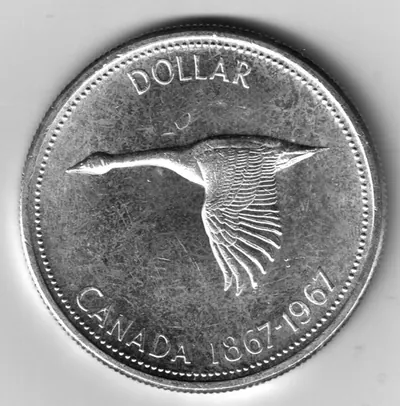
A goose in flight, the last Canadian silver dollar made for circulation; from 1968 the dollar was nickel. It’s 80% silver, 23.33 g, with 0.600 oz of silver. Two very different markets:
- Specimens from the cased sets sell for modest premiums: NGC SP66 sold for US$228 (Heritage, January 2021) and PCGS SP68 for US$587.50 (Heritage, January 2014).
- High-grade business strikes are scarce: PCGS MS64 US$851.88 (Stack’s Bowers, July 2014), MS66 US$1,080 (Heritage, January 2018) and MS65 US$3,290 (Heritage, September 2016).
Not sure which version you have? Scan both sides with CoinLens to identify the coin and see an estimated value.
The 1967 $20 gold coin
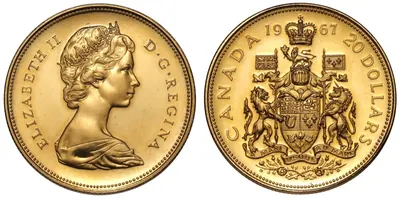
To mark the centennial, the Mint also struck a $20 gold coin, 18.27 g of 90% gold, holding 0.5287 oz of gold. It shows the Canadian coat of arms rather than an animal, with the Queen’s portrait on the other side. 337,688 were issued, sold in the black cased centennial sets together with the six circulation designs in specimen finish.
The coin is legal tender at $20, but its gold is worth far more. Recent results from Heritage:
- NGC SP66 Cameo: US$1,080 (March 2023)
- NGC SP69 Cameo: US$1,230 (June 2023)
- SP67: US$1,560 (April 2024)
Gold prices have moved since, so use today’s gold price as your floor. A full cased set with the $20 sold for US$850 hammer at Brunk Auctions in December 2020, when gold was lower.
Check that the gold is still in the case. Many sets have been broken up over the years, and a set without the $20 coin is worth only the silver in the other coins plus a small premium.
What the centennial designs mean
Painter Alex Colville was commissioned in 1965, and each animal was chosen to carry a meaning for the centennial:
| Coin | Animal | Meaning |
|---|---|---|
| 1 cent | Rock dove | Spiritual values and peace |
| 5 cents | Snowshoe rabbit | Fertility and new life |
| 10 cents | Mackerel | Continuity |
| 25 cents | Lynx | Intelligence and decisive action |
| 50 cents | Howling wolf | The vastness of Canada |
| 1 dollar | Canada goose | “Dynamic serenity” |
Every coin carries the double date 1867–1967, the years of Confederation and its centennial, instead of a single year. If your coin shows only “1967”, it isn’t a centennial design.
The designs ran for one year only. In 1968 the regular reverses returned: the maple leaf cent, the beaver nickel, the Bluenose dime, the caribou quarter, the coat-of-arms 50 cents and the voyageur dollar, now in nickel.
How to tell silver from non-silver Canadian coins
- 1920–1966: dimes, quarters and half dollars are 80% silver; dollars from 1935 are too.
- 1967: dimes and quarters come in 80% and 50% versions. The half dollar and the dollar are 80% silver.
- 1968: some dimes and quarters are 50% silver; the rest, and all dollars, are nickel.
- 1969 onward: no silver in circulation coins.
A quick test for 1968 coins: nickel coins stick to a magnet and silver ones don’t. It doesn’t help with 1967 dimes and quarters, because both alloys are non-magnetic.
Is it a 1967 error or variety?
Most “errors” people find on 1967 coins are damage: scratches, bent coins or toning. Real mint errors, such as off-centre strikes or doubled strikes, are scarce and need a dealer or grading service to confirm. Ordinary wear on the goose’s wing or the wolf’s head is not an error.
How to check your coin with CoinLens
Photograph both sides with CoinLens (Coin Identifier - CoinLens, for iPhone and Android). It identifies the coin within seconds from its database of almost 500,000 coins worldwide. It shows composition and an instant value estimate, and you can save coins to your collection with a running total. Free scans are limited; Premium unlocks unlimited scans. For uncirculated dollars and 50-cent pieces that might grade MS64 or higher, a professional grade is what unlocks the big prices.
Where to sell
- Coin and bullion dealers for the silver coins and the $20 gold, at prices tied to silver and gold. Get two quotes.
- Auctions (Heritage, Stack’s Bowers, Canadian auction houses) for high-grade business-strike dollars and 50-cent pieces, ideally certified by PCGS, NGC or ICCS.
- eBay or collector groups for complete cased centennial sets. Make sure the listing shows the $20 coin.
- The penny and nickel are worth face value unless they’re uncirculated.
Silver melt value calculator
Canada 1967 centennial silver dollar (Canada goose): 0.6000 troy oz of silver each
Melt value ($26.01 each)
Silver spot $43.35/oz as of November 26, 2026 (gold-api.com)
Melt value today for a pile, a roll or $ face value → Silver melt calculator
Melt value is the floor. Condition and mint details decide the rest — check yours in the app.
Frequently asked questions
Are 1967 Canadian coins worth anything?
The penny and nickel are worth about face value because millions were made. The dime, quarter, 50 cents and dollar contain silver, so they are worth more than face for their metal. The $20 gold coin from the cased sets is worth well over US$1,000 at recent gold prices, and high-grade business-strike dollars and 50-cent pieces sell for hundreds.
How much is a 1967 Canadian silver dollar worth?
The goose dollar holds 0.600 troy ounces of silver, so an ordinary coin is worth its melt value (see the calculator above). Specimen coins from the cased sets sell for a little more: NGC SP66 brought US$228 at Heritage in January 2021. Business strikes graded PCGS MS65 and up are scarce: one sold for US$3,290 in September 2016.
How much is the 1967 Canadian $20 gold coin worth?
It contains 0.5287 troy ounces of gold (18.27 g of 90% gold), so its floor is the gold value. Recent Heritage results: NGC SP66 Cameo US$1,080 (March 2023), NGC SP69 Cameo US$1,230 (June 2023) and SP67 US$1,560 (April 2024). 337,688 were issued, sold in the cased centennial sets.
Is the 1967 Canadian dime silver?
Yes. The 1967 mackerel dime was struck in two alloys, 80% silver and 50% silver, with 62,998,215 made in total. Both are worth more than face value. The 80% version holds about 0.060 oz of silver and the 50% version about 0.038 oz. The two weigh the same, so a scale can’t tell them apart.
Why are there two kinds of 1967 Canadian quarter?
A change authorized on 17 August 1967 cut the quarter’s silver from 80% to 50% partway through the year, so 1967 lynx quarters exist in both alloys. The same thing happened in 1968, when the quarter moved from 50% silver to pure nickel.
What is the rarest 1967 Canadian coin?
Of the six circulation coins, the howling wolf 50 cents has the lowest mintage, at 4,211,392, followed by the goose dollar at 6,767,496. Neither is rare in ordinary condition; condition is what makes them valuable. The $20 gold coin had the smallest issue, 337,688.
Is the 1967 Canadian nickel magnetic?
Yes. The 1967 rabbit 5-cent coin is nickel, which is magnetic. That is normal and doesn’t mean anything is wrong with it. Silver 1967 dimes, quarters, 50-cent pieces and dollars are not magnetic.
Sources
- Wikipedia: Commemorative coins of Canada (1967 centennial designs, symbolism and mintages)
- Wikipedia: Alex Colville (1965 commission for the centennial coin set)
- Wikipedia: Canadian silver dollar (1967 specs; last circulation silver dollar)
- Wikipedia: 50-cent piece (Canadian coin), 1967 specs and 80% silver
- Wikipedia: Dime (Canadian coin), 1967 80% and 50% silver versions
- Wikipedia: Quarter (Canadian coin), 1967 lynx and the 17 August 1967 silver reduction
- Wikipedia: Nickel (Canadian coin), 1967 composition and weight
- Wikipedia: Penny (Canadian coin), 1967 weight and composition
- CoinVarieties wiki: Canada 1967 20 dollars (18.27 g, .900 gold, 337,688 issued)
- NGC Auction Central: 1967 Canada $20 Confederation Centennial SP (Heritage results 2023–2024)
- Spink sale 24006, lot 515: 1967 $20 gold, NGC SP65 Cameo, £1,200
- Brunk Auctions, 4 Dec 2020, lot 432: 1967 Canadian centennial set with $20 gold, $850
- NGC Auction Central: 1967 Canada $1 MS (Heritage and Stack's Bowers results)
- NGC Auction Central: 1967 Canada $1 SP (Heritage results)
- NGC Auction Central: 1967 Canada 50c MS (Heritage and Stack's Bowers results)
- NGC Auction Central: 1967 Canada 25c SP (Heritage, NGC SP68)
Values are estimates, not offers. Condition decides the price; for a valuable coin, get a professional grade.