How Much Are Old Japanese Coins Worth? (Silver Yen, Sen and Showa Silver)
Most old Japanese coins are common: wartime aluminum sen and base-metal coins are worth little. Silver is the money: a Meiji silver yen holds 0.780 oz, and top grades sell far higher, such as an 1894 yen in PCGS MS-66 at $3,525 (Ponterio, August 2012).
Have one in hand? Scan it with CoinLens to identify it and see an estimate in seconds.
| Coin | Years | Metal and weight | Silver (troy oz) | Value driver |
|---|---|---|---|---|
| 1 yen silver (dragon) | 1870–1914 | 26.96 g, .900 silver | 0.780 | $33.82 melt |
| Trade dollar (boeki gin) | 1875–1877 | 27.22 g, .900 silver | 0.788 | Silver plus a strong collector premium; three-year type |
| 50 sen silver (large) | 1906–1917 | 10.1 g, .800 silver | 0.260 | Silver plus premium for high grades |
| 50 sen silver (small) | 1922–1938 | 4.95 g, .720 silver | 0.115 | Silver; very common |
| Silver 10 and 20 sen | 1870s–1917 | Silver (.800 on most issues) | Small | Collector value; early Meiji dates scarcer |
| Cupronickel and nickel sen | 1889–1930s | Base metal | — | Low; most dates common |
| Aluminum, tin-zinc and brass sen | 1938–1947 | Base metal; aluminum 1 sen 0.55–0.65 g | — | Low; made by the hundreds of millions |
| 100 yen silver (phoenix, rice) | 1957–1966 | 4.8 g, .600 silver | 0.093 | Silver; small premium |
| 100 yen Tokyo Olympics | 1964 | 4.8 g, .600 silver | 0.093 | Silver; 80,000,000 made |
| 1000 yen Tokyo Olympics | 1964 | 20 g, .925 silver | 0.594 | Silver plus small premium; 15,000,000 made |
Which one is yours? Check it with CoinLens →
Specifications from Wikipedia's articles on each denomination and from the CoinVarieties wiki. Silver weights are from CoinVarieties or our calculation (weight × fineness ÷ 31.1035). The =melt cell shows a silver yen's metal value at today's price. Melt at silver $43.35/oz, November 26, 2026.
DEMO
Check your 1870–1914 Japan 1 yen, silver (Meiji and Taisho)
Add a photo of each side
Add a photo of at least one side first.
Demo — photos stay on your device. Nothing is uploaded.
DEMO
Your photos are ready. The identification happens in the CoinLens app.
On the web this is a demo — it can't recognize coins. In the app, the same two photos give you the coin's name, details and a value estimate.
Scan these in the free appEXAMPLE — what CoinLens shows
Value estimate:
Sample from our guide's data, not a result for your photo.
That was a sample. Scan your coin →·
Coin facts
- Coin
- Japan 1 yen, silver (Meiji and Taisho)
- Years
- 1870–1914
- Mints
- Osaka
- Composition
- 90% silver, 10% copper
- Weight
- 26.96 g
- Diameter
- 38.1 mm
- Silver (ASW)
- 0.7801 troy oz
- Melt value
- $33.82
Mintage
- 1870 (Meiji 3, all types)
- 3,685,049
- 1875 (Meiji 8)
- 139,323
- 1902 (Meiji 35)
- 668,782
- 1908 (Meiji 41)
- 334,705
- 1914 (Taisho 3, last silver yen)
- 11,500,000
| Era | Characters | Years | To get the Western year | Example |
|---|---|---|---|---|
| Meiji | 明治 | 1868–1912 | Add 1867 | 明治二十七年 = Meiji 27 = 1894 |
| Taisho | 大正 | 1912–1926 | Add 1911 | Taisho 3 = 1914 |
| Showa | 昭和 | 1926–1989 | Add 1925 | Showa 39 = 1964 |
| Heisei | 平成 | 1989–2019 | Add 1988 | Heisei 22 = 2010 |
| Reiwa | 令和 | 2019– | Add 2018 | Reiwa 5 = 2023 |
Which one is yours? Check it with CoinLens →
Era dates from Wikipedia's Japanese era name article. 元年 (gannen) means year one of an era. Kanji numerals: 一 1, 二 2, 三 3, 四 4, 五 5, 六 6, 七 7, 八 8, 九 9, 十 10. Melt at silver $43.35/oz, November 26, 2026.
| Coin | Grade | Result (house, date) |
|---|---|---|
| 1 yen 1870 (Meiji 3), type I | PCGS MS-64 | $1,800 (Heritage, Apr 2018) |
| 1 yen 1882 (Meiji 15) | PCGS AU-55 | $264 (Goldberg, Sep 2018) |
| 1 yen 1887 (Meiji 20) | PCGS MS-62 | $900 (Stack’s Bowers, Aug 2020) |
| 1 yen 1894 (Meiji 27) | PCGS MS-66 | $3,525 (Ponterio, Aug 2012) |
| 1 yen 1904 (Meiji 37) | PCGS MS-62 | $288 (Stack’s Bowers, Aug 2020) |
| 1 yen 1908 (Meiji 41), scarce date | PCGS AU-55 | $210 (Goldberg, Sep 2018) |
| 1 yen 1914 (Taisho 3), last silver yen | NGC MS-64 | $384 (Stack’s Bowers, Aug 2018) |
| 50 sen 1912 (Meiji 45) | PCGS MS-65 | $240 (Stack’s Bowers, Feb 2024) |
| 10 sen 1923 (Taisho 12), cupronickel | PCGS MS-65 | $42 (Stephen Album, Jul 2024) |
| 20 yen gold 1897 (Meiji 30) | NGC UNC Details | $1,527.50 (Heritage, Sep 2015) |
| 20 yen gold 1870 (Meiji 3) | PCGS MS-65 | $78,000 (Heritage, Jan 2020) |
Which one is yours? Check it with CoinLens →
Results as recorded on the CoinVarieties wiki, which reproduces each lot and its price including buyer's fees. Individual sales, not a price guide. Worn coins sell for much less, usually close to silver value. Melt at silver $43.35/oz, November 26, 2026.
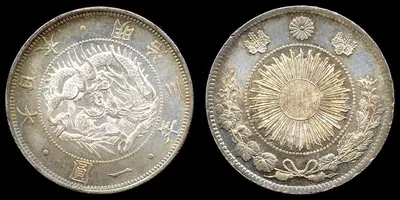
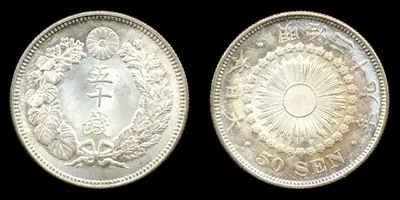
Japan’s modern coinage began in 1870, when a new mint at Osaka started striking Western-style round coins in yen and sen. The old Japanese coins people find fall into a few groups:
- Meiji and Taisho silver yen (1870–1914). Large dragon coins holding 0.780 oz of silver. Worth at least melt, and a lot more in high grades: a 1894 yen in PCGS MS-66 sold for $3,525 (Ponterio, August 2012).
- Silver sen (1870s–1938). 10, 20 and 50 sen coins with modest silver content. Common dates are inexpensive.
- Wartime coins (1938–1947). Aluminum, tin-zinc and brass sen made by the hundreds of millions. Usually worth very little.
- Postwar silver (1957–1966). The silver 100 yen and the 1964 Tokyo Olympics 1000 yen (0.594 oz). Worth their silver plus a small premium.
The first thing to do is read the date, because Japanese coins use era years rather than Western years. The era table above does the conversion.
How to read a Japanese coin’s date
Every Japanese coin from 1870 to today is dated by the year of the emperor’s reign:
- Find the era name in two kanji: 明治 (Meiji), 大正 (Taisho), 昭和 (Showa), 平成 (Heisei) or 令和 (Reiwa).
- Read the year number after it, followed by 年 (“year”). The first year of an era is written 元年 (gannen).
- Add the offset: Meiji +1867, Taisho +1911, Showa +1925, Heisei +1988, Reiwa +2018.
So 明治二十七年 is Meiji 27, or 1894, and 昭和三十九年 is Showa 39, or 1964. Kanji numbers combine: 二十七 is “two ten seven”, 27.
Watch the direction. Some prewar coins read right to left, so the characters can appear reversed: 十三 on a coin may be 三十 (30) read in the other direction. If a date makes no sense, try reading it the other way. From 1967 the 100 yen began using Arabic numerals for the year.
Not sure which coin you have? Scan both sides with CoinLens to identify it and see an estimated value.
Meiji and Taisho silver yen (1870–1914)
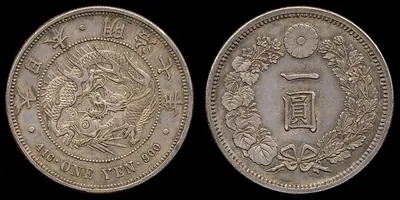
The silver yen was Japan’s answer to the Mexican dollar that dominated trade in East Asia. It weighs 26.96 g of 90% silver, roughly equal to a US silver dollar. A coiled dragon fills one side; the other has the kanji 一圓 (one yen) in a wreath, or a sunburst on the 1870 first type.
Most dates were struck in the millions and are common, but a few had small runs:
| Date | Mintage |
|---|---|
| 1875 (Meiji 8) | 139,323 |
| 1908 (Meiji 41) | 334,705 |
| 1902 (Meiji 35) | 668,782 |
| 1878 (Meiji 11) | 856,378 |
| 1874 (Meiji 7) | 942,006 |
| 1894 (Meiji 27) | 22,118,416 |
| 1914 (Taisho 3) | 11,500,000 |
Wikipedia’s mintage table shows no silver yen for 1871–1873, 1876–1877 or 1898–1900. A silver yen with one of those dates deserves extra suspicion.
When Japan adopted the gold standard on 1 October 1897, silver yen were demonetized, with holders given until 31 July 1898 to exchange them. Many were melted. Others were countermarked 銀 (gin, “silver”) to circulate as trade coins, including in Taiwan. The 1914 Taisho yen was a one-year type and the last silver yen.
Typical results: $210–$264 for PCGS AU-55 coins (Goldberg, 2018), $288–$900 for PCGS MS-62 (Stack’s Bowers, 2020), and $3,525 for a superb PCGS MS-66 1894 (Ponterio, 2012).
Trade dollars (1875–1877)
Japan also struck a heavier trade dollar, 27.22 g of .900 silver (0.788 oz), to compete in the Chinese silver trade on the same specifications as the US trade dollar. The experiment failed after three years. About 3 million were made across the three years, and collectors pay a premium for this short-lived type.
Silver sen coins
Japan’s 10, 20 and 50 sen coins were silver for decades. The silver content shrank as silver prices rose:
- 50 sen, 1906–1917: 10.1 g of .800 silver (0.26 oz). A 1912 in PCGS MS-65 sold for $240 (Stack’s Bowers, February 2024).
- 50 sen, 1922–1938: a much smaller 4.95 g of .720 silver (0.115 oz). Very common: 78,520,000 were struck in 1924 alone.
- 10 sen: struck in silver until the end of 1917, when rising silver prices ended silver ten sen.
Wartime and postwar sen (1938–1947)
From 1938 Japan’s coinage was rapidly debased to save metals for the war:
- Aluminum 1 sen and 10 sen; from 1941 the 1 sen shows Mount Fuji. Over 1.1 billion aluminum 1 sen were struck in 1943, and 944,900,000 aluminum 10 sen in 1942.
- Tin-zinc 1 sen in 1944–1945, when aluminum was needed for aircraft.
- Baked clay emergency coins made in 1945, never issued for circulation.
- Brass 50 sen of 1946–1947 after the war.
These are the coins American families most often have, often brought home in a jar or tin after the war. Ordinary pieces are worth very little. All sen coins were taken out of circulation at the end of 1953, so they no longer have face value.
Showa silver: 100 yen and the 1964 Olympics
Japan issued a silver 100 yen from 1957 to 1966: a phoenix design for 1957–1958, then a sheaf of rice. Each is 4.8 g of .600 silver, about 0.093 oz. For the 1964 Tokyo Olympics, 80,000,000 special 100 yen coins were struck, and they were hoarded as souvenirs rather than spent.
The 1964 Olympic 1000 yen, Japan’s first 1000 yen coin, is 20 g of .925 silver (0.594 oz), with 15,000,000 made. Silver was dropped from the 100 yen in 1967, which led to hoarding and the melting of older coins. These coins are common and trade close to their silver value.
How to spot a fake Meiji silver yen
Silver yen are a target for counterfeiters, including well-made struck fakes:
- Weigh it. A genuine yen is 26.96 g and a trade dollar 27.22 g. Light coins, magnetic coins, or coins with a seam on the edge are fake.
- Look at the strike. NGC described a fake 1891 yen with flat, yellowish high points, weak luster and denticles that fade out at 12 and 6 o’clock.
- Repeated marks. That fake and another examined by ANACS were struck from dies copied from a real coin, so every fake carries the same scratches and dings. Two genuine coins never share identical marks.
- Check the date against the mintage list. A silver yen dated 1871–1873 or 1876–1877 doesn’t match the circulation mintages.
For valuable dates or high grades, buy and sell only coins certified by PCGS or NGC.
How to check your coin with CoinLens
Photograph both sides with CoinLens (Coin Identifier - CoinLens, for iPhone and Android). It identifies the coin within seconds from its database of almost 500,000 coins worldwide, shows its composition, minting years and an instant value estimate, and lets you save coins to a collection. Free scans are limited; Premium unlocks unlimited scans. It saves you from decoding the kanji date by hand, but have a valuable silver yen authenticated before selling.
Where to sell old Japanese coins
- Coin and bullion dealers for common silver yen, silver 50 sen and 1964 Olympic coins, priced against silver.
- Auctions (Stack’s Bowers, Heritage, Stephen Album) for high-grade and scarce-date yen, trade dollars and gold.
- eBay for mixed lots of sen coins. Price from sold listings, not asking prices; most wartime coins sell in bulk.
Silver melt value calculator
Japan 1 yen, silver (Meiji and Taisho): 0.7801 troy oz of silver each
Melt value ($33.82 each)
Silver spot $43.35/oz as of November 26, 2026 (gold-api.com)
Melt value today for a pile, a roll or $ face value → Silver melt calculator
Melt value is the floor. Condition and mint details decide the rest — check yours in the app.
Frequently asked questions
Are old Japanese coins worth anything?
The silver ones are. Meiji and Taisho silver yen (1870–1914) hold 0.780 oz of silver, silver 50 sen hold 0.115–0.260 oz, and the 1957–1966 100 yen and the 1964 Olympic 1000 yen contain silver too. Aluminum, tin-zinc and brass sen from the war years, and modern coins, were made in huge numbers and are usually worth little. Sen coins were taken out of circulation at the end of 1953.
How do I read the date on a Japanese coin?
Find the era name: 明治 Meiji, 大正 Taisho, 昭和 Showa, 平成 Heisei or 令和 Reiwa, then the year number in kanji and 年 (year). Add 1867 for Meiji, 1911 for Taisho, 1925 for Showa, 1988 for Heisei or 2018 for Reiwa. So 昭和三十九年 (Showa 39) is 1964. Older coins often read right to left, so check the order of the characters.
How much is a Japanese silver yen worth?
At least its silver: 26.96 g of 90% silver, or 0.780 troy oz (see the melt calculator above). Collector prices are higher for nice coins: PCGS AU-55 examples sold for $210–$264 and a PCGS MS-62 1904 for $288, while a PCGS MS-66 1894 brought $3,525. Scarce dates such as 1875, 1902 and 1908 had small mintages.
Are 1964 Japanese Olympic coins silver?
Yes. The 1964 Tokyo Olympics 1000 yen is 20 g of .925 silver (0.594 oz), with 15,000,000 made, and the 100 yen Olympic coin is 4.8 g of .600 silver, with 80,000,000 made. Both are common and trade close to their silver value, with a small premium for nice coins.
What are old aluminum Japanese sen coins worth?
Wartime aluminum sen coins were made by the hundreds of millions: over 1.1 billion aluminum 1 sen were struck in 1943 alone. They are worth very little unless uncirculated or a scarce variety. Clay emergency coins made in 1945 were never issued and are collected separately.
How can I tell if a Meiji silver yen is fake?
Weigh it: a genuine silver yen is 26.96 g and a trade dollar 27.22 g. NGC and ANACS have documented fake 1891 yen struck from dies copied from a real coin; they showed flat, yellowish high points, weak luster, denticles that fade out and identical marks repeated on every fake. Compare the date with the mintage list, because some years had no silver yen struck for circulation.
What is a 'gin' countermarked yen?
When Japan went onto the gold standard in 1897, silver yen were demonetized. Many were melted, and others were countermarked with the character 銀 (gin, ‘silver’) so they could circulate as trade coins, including in Taiwan. Countermarked yen are collected as a separate variety.
Sources
- Wikipedia: 1 yen coin (silver yen specifications, mintages by year, 1897 demonetization, gin countermarks)
- Wikipedia: 100 yen coin (1957–1966 silver, 60% silver, 1964 Olympic 80,000,000 coins, mintages)
- Wikipedia: 1000 yen coin (1964 Tokyo Olympics, 15,000,000)
- Wikipedia: Japanese era name (era dates, gannen)
- Wikipedia: 1 sen coin (wartime aluminum and tin-zinc alloys)
- Wikipedia: 5 sen coin (sen withdrawn at the end of 1953)
- Wikipedia: 10 sen coin (silver .800, 1917 end of silver)
- Wikipedia: 50 sen coin (silver issues, demonetization)
- CoinVarieties: Japan 1870 (M3) yen (Heritage Apr 2018 PCGS MS-64 $1,800)
- CoinVarieties: Japan 1882 (M15) yen (Goldberg Sep 2018 PCGS AU-55 $264)
- CoinVarieties: Japan 1887 (M20) yen (Stack's Bowers Aug 2020 PCGS MS-62 $900)
- CoinVarieties: Japan 1894 (M27) yen (Ponterio Aug 2012 PCGS MS-66 $3,525)
- CoinVarieties: Japan 1904 (M37) yen (Stack's Bowers Aug 2020 PCGS MS-62 $288)
- CoinVarieties: Japan 1908 (M41) yen (Goldberg Sep 2018 PCGS AU-55 $210; mintage 334,705)
- CoinVarieties: Japan 1914 (T3) yen (Stack's Bowers Aug 2018 NGC MS-64 $384)
- CoinVarieties: Japan 1875 (M8) trade dollar (27.22 g .900; 3,056,638 for 1875–77)
- CoinVarieties: Japan 1912 (M45) 50 sen (Stack's Bowers Feb 2024 PCGS MS-65 $240; 10.1 g .800)
- CoinVarieties: Japan 1924 (T13) 50 sen (4.95 g .720)
- CoinVarieties: Japan 1923 (T12) 10 sen (Stephen Album Jul 2024 PCGS MS-65 $42)
- CoinVarieties: Japan 1943 (S18) sen (aluminum, 1,163,949,434 plus 627,160,000)
- CoinVarieties: Japan 1942 (S17) 10 sen (aluminum, 944,900,000)
- CoinVarieties: Japan (1945) sen (baked clay)
- CoinVarieties: Japan 1957 (S32) 100 yen (4.8 g .600)
- CoinVarieties: Japan 1964 1000 yen Olympic (20 g .925, .594 oz)
- CoinVarieties: Japan 1897 (M30) 20 yen (Heritage Sep 2015 NGC UNC Details $1,527.50)
- CoinVarieties: Japan 1870 (M3) 20 yen (Heritage Jan 2020 PCGS MS-65 $78,000)
- NGC: Counterfeit detection, 1891 Japanese yen (transfer-die fake)
- Coin World: Fake 1891 Japanese yen identified by ANACS
Values are estimates, not offers. Condition decides the price; for a valuable coin, get a professional grade.